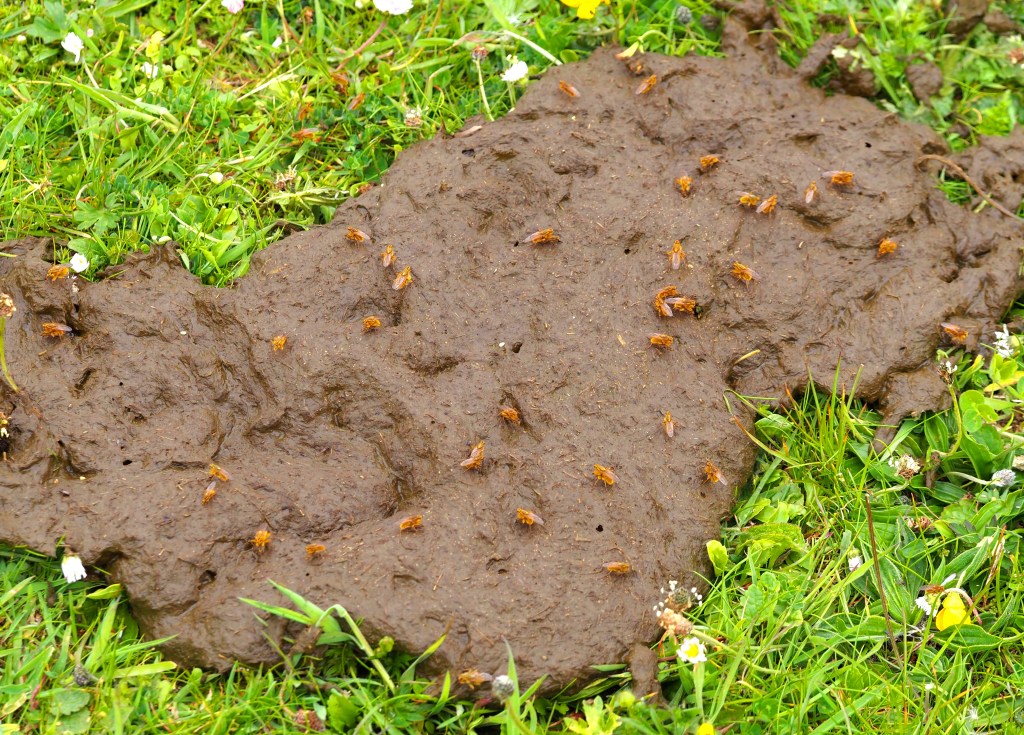
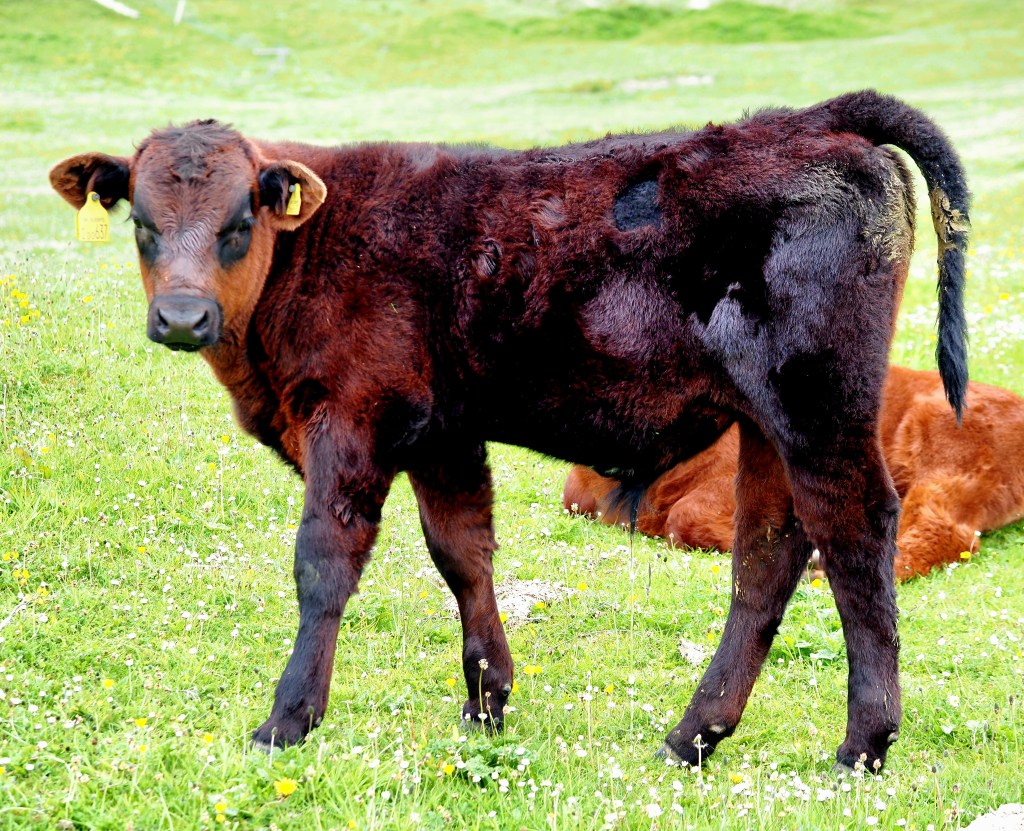
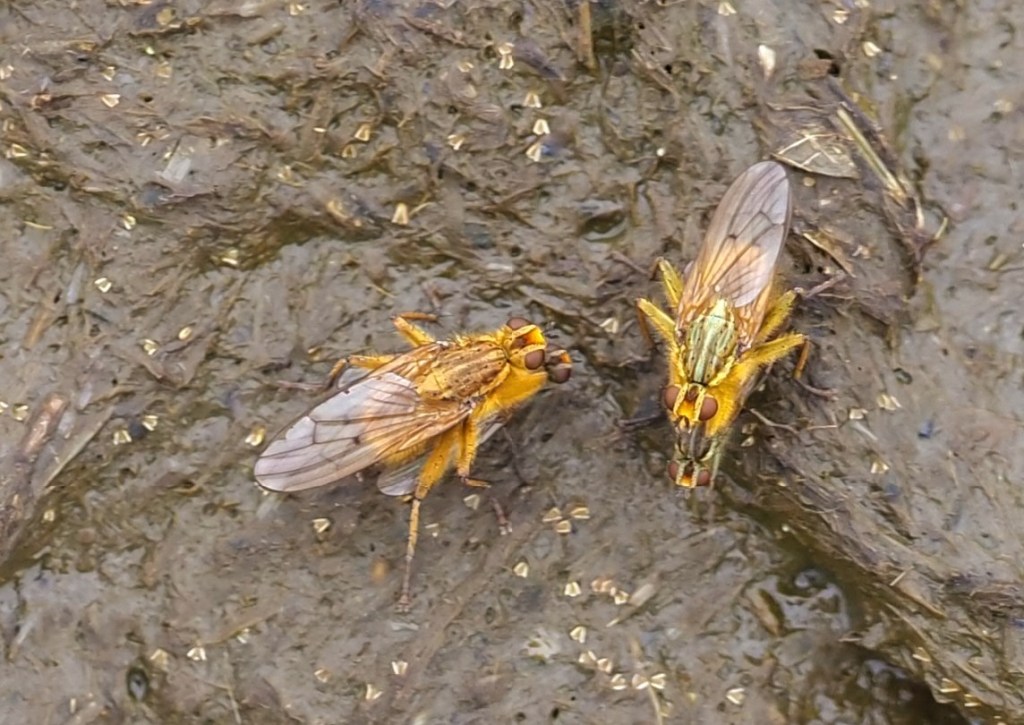
Cows produce a lot of dung, up to 30kg of manure a day, so it’s a good job that much of it is broken down and consumed by insects. One of those insects, which occurs widely in Europe and North America, is the yellow dung fly, Scathophaga stercoraria, whose larvae feed on cow pats.
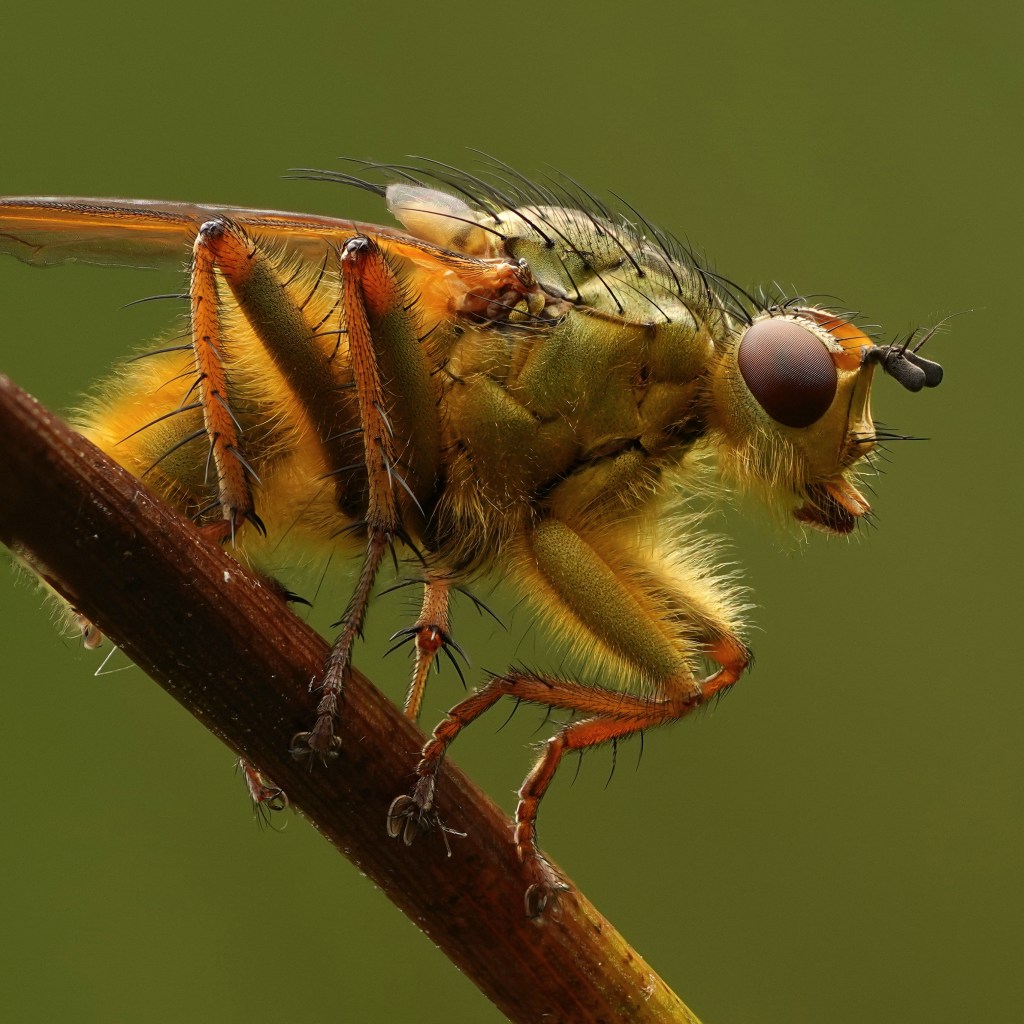
Female Scathophaga stercoraria spend most of their time away from cow pats, hunting for prey items and searching for nectar in the the surrounding fields. They only visit the dung heap to mate and oviposit, but usually arrive soon after a dropping of dung is deposited.
The males are usually the first to arrive and spend the majority of their time waiting on or around fresh dung pats to mate with incoming females.
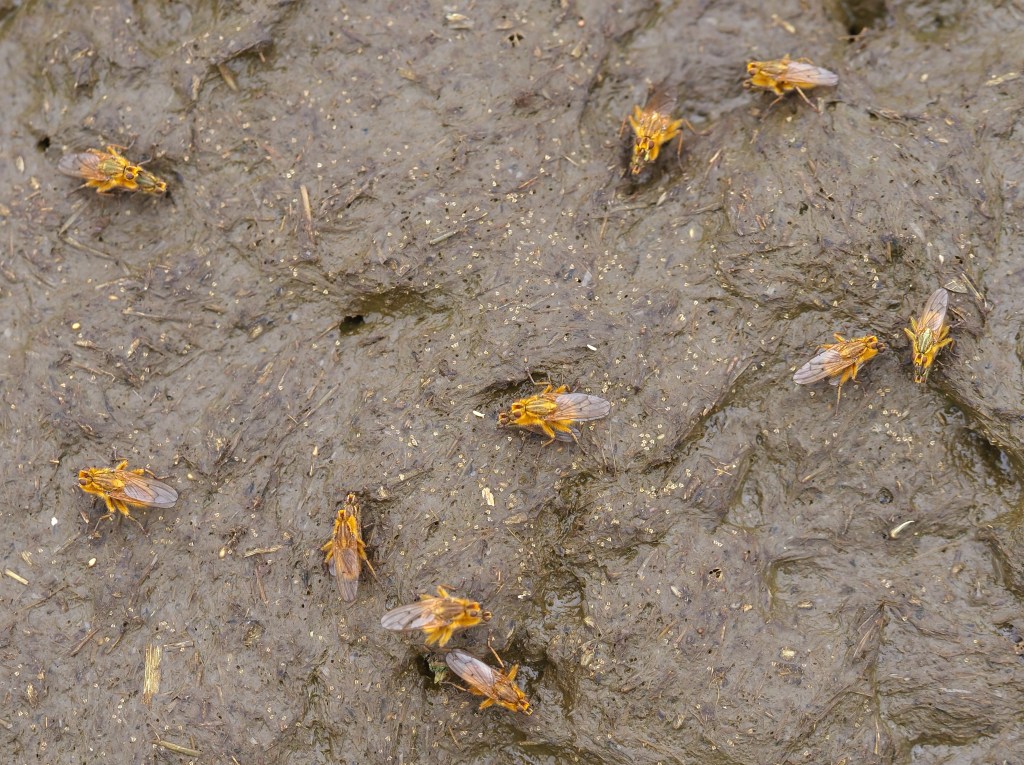
There is no pre-copulatory courtship and females are grasped by the nearest male as soon as they arrive at a pat. In other words, females tend to copulate immediately, often with the first male they encounter. This begs the question, why does the female not make some sort of selection of the assembled males, gathered at the mating/oviposition site, as occurs in many other insects?
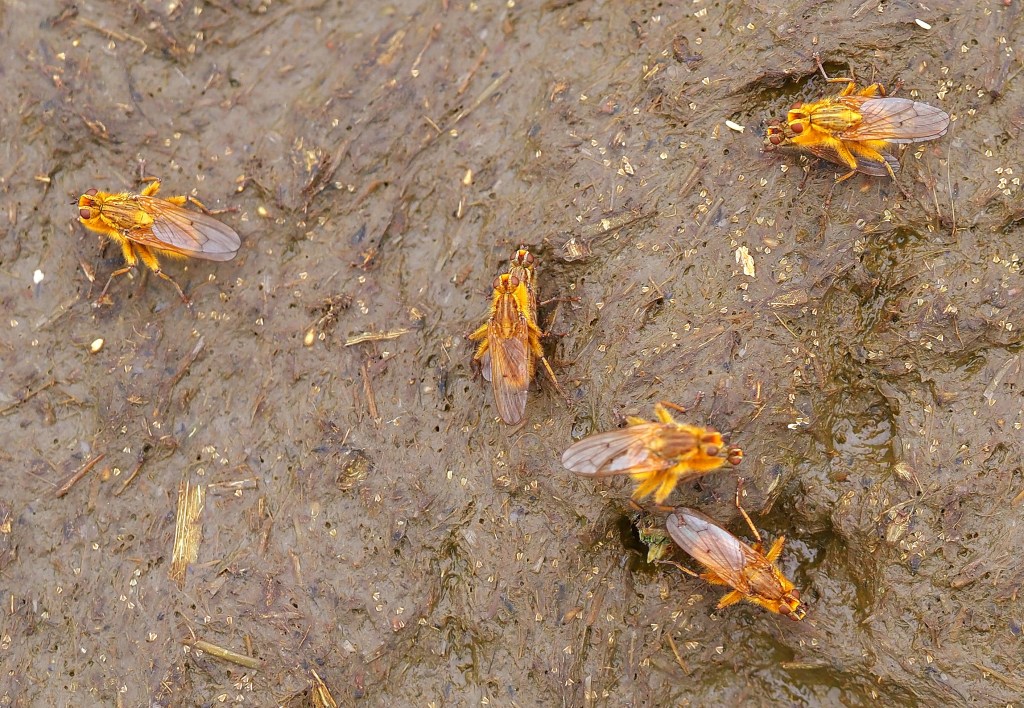
During copulation, which typically lasts for about 20-50 minutes (but is highly variable), the male guards the female from mating attempts by other males, in order to ensure that his sperm is not displaced by that of others, before fertilisation has occurred.
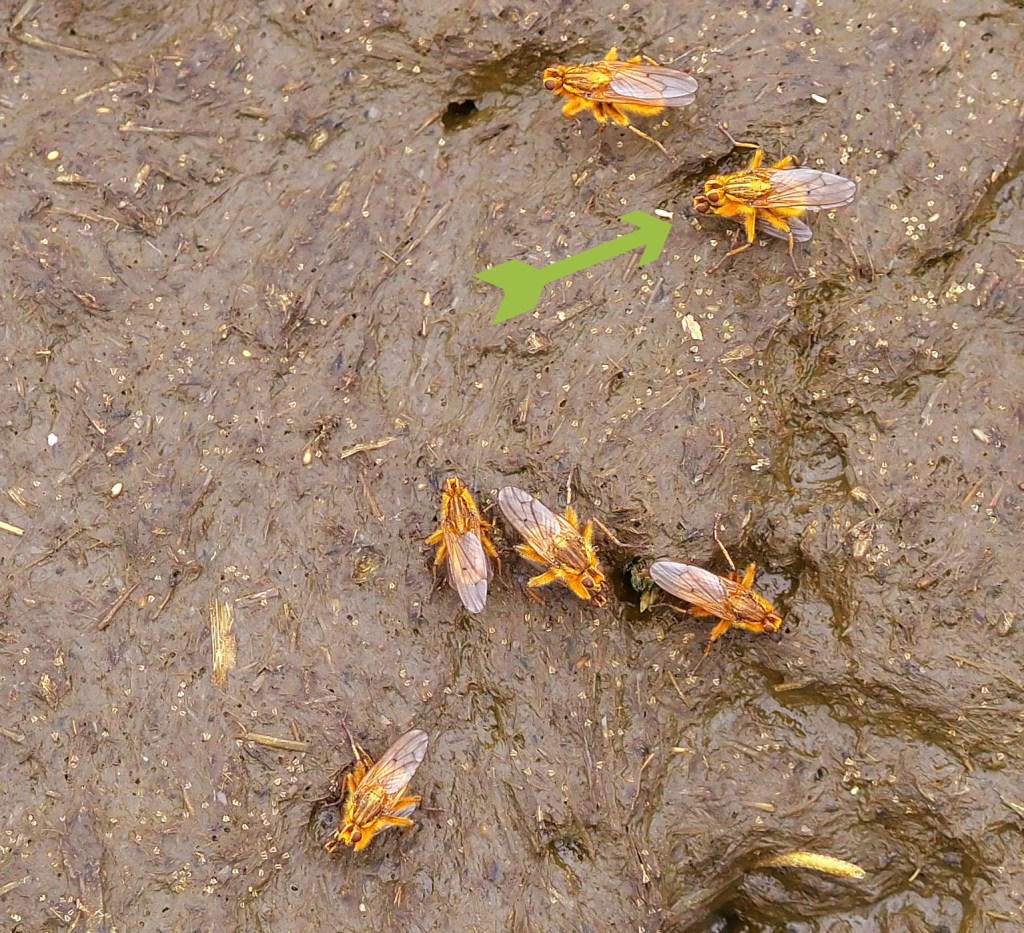
Competition for females is intense, as the numbers of yellow dung flies on a cow pat is highly skewed towards males: with as many as 400 on a single dung dropping. All scrambling to grab a female as soon as she arrives!
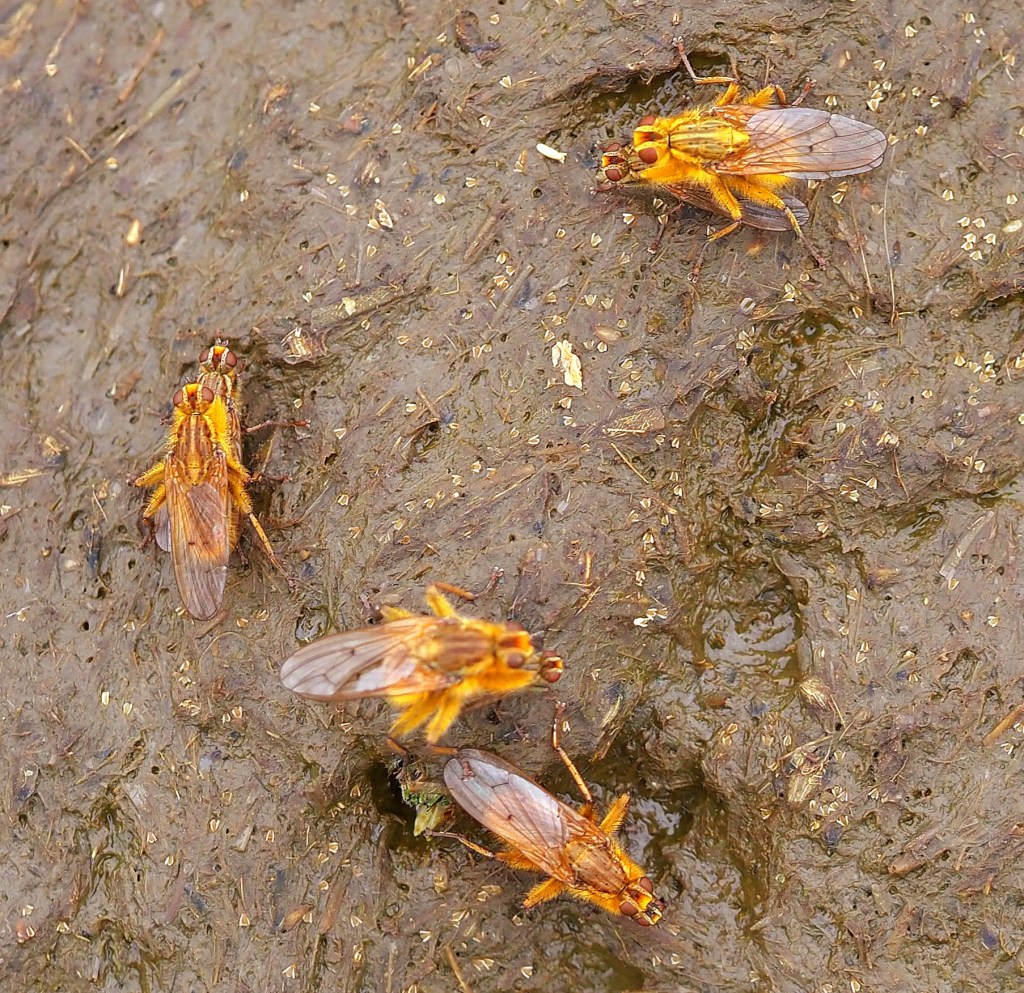
After copulation, the male continues to ride on the back of the female as she deposits about 30-90 eggs into the dung, and only then departs to forage in the surrounding vegetation.
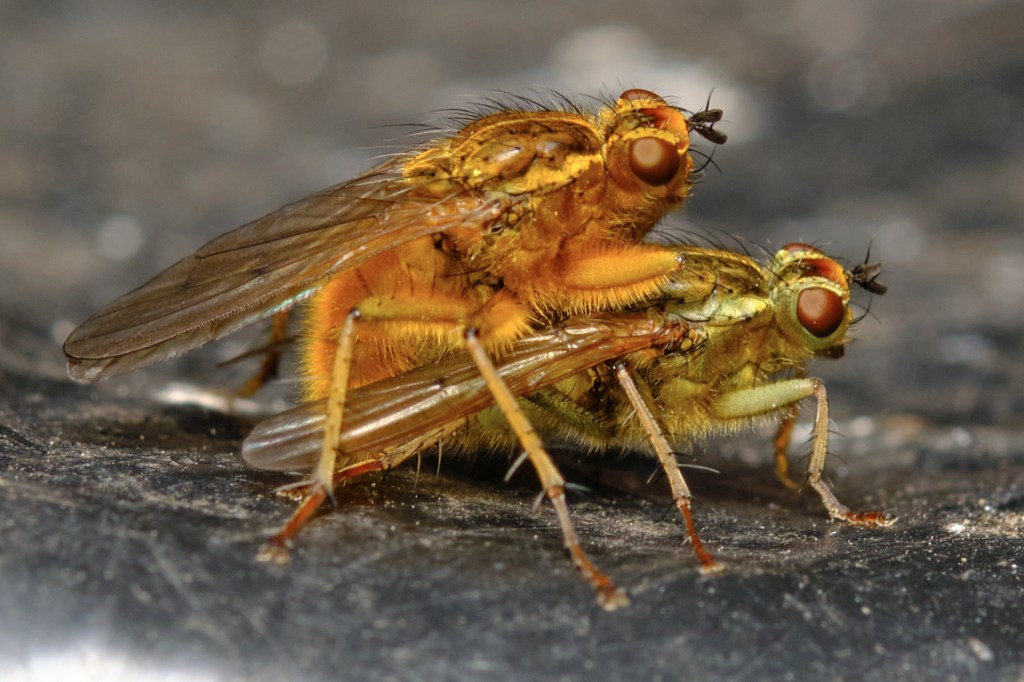
(CC BY-SA 2.0)
Mating success among males in Scathophaga stercoraria, is positively related to body size, and males are aggressive towards each other, especially when competing for access to receptive, gravid females on fresh dung. The larger males are better at acquiring mates, and at guarding the female throughout her oviposition, on the dung pat.
Much of the early research on this species was carried out by Professor Geoff Parker of the University of Liverpool, and published in a series of seminal papers which developed the idea of sperm competition as a form of post-copulatory sexual selection. Female dung flies mate with one male after another, and Parker predicted that the sperm of the different males that had partnered a given female, would, in effect, compete with each other (internally) to fertilise her eggs. Thus, once a male had mated with a female, it is in his interests to prevent other males from copulating with her, at least until such time as the eggs that he had fertilised had been deposited.
Mate‐Now‐Choose‐Later!
The last male to mate with the female, is, on average, the father of about 80 per cent of her subsequent progeny; this is why males guard and defend females against other males during oviposition. The last male’s ejaculate displaces the sperm of other males from the female’s sperm stores. However, female yellow dung flies, have three sperm-storage organs, and to some extent, can store the sperm of different males in different places. This gives them the ability therefore, to influence the paternity of their offspring, and may explain why they are prepared to accept the first males they encounter on a fresh cow pat. They choose, or discard, his sperm later!
In conclusion, males can continue to compete to fertilise females after copulation has occurred, and females can also exert choices (cryptic female choice) within their own bodies. In short, sexual selection can continue during and after mating in some insects, such as the yellow dung fly.
References
Cannon, R. J. (2023). Courtship and Mate-finding in Insects: A Comparative Approach. CABI publishing. https://www.nhbs.com/courtship-and-mate-finding-in-insects-book
Parker, G. A. (1970a). The reproductive behaviour and the nature of sexual selection in Scatophaga stercoraria L.(Diptera: Scatophagidae): I. Diurnal and seasonal changes in population density around the site of mating and oviposition. The Journal of Animal Ecology, 185-204.
Parker, G. A. (1970b). The reproductive behaviour and the nature of sexual selection in Scatophaga stercoraria L.(Diptera: Scatophagidae): II. The fertilization rate and the spatial and temporal relationships of each sex around the site of mating and oviposition. The Journal of Animal Ecology, 205-228.
Pitnick, S., Henn, K. R., Maheux, S. D., Higginson, D. M., Hurtado-Gonzales, J. L., Manier, M. K., … & Uy, J. A. C. (2009). Size-dependent alternative male mating tactics in the yellow dung fly, Scathophaga stercoraria. Proceedings of the Royal Society B: Biological Sciences, 276(1671), 3229-32.
Simmons, L. W., Parker, G. A., & Hosken, D. J. (2020). Evolutionary insight from a humble fly: sperm competition and the yellow dungfly. Philosophical Transactions of the Royal Society B, 375(1813), 20200062.
Ward, P. I. (2007). Postcopulatory selection in the yellow dung fly Scathophaga stercoraria (L.) and the mate‐now‐choose‐later mechanism of cryptic female choice. Advances in the Study of Behavior, 37, 343-369.
 Ray Cannon's nature notes
[…] to a blog post, I think I found out what they are: Yellow Dung Flies or scathophaga […]
[…] have blogged before about the fascinating reproductive behaviour of the Golden Dung Fly (Scathophaga stercoraria, […]