
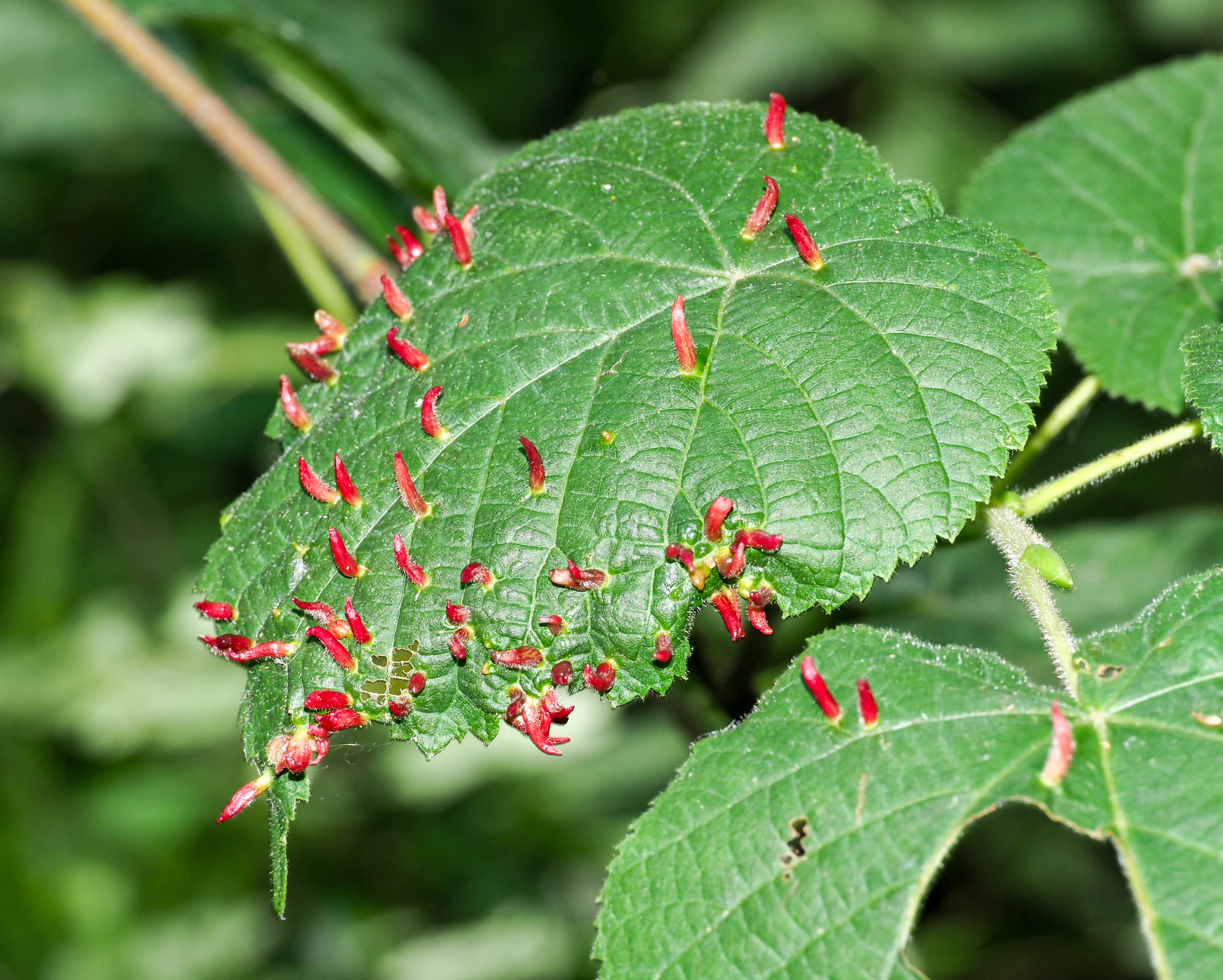
It must be galling to be covered in these! Sorry for the schoolboy pun but they do not look very attractive do they? These so-called nail galls are caused by a very tiny mite in the Family Eriophyidae. Eriophyid mites are only about 0.2 mm long and up to 200 of them can be living and feeding in one of these galls. They are so small that they can feed on a single plant epidermal cell for hours or even days (1). Eriophyes tilae is the species which causes these nail galls on lime trees (Tilia sp.) but there are a number of different subspecies which are difficult to tell apart.
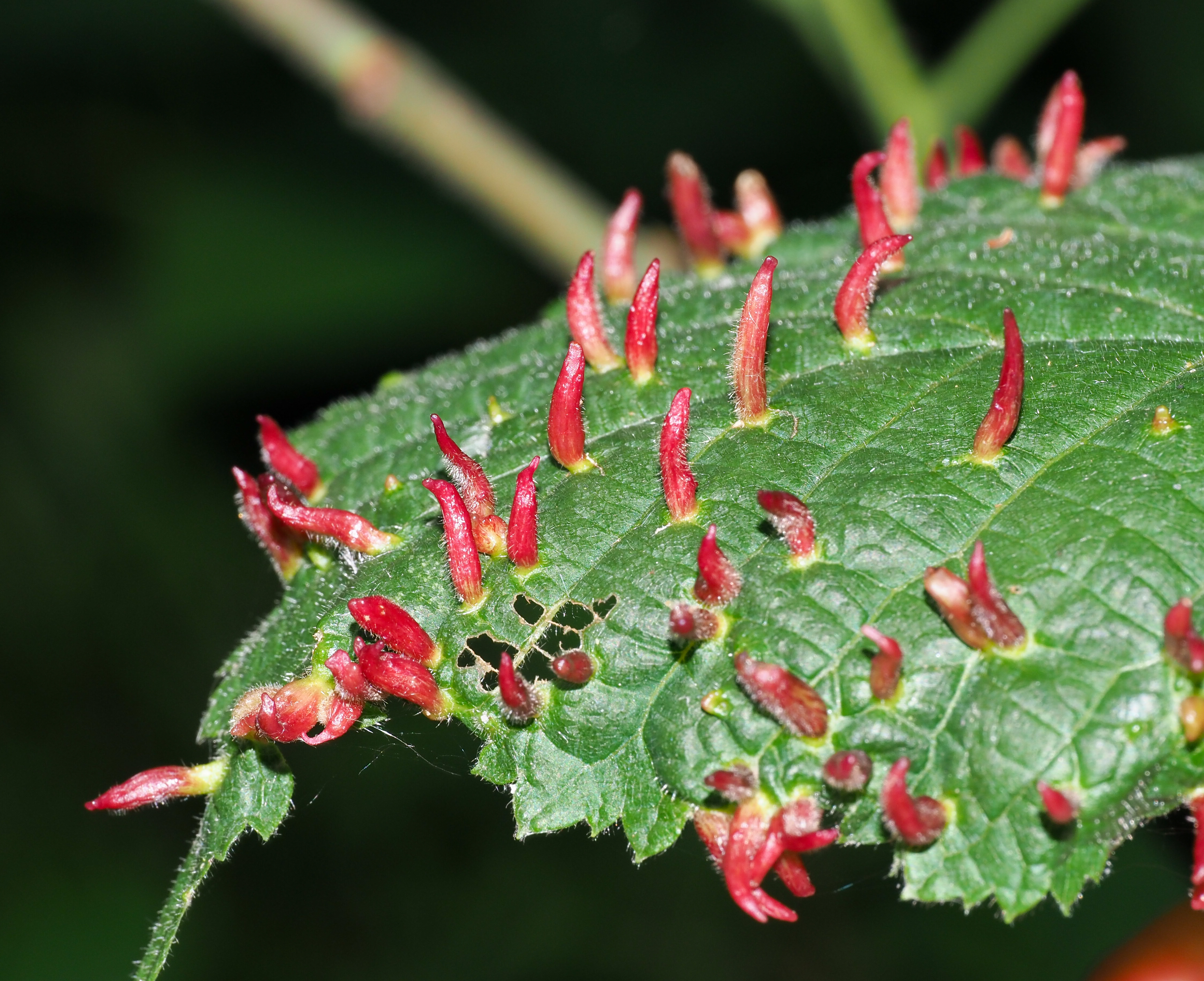
The entrance to the gall is through a narrow hairy opening on the underside of the leaf. The feeding mechanism is described by Thomsen (1988), who I will quote:
“the mite deposits spit on the outside of the nutritive cell, thus dissolving the cell wall enzymatically before food is ingested. Subsequently, the chelicera and the other stylets are thrust mechanically into the nutritive cell. Through suction the mite empties the cell. Around the hole in the cell wall a callose cone is formed with embedded spit.“
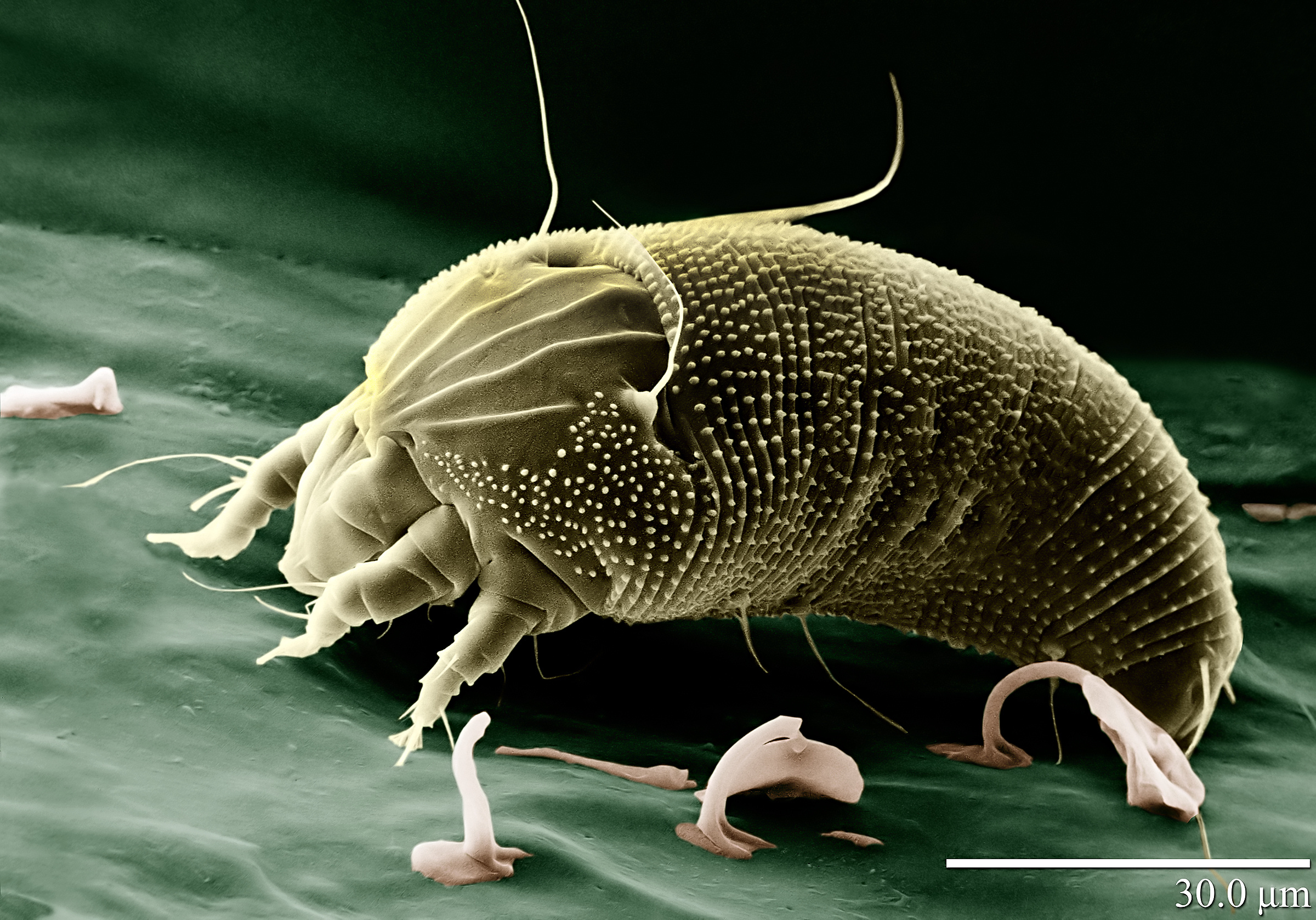
I don’t have a picture of Eriophyes tiliae – it is less than 0.2 mm long! – so this amazing picture of a rust mite, Aceria anthocoptes, will have to suffice. Same family: Eriophyidae.
The galls are induced by a chemical reaction caused by the feeding of the mites, and they provide both a source of food and protection for the mites. When I looked closely at one of these photographs, after I had taken it and opened it on the computer, I noticed that there was a tiny yellow-green bug (perhaps a plant-hopper nymph) lurking amongst the base of the nail galls (see below). This little insect is however, much bigger than an eriophyid (or eriophioid as some people say!) mite!
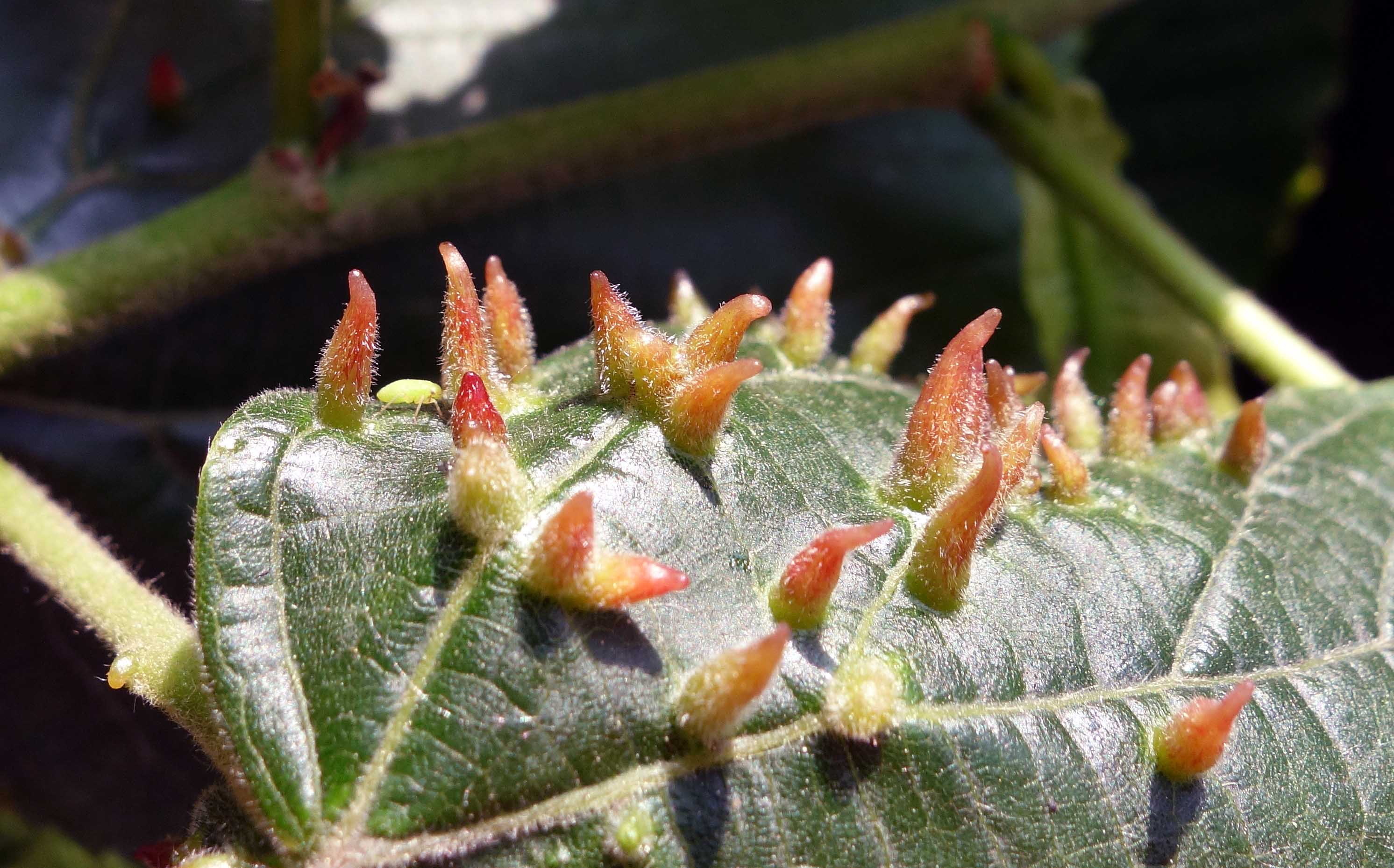
The life-cycle is worth describing. The mites overwinter in bark crevices and around the buds of lime trees (large-leaved lime tree Tilia platyphyllos, the common lime tree Tilia × europaea). They move onto the leaves in the spring and start feeding. The chemicals they release while drinking sap from the lower leaf epidermis induces the finger-like gall which grows around the mite. The mites leave the galls at the end of summer and move back into protected sites on the tree to pass the winter.
References
1) Eriophyoid Mites: Their Biology, Natural Enemies and Control. Edited by E.E. Lindquist, J. Bruin, M.W. Sabelis
2) Galls on Campus 4: Mite galls on limes. http://blogs.reading.ac.uk/whiteknightsbiodiversity/2011/08/02/galls-on-campus-4-mite-galls-on-limes
Thomsen, J. (1988). Feeding behaviour of Eriophyes tiliae tiliae Pgst. and suction track in the nutritive cells of the galls caused by the mites. Entomologiske Meddelelser, 56(2), 73-78.

