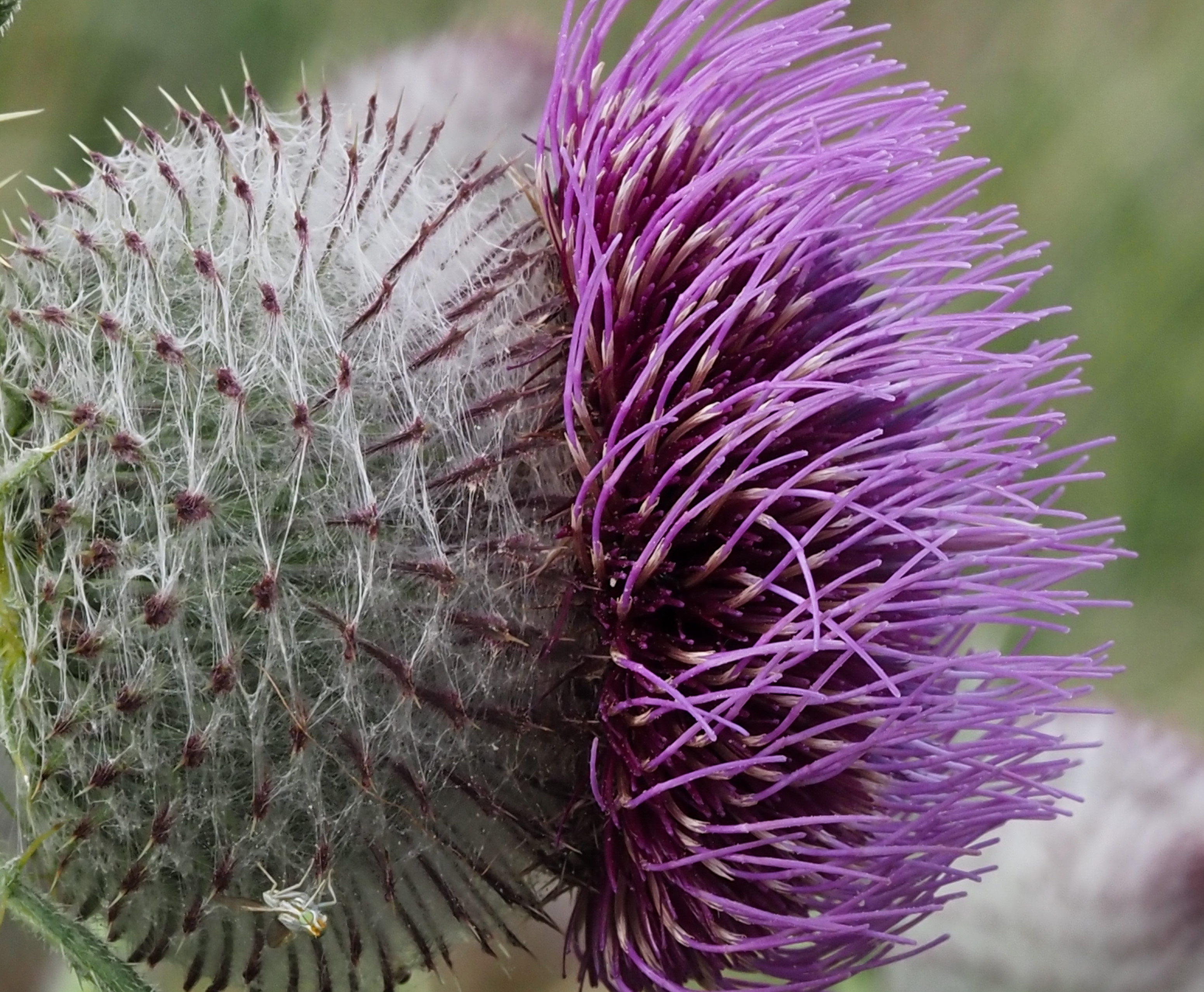
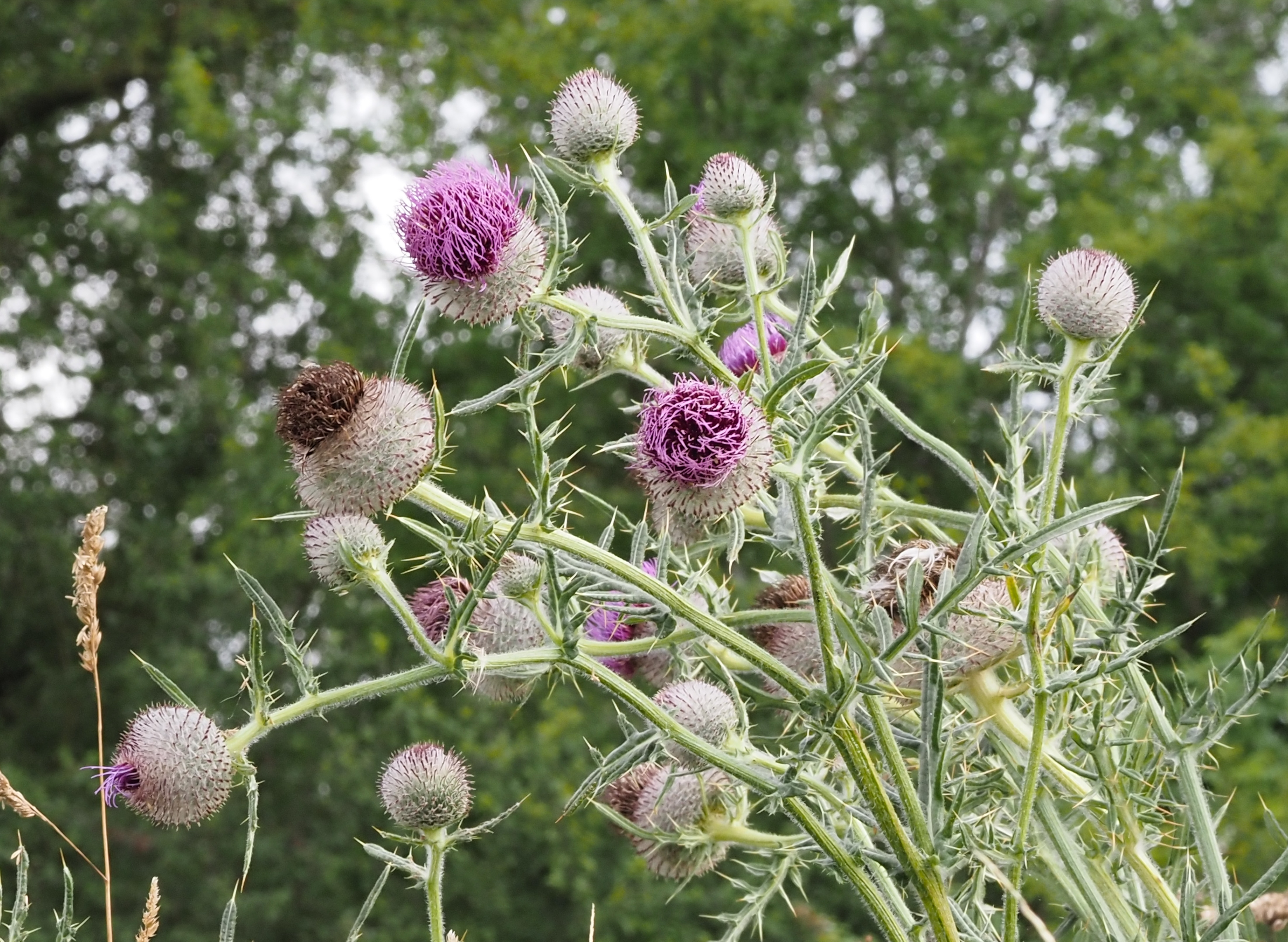
Woolly thistles (Cirsium eriophorum) have large globular flowers – strictly speaking they are an inflorescence – which are covered with dense purple ‘hairs’. Before the flower heads open (below left) they have an attractive pattern of bracts arranged in Fibonacci spirals. The flowers contain many tubular florets, with long reddish-purple tubes and lighter purple stamens (below right).


The tiny florets on top of the flower head emerge from spiny bracts. The numerous narrow, spiny bracts below the florets are angled outwards and the space between them is filled with dense cobwebby hairs (below left).
The flowers themselves are rich in nectar and attract bees, flies, beetles, butterflies and moths. I was impressed with how the bees pushed themselves through the florets to access the nectar.
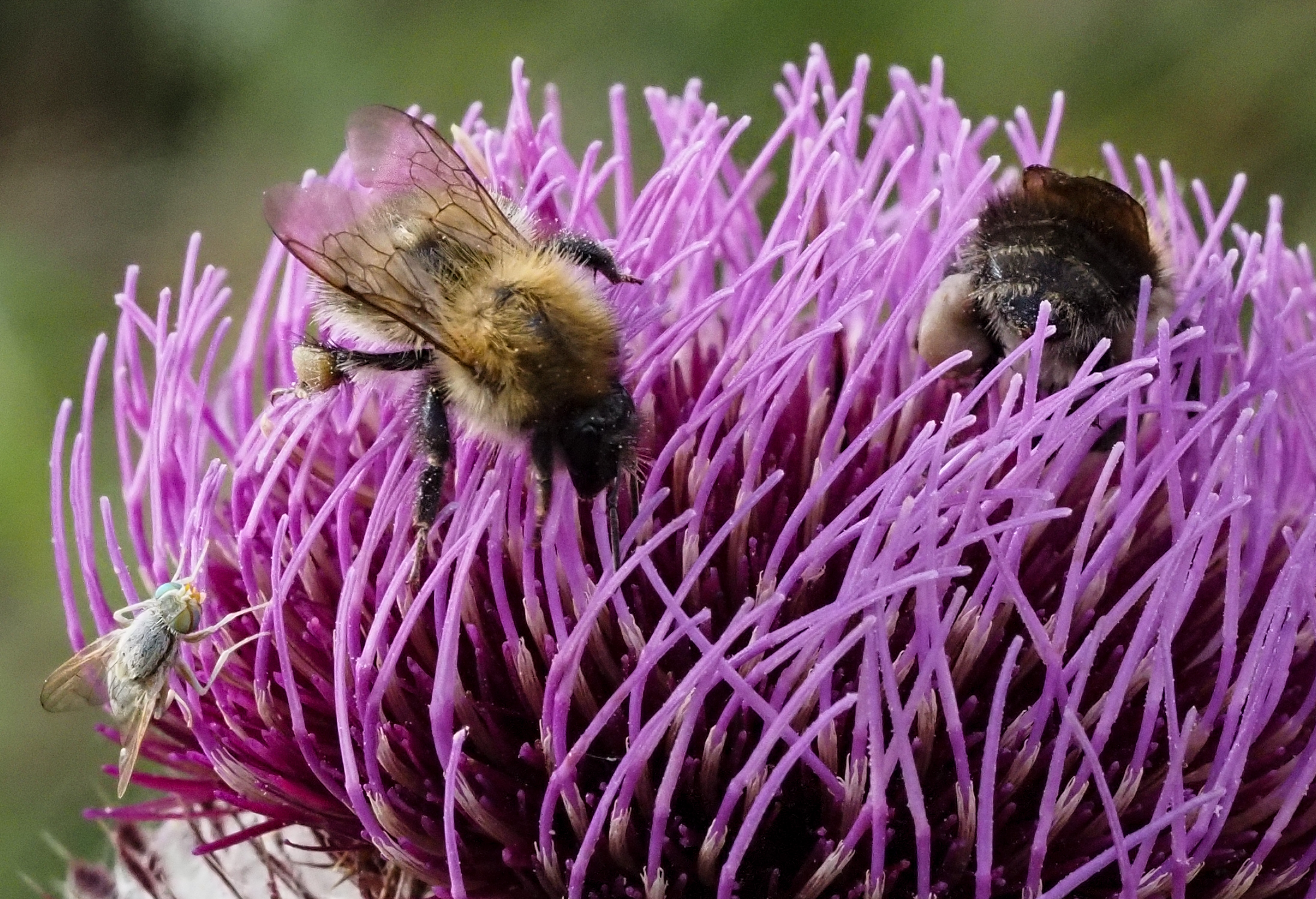
Bumblebees have relatively long tongues (the proboscis) which can extend up to 10 mm or more in some species. In fact, Bombus hortorum has the longest tongue of UK spedcies, which can reach just over 2 cm when fully stretched. The common carder bee (Bombus pascuorum) also has a relatively long proboscis, which is reportedly about 8mm in foraging workers, like the ones shown here. However, tongue length is roughly proportional to body size, so these smaller workers will have smaller tongues than the large queens.
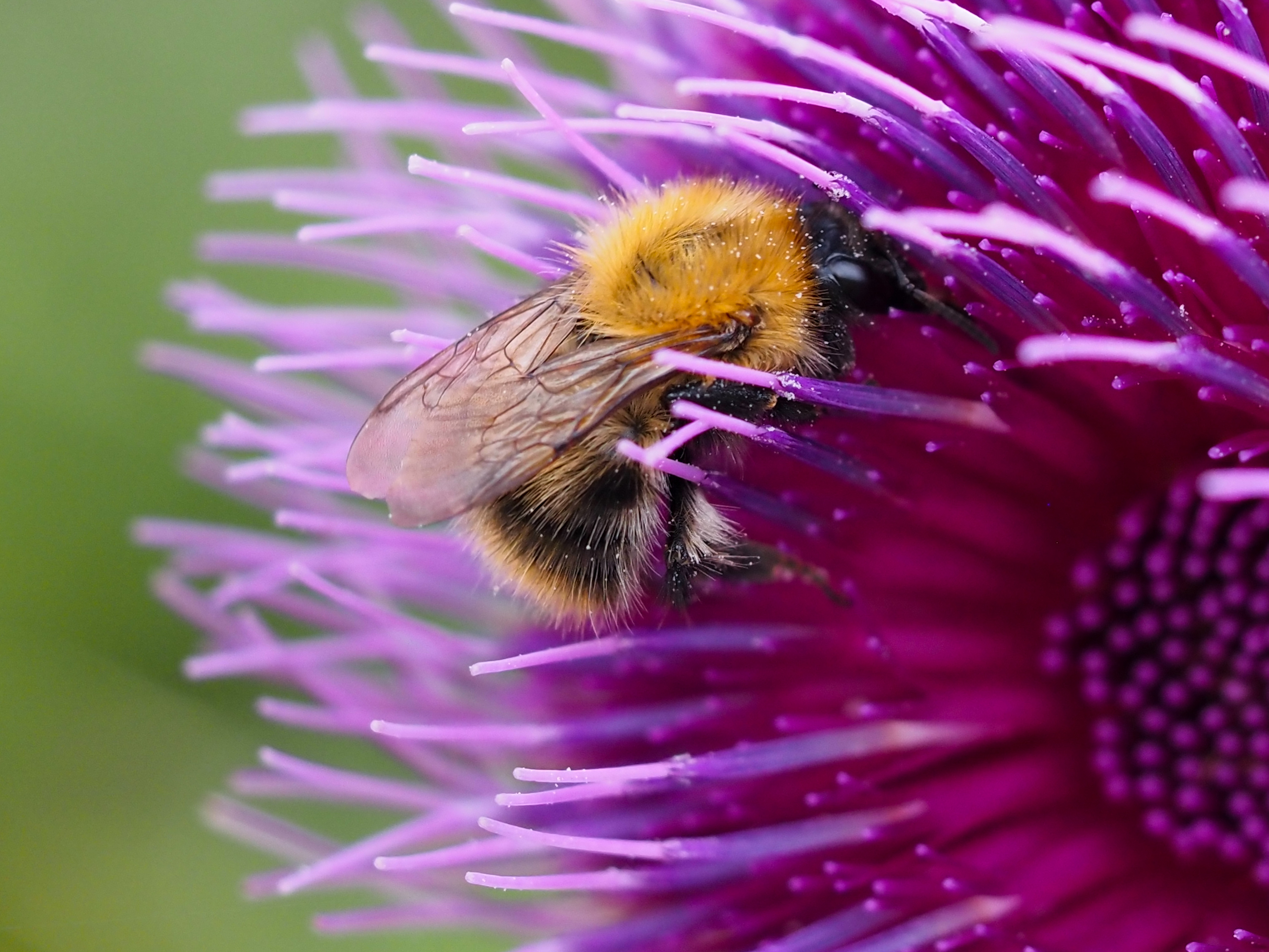
Nevertheless, the bumblebees (and honey bees) appeared to cope well with the dense flower head, propelling themselves through the florets using all six legs and reaching down to the base of the inflorescence to reach the nectar.
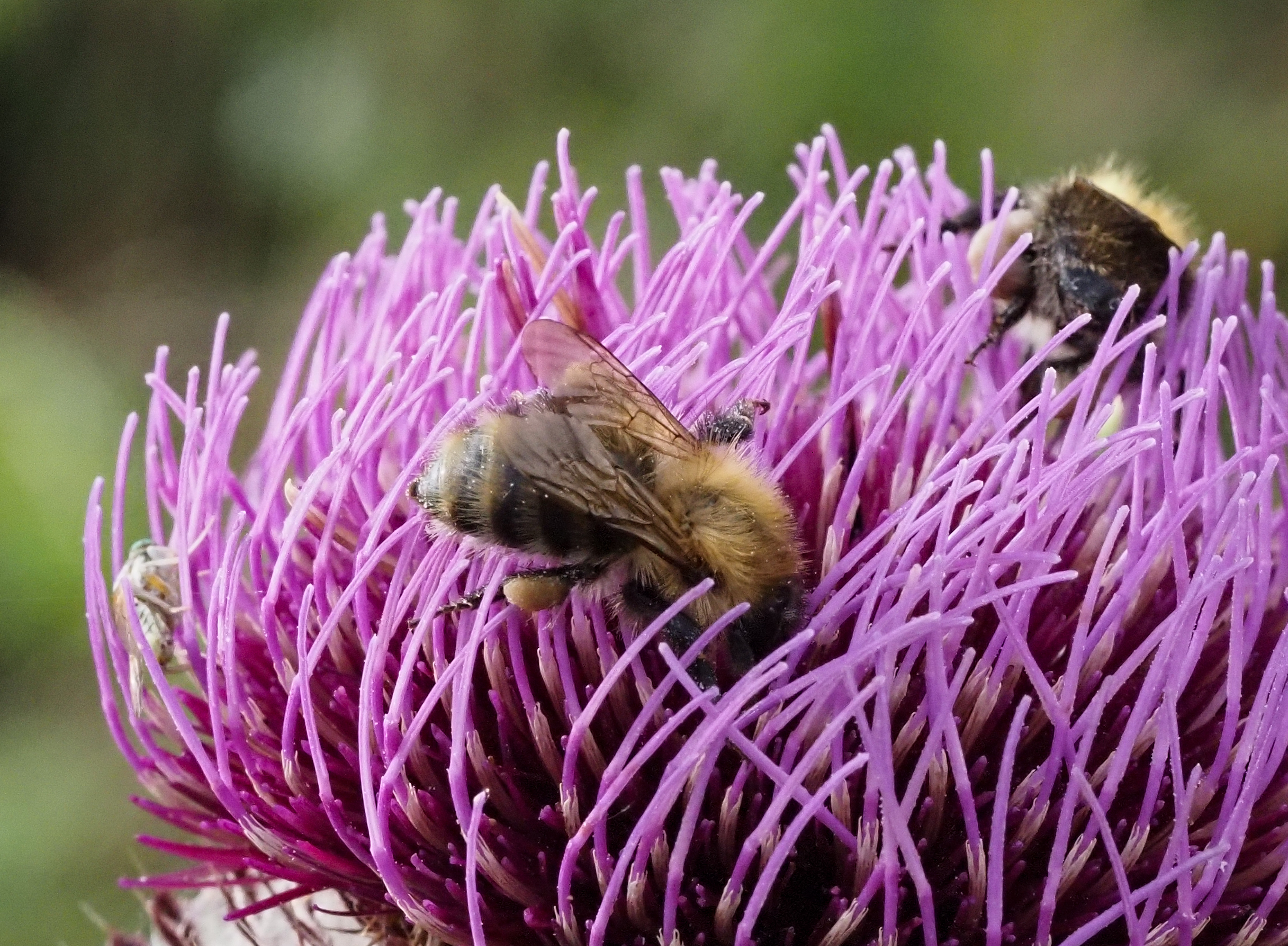
N.B. the flies were probably feeding on the pollen on the anthers at the top of the florets.
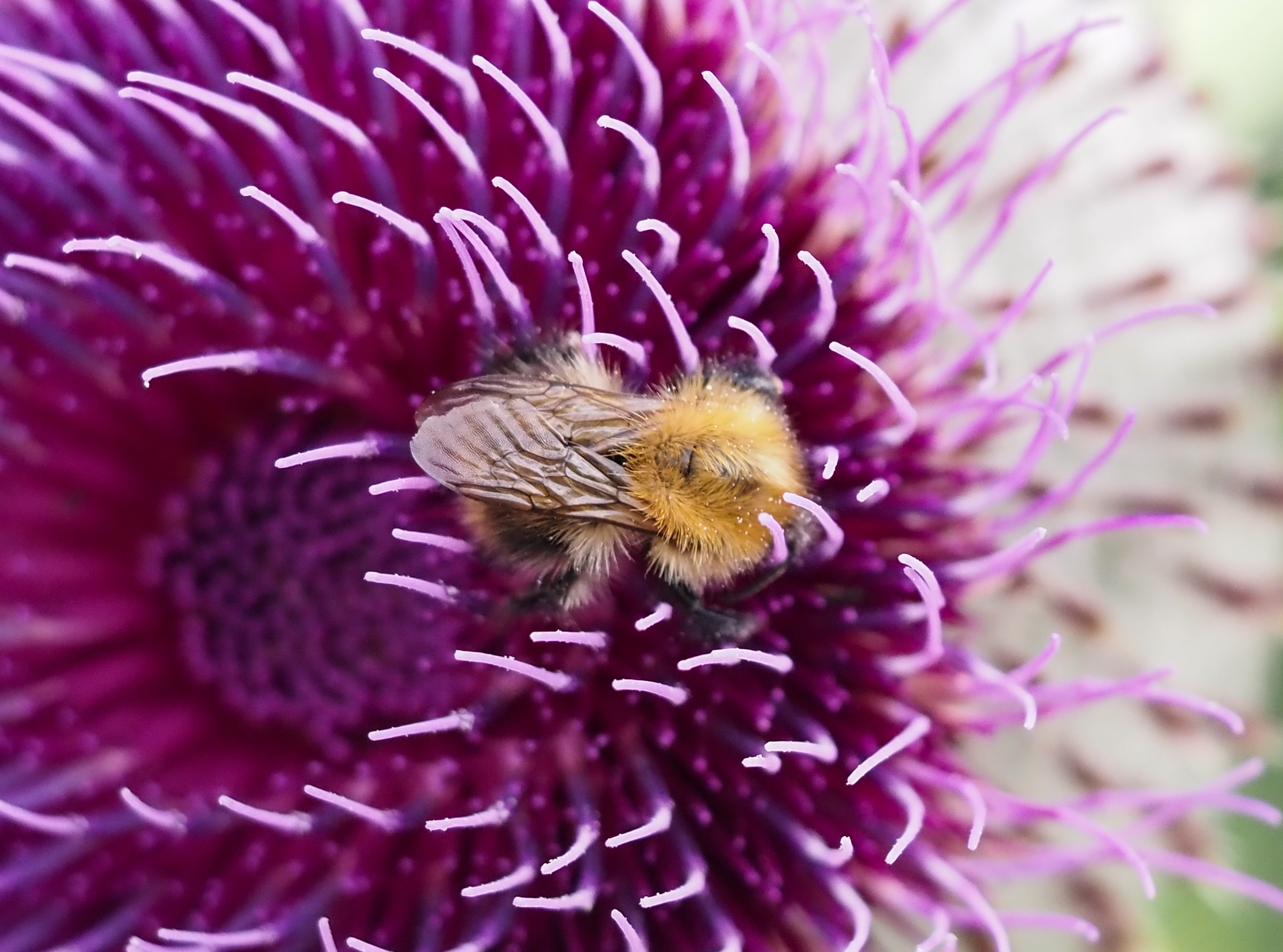
Bumblebees can be tricky to tell apart sometimes, but I think the one below, is a Red-tailed bumblebee (Bombus lapidarius) male, because of the tufts of yellow facial hairs, and the absence of yellow hairs at the top of thorax; but it is possible that it might be an Early bumblebee (Bombus pratorum) worker?
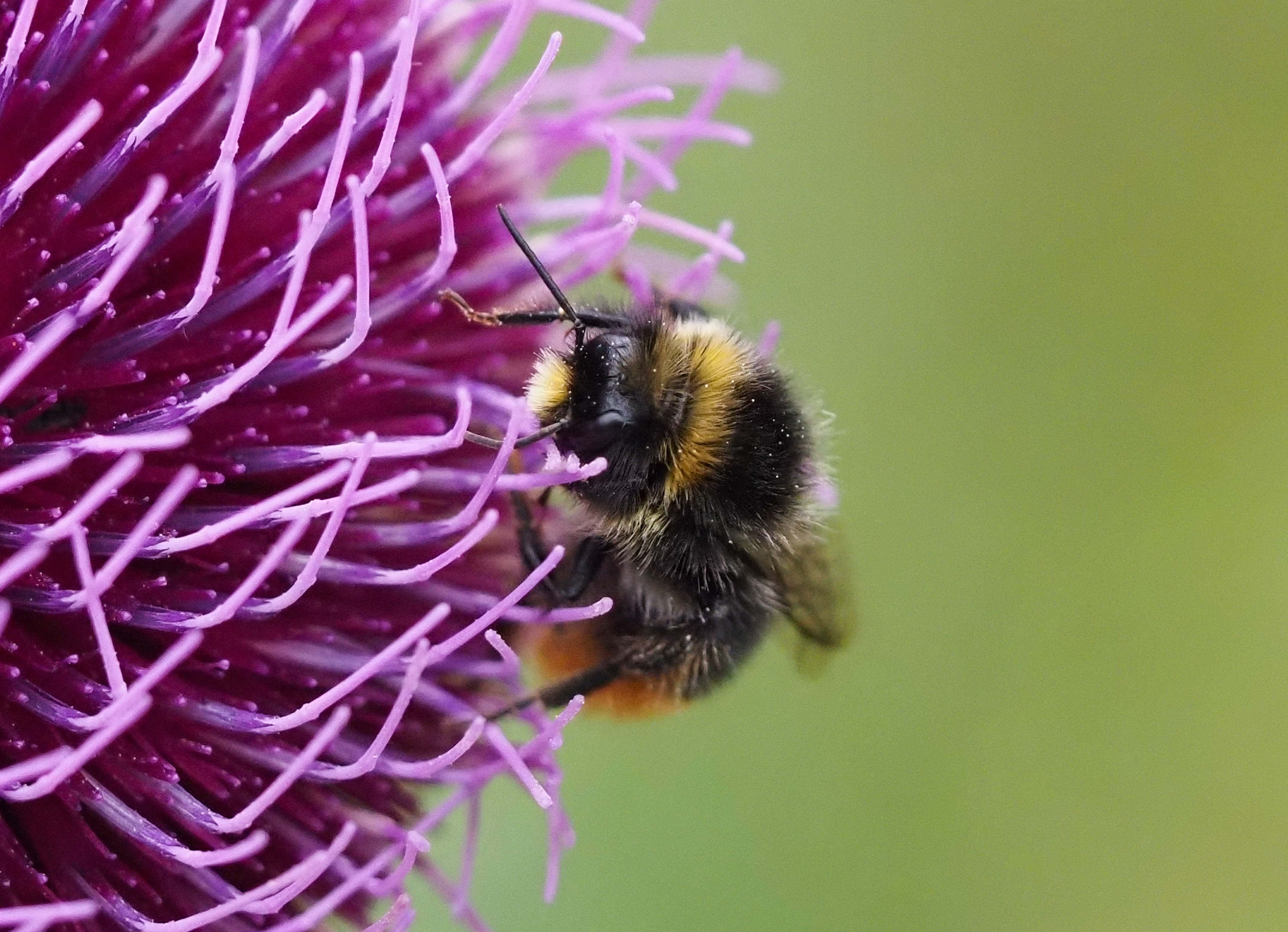
Nevertheless, regardless of species, all the bees stayed on the flower tops for a while, capitalizing on the abundance of nectar at the base of each floret. Pushing through the florets probably requires a considerable amount of force, relative to the size of these little bees, but they are undoubtedly very strong and easily push aside the florets to reach their goal.
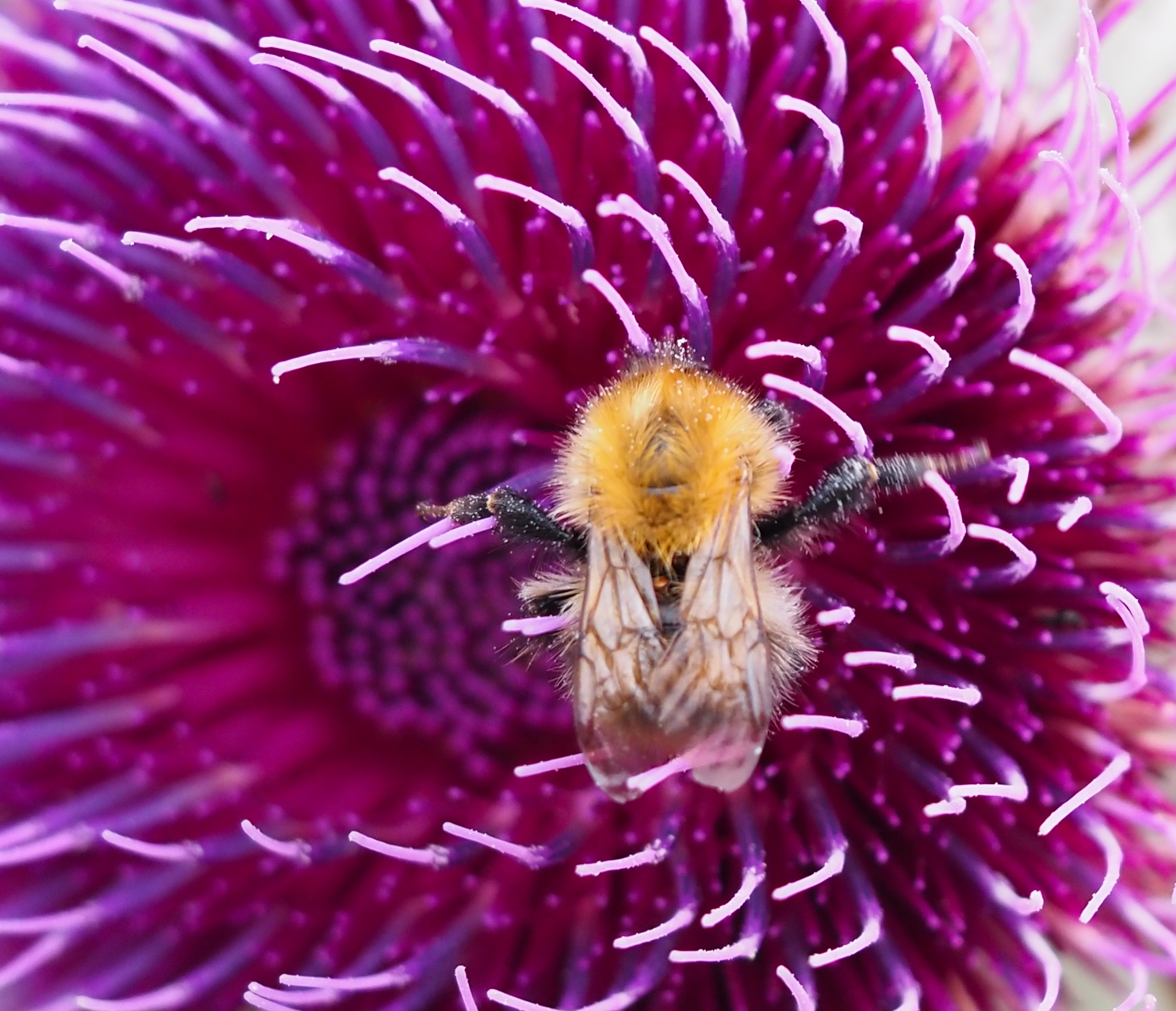
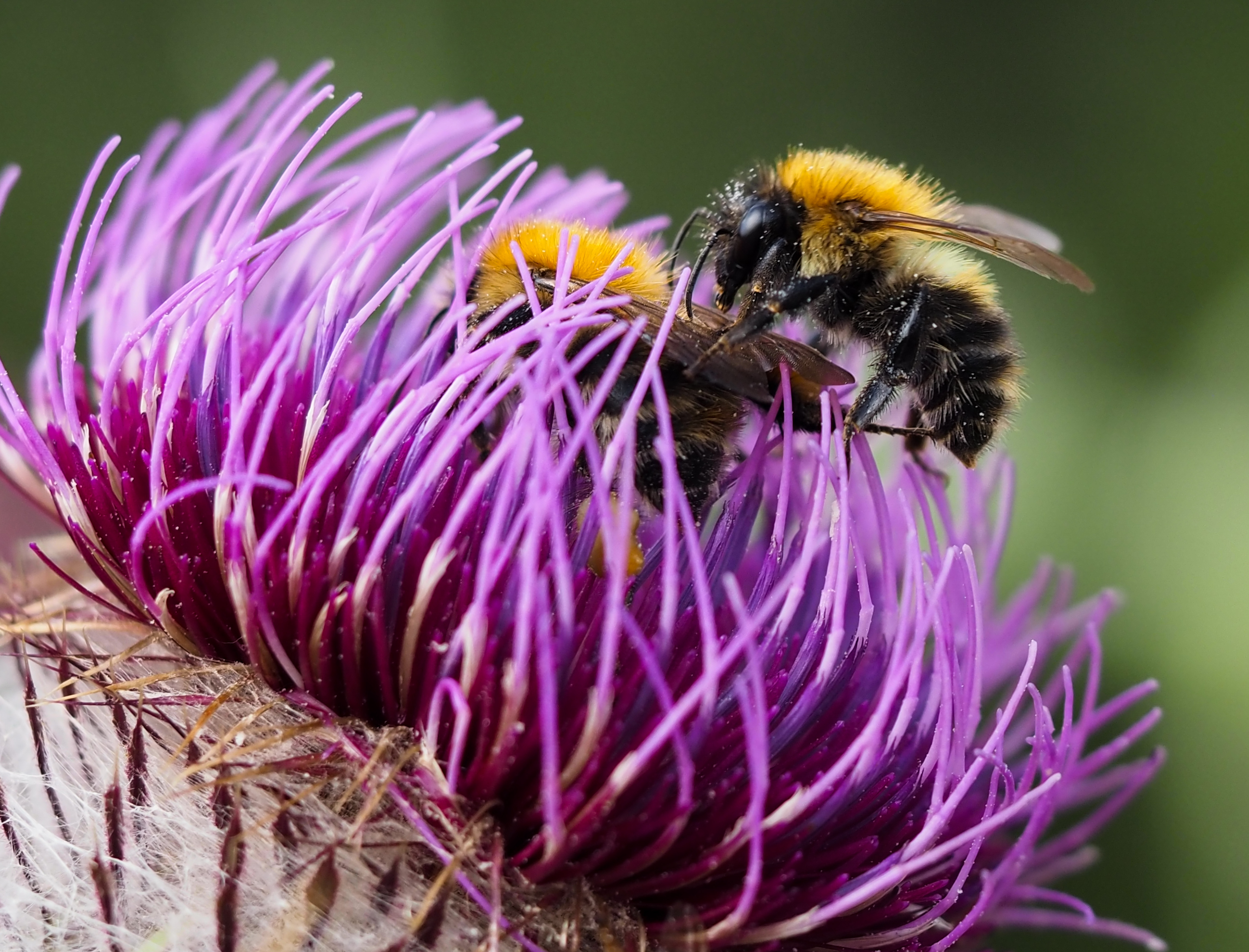
There was plenty of room for a couple of bees to share a flower head, but sometimes the presence of another worker seemed to put off a newly arriving bee. This carder bee worker (below) briefly alighted on top of another individual – just a light touch – before flying off!
All photographs taken by Raymond JC Cannon in Felmersham gravel pits SSSI, Bedfordshire.
 Ray Cannon's nature notes
[…] of a Fibonacci spiral occurs in Woolly thistles (Cirsium eriophorum), which I mentioned in a previous blog. The large flower head, up to 70mm across, is almost spherical apart from the slightly flattened […]