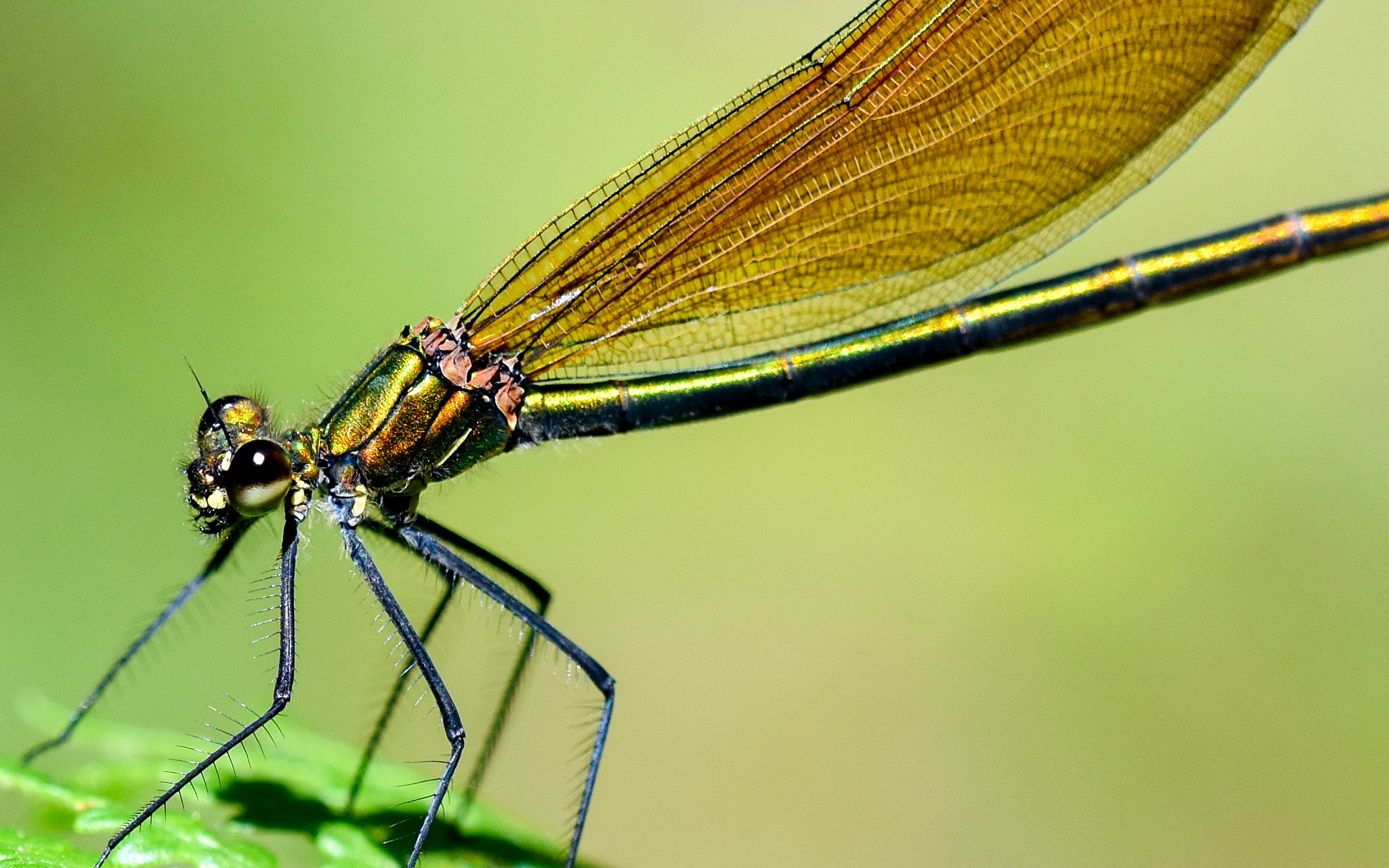
In this blog, I explore the behaviour of calopterygid damselflies (family Calopterygidae) common known as Demoiselles. I draw heavily on the work of researchers and experts, as well as my own observations and photographs from England, Spain, and Thailand.
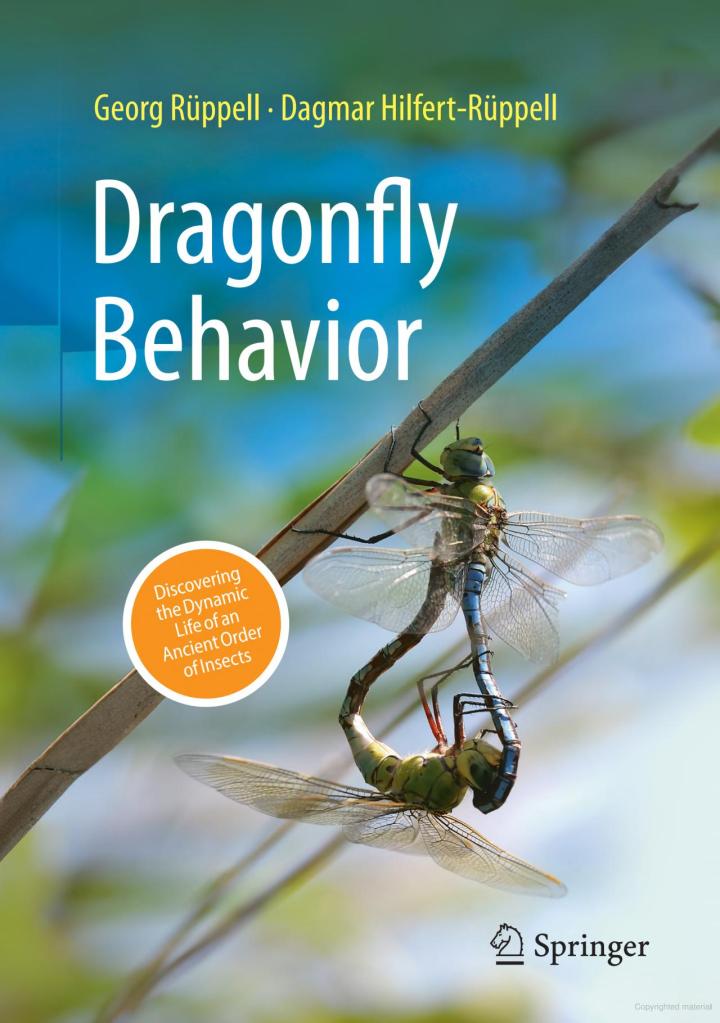
For those wanting to know more about these fascinating damselflies, I highly recommend the book by Rüppell, G., & Hilfert-Rüppell, D. (2024): Behavior of dragonflies (below), Springer-Verlag.
Also the paper by Steve Cham (2020) on male aggression in Calopteryx splendens, available here, or see references below.
Demoiselles (Calopterygidae) have relatively large wings for their size and weight, which means that they have a very low wing loading. This enables them to engage in slower, more manoeuvrable flight; but the rate at which they flap their wings can vary widely, depending on what sort of behaviour they are engaged in. For example, their wing beats vary markedly, depending on whether they are flying by themselves, engaged in courtship, fighting each other (males), or flying in tandem (male and female).
Their style of flight has been described as ‘a lively bouncing dance-like motion’ somewhat reminiscent of butterflies (Karjalainen & Hämäläinen, 2013).
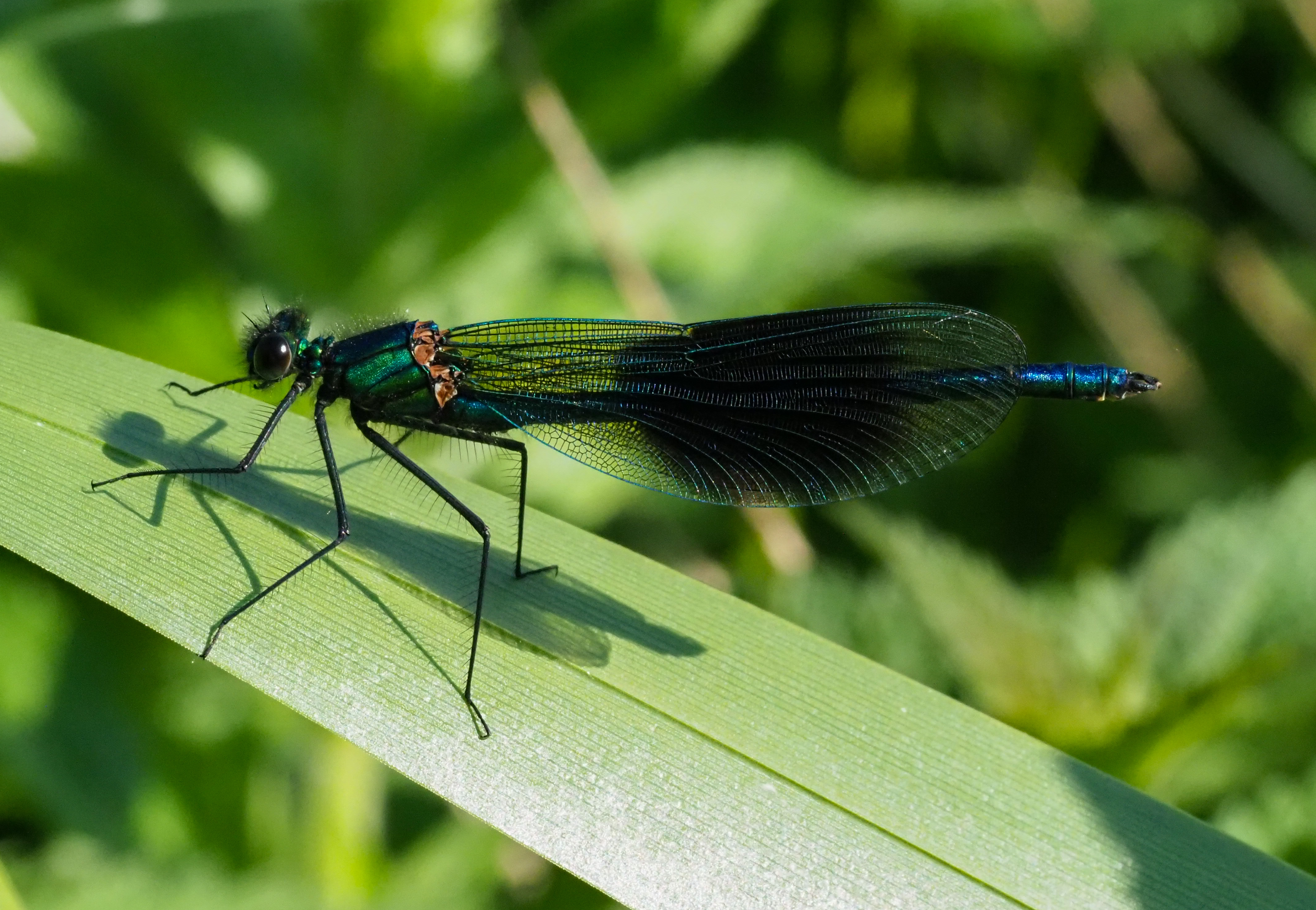
Photo by Raymond JC Cannon
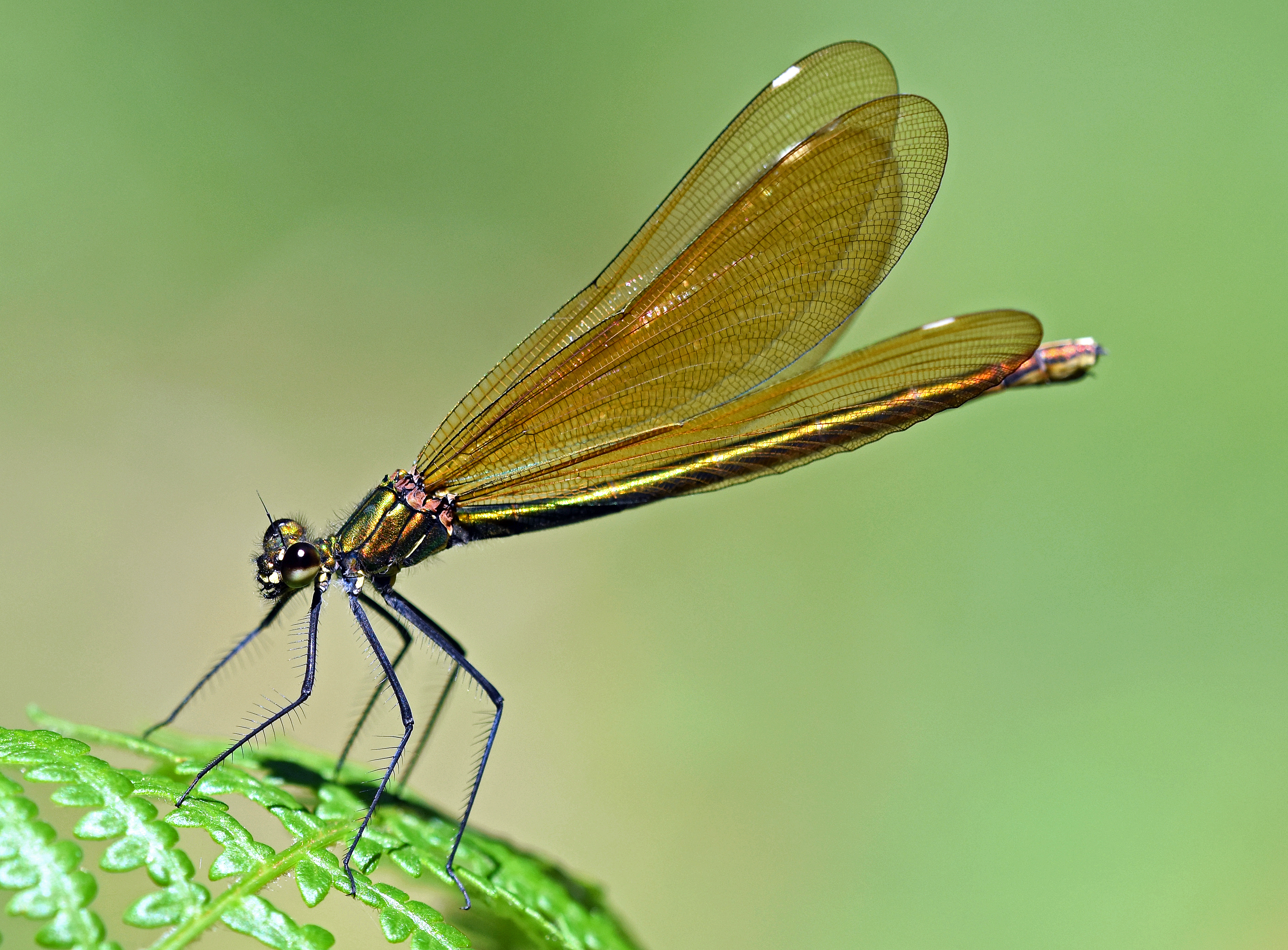
The wingbeat frequencies of calopterygids can change quickly and frequently. For example, they can bring any one, two, three, or all four wings to a sudden standstill whilst in flight, and these aerobatic movements all have communicative functions. For example, the beautiful Asian, Neurobasis, species (below) can slow down the motions of their metallic ornamented hind- wings and even hold them motionless, in both threatening and courting flight.
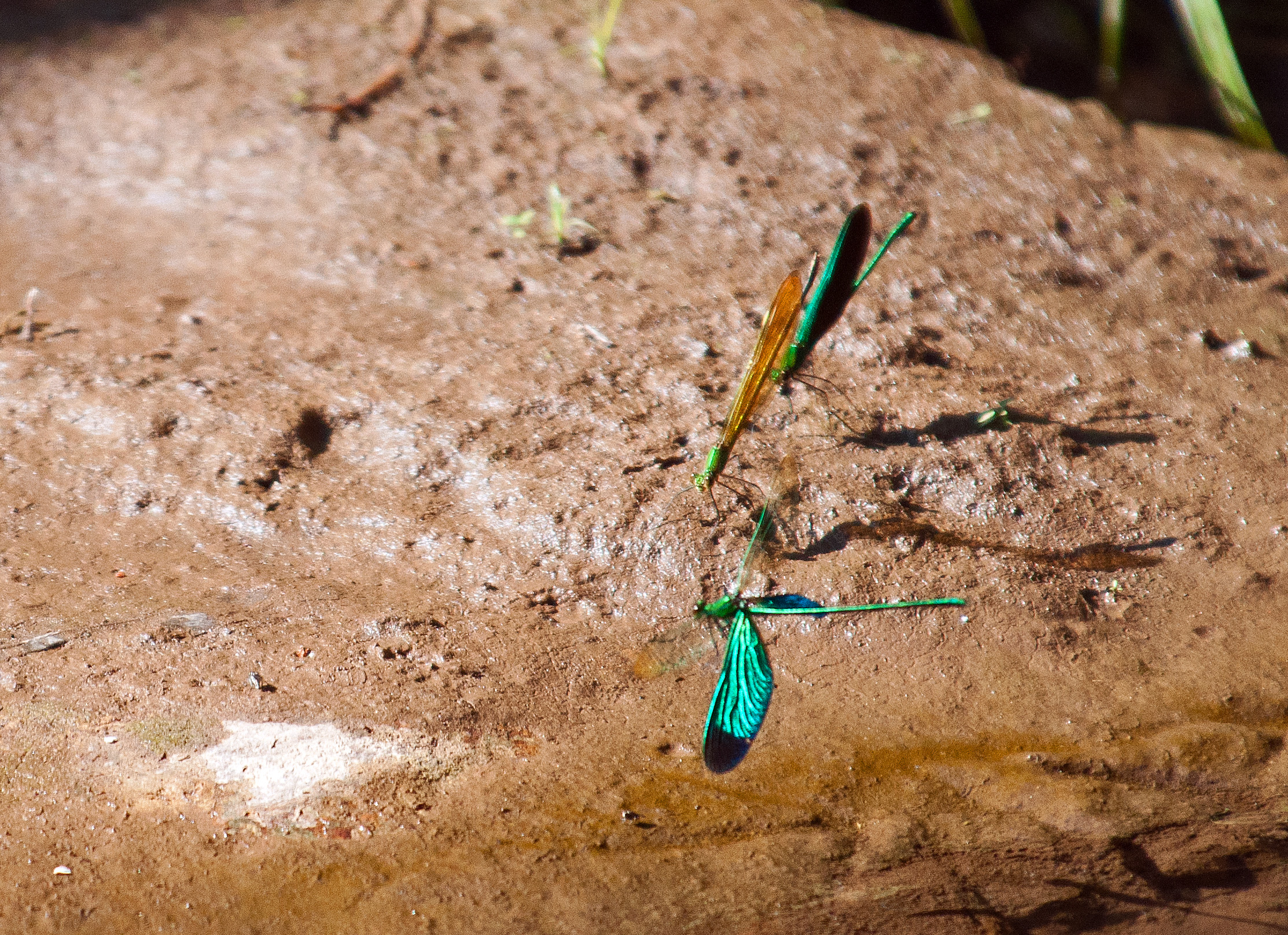
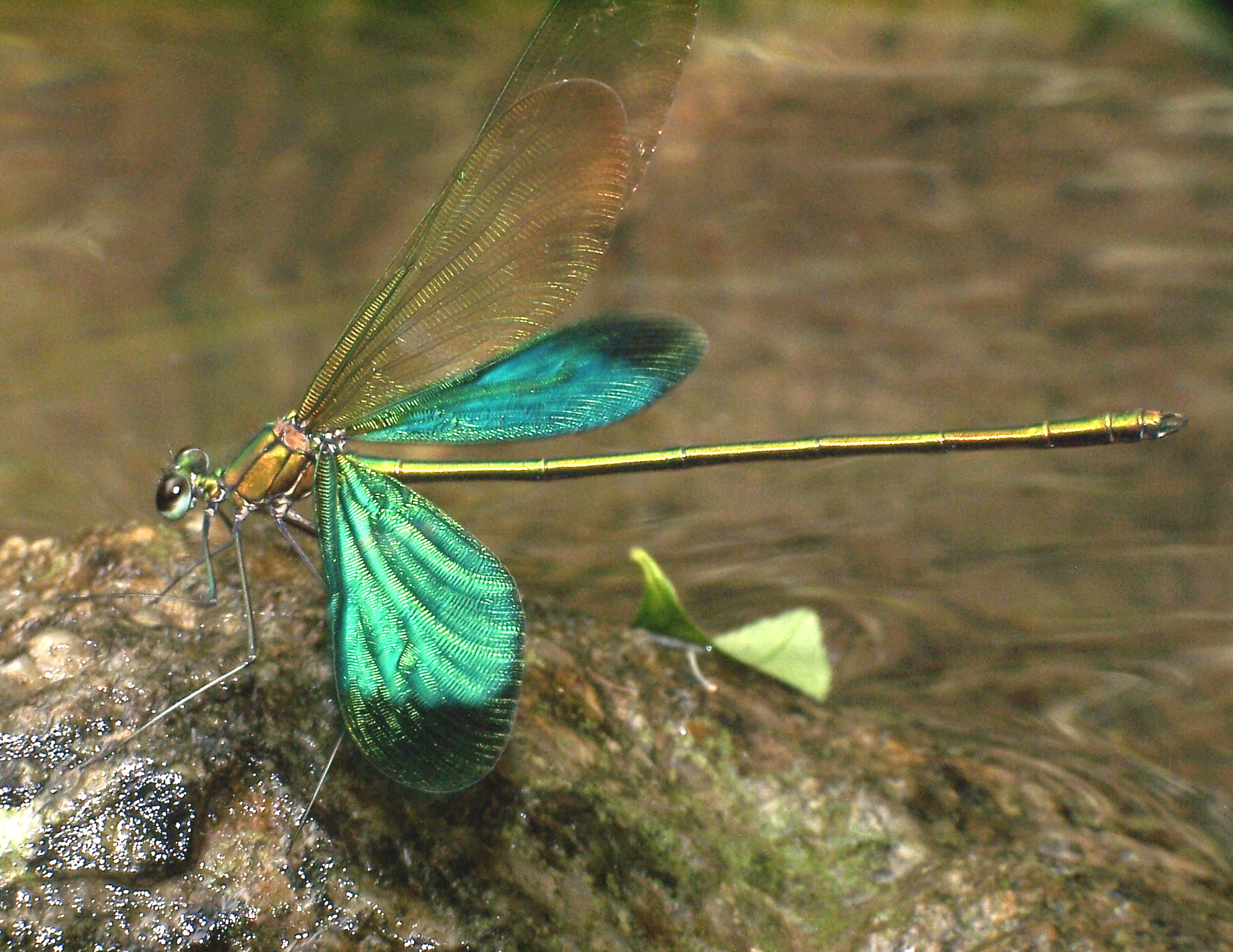
The metallic, green hind-wings of the Stream Glory, Neurobasis chinensis, which occurs in eastern tropical Asia, are not visible when the wings are closed above the body (below left), but are remarkably vivid and shiny when the male opens and flashes them (below right).
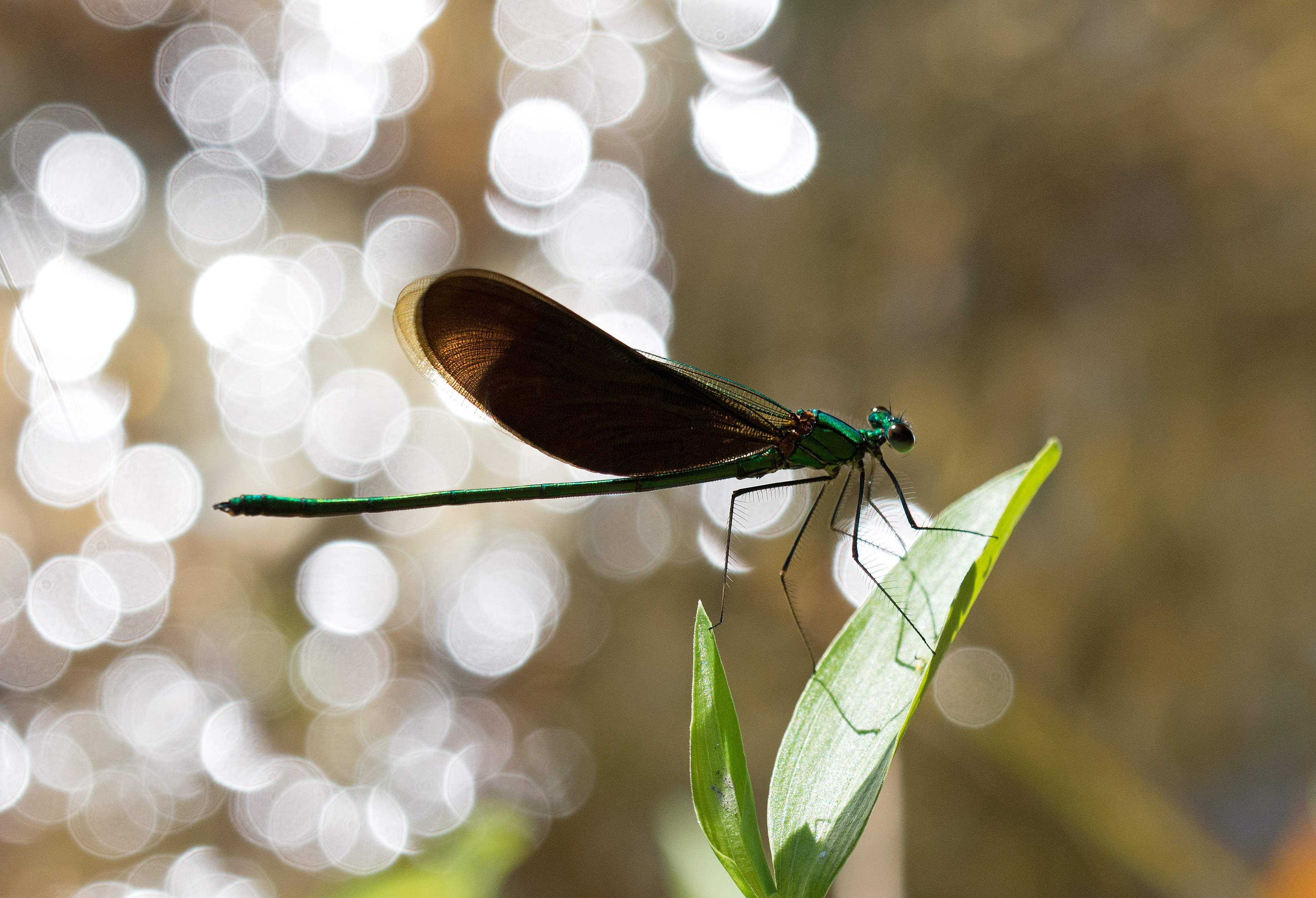
Photo by Raymond JC Cannon
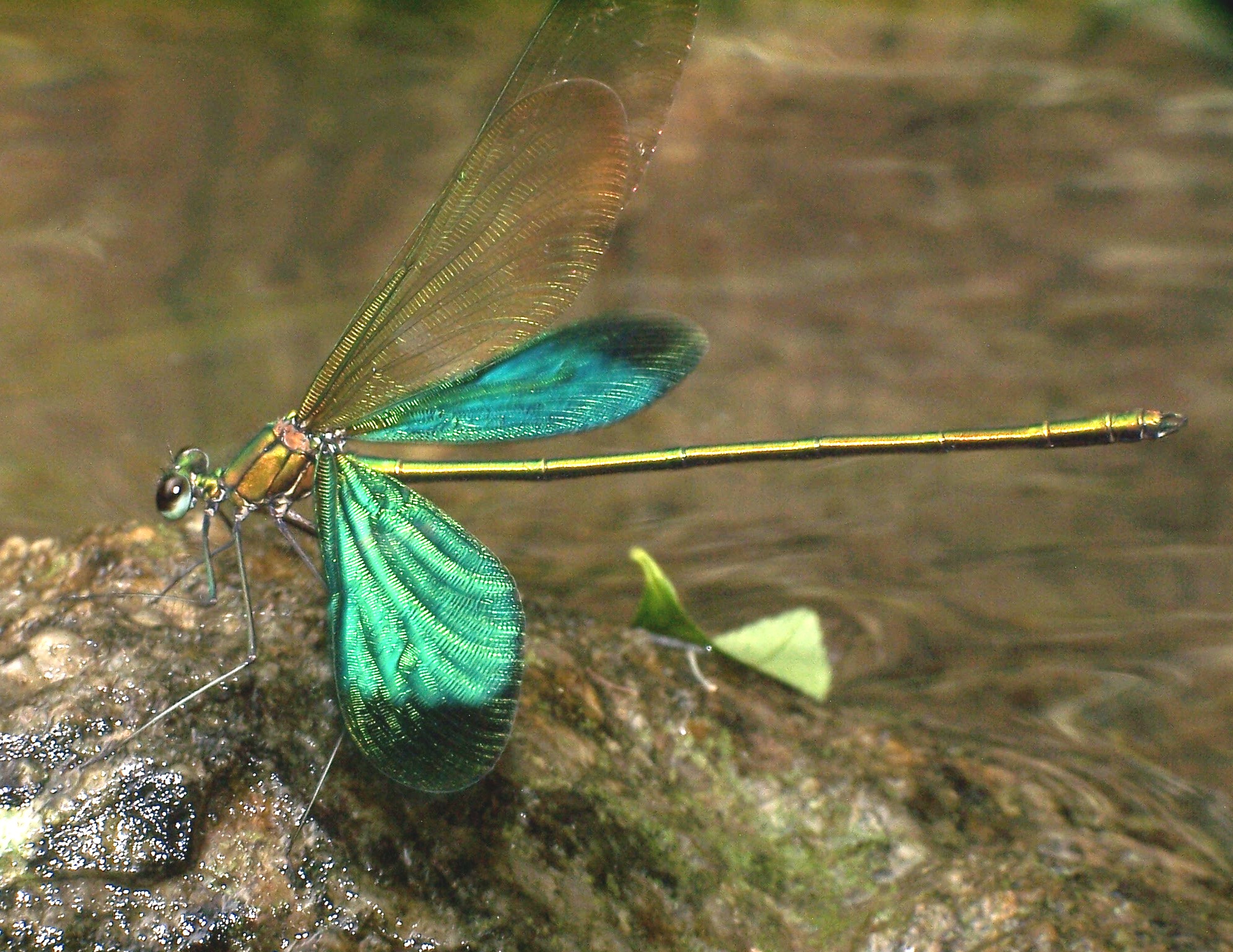
In the Copper Demoseille, Calopteryx haemorrhoidalis asturica (below) – a southern European species – males court females that arrive at their territories by carrying out a cross display and/or a courtship arc (see below). These courtship displays are common to most, if not all, Demoiselles.
In the courtship arc, males fly around and in front of a perching female, moving slowly from side to side, using just their forewings to remain airborne. The wing beats of males during courtship flights are much higher than that during normal patrolling flights.
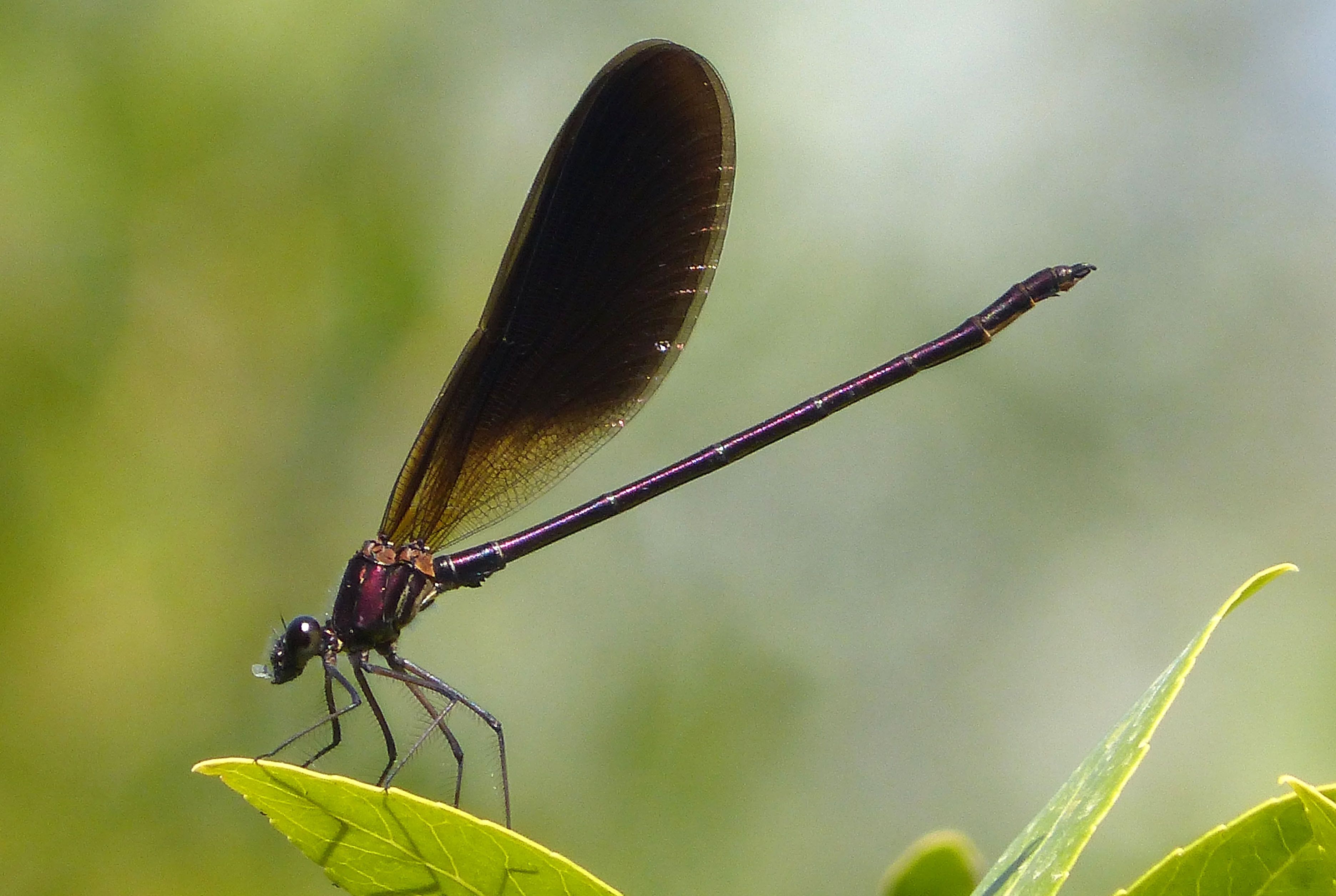
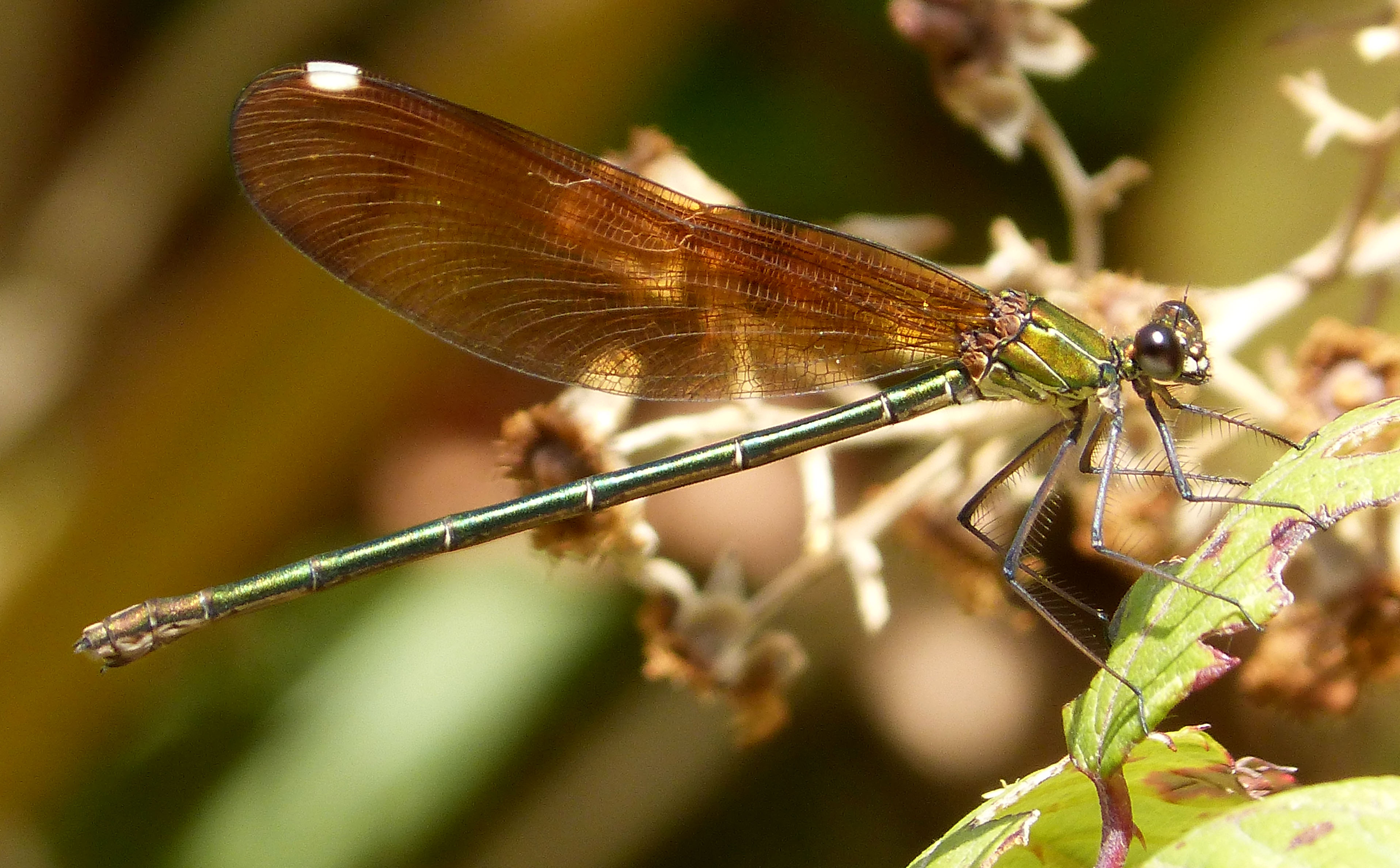
These courtship behaviours are performed sequentially, until copulation occurs, or the female decides to reject the male’s advances, and flies off. However, the extent to which these behaviours are carried out can vary both within and between calopterygid species depending on latitude and climate.
In the UK we have two species: the beautiful demoiselle (Calopteryx virgo) and the banded demoiselle (Calopteryx splendens). There are another two species in western Europe: the copper demoiselle (Calopteryx haemorrhoidalis) and the western demoiselle (Calopteryx xanthostoma).
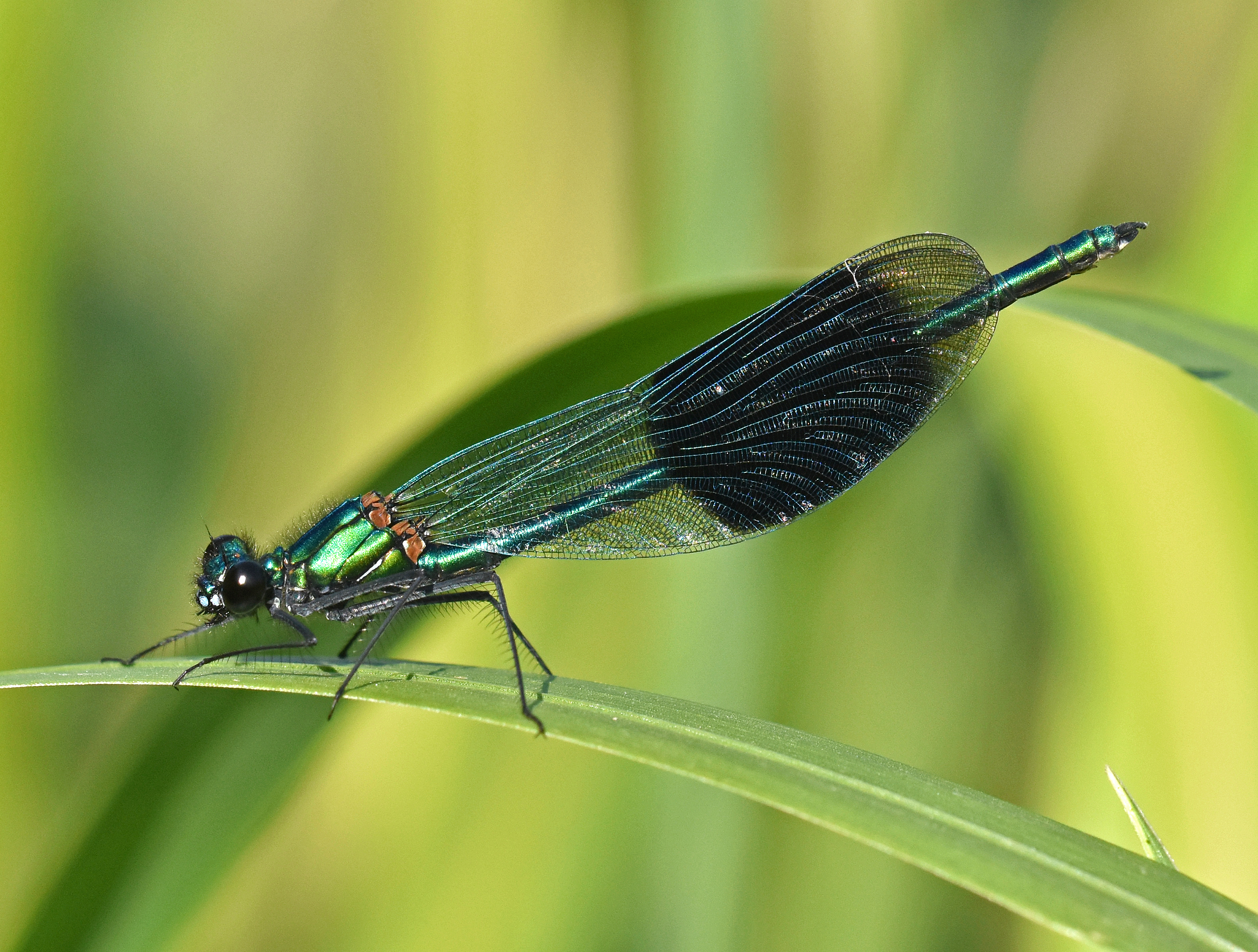
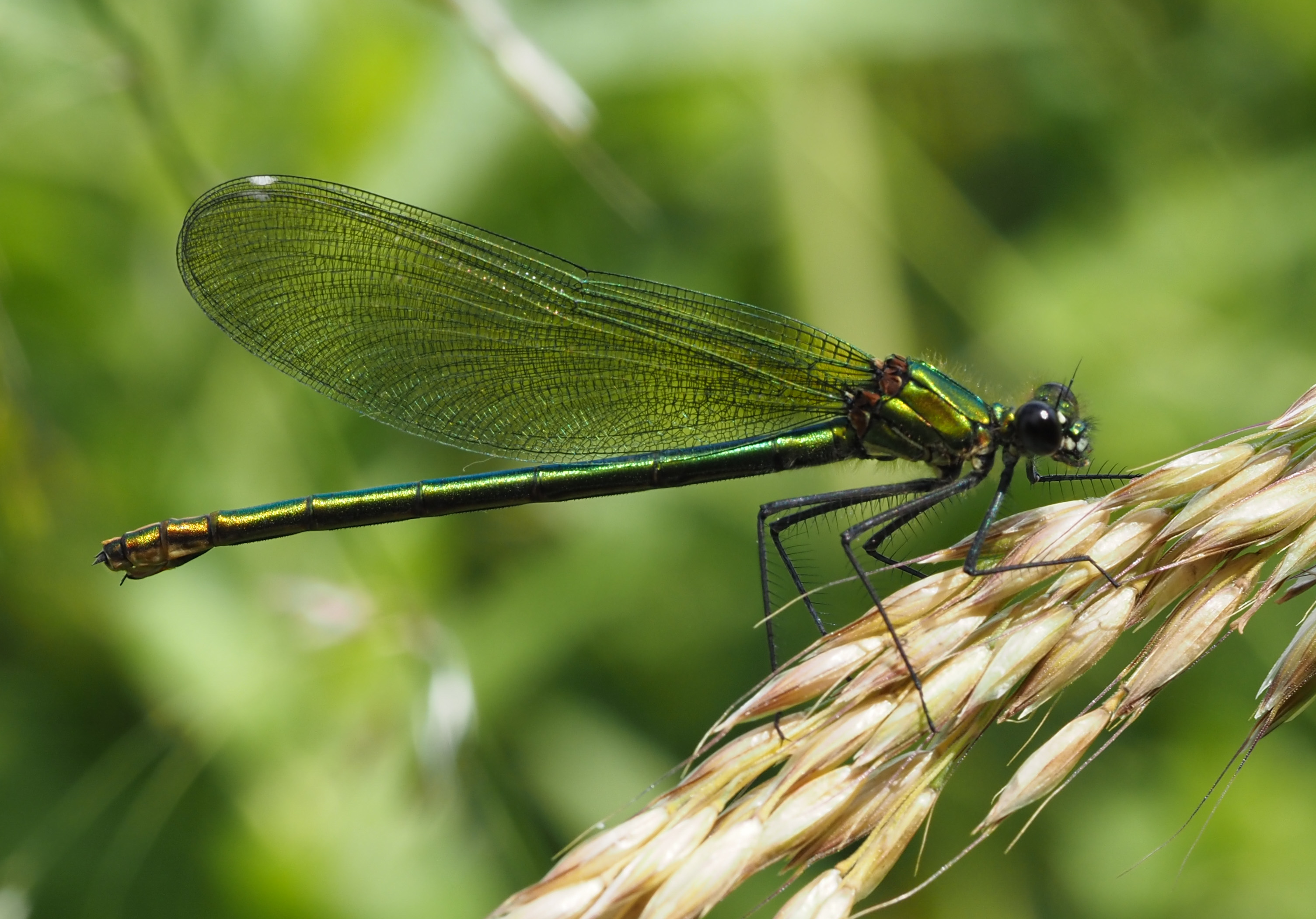
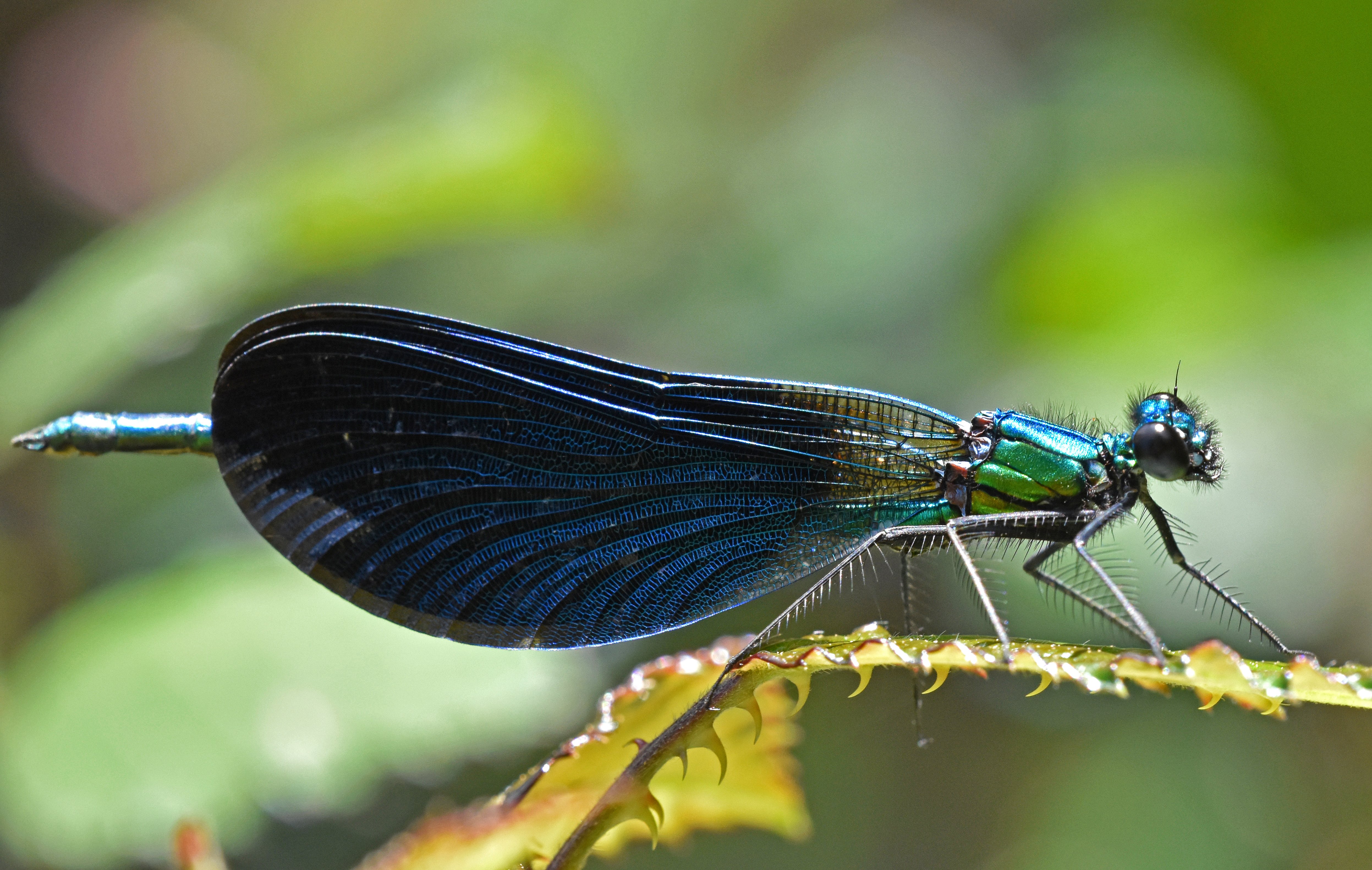
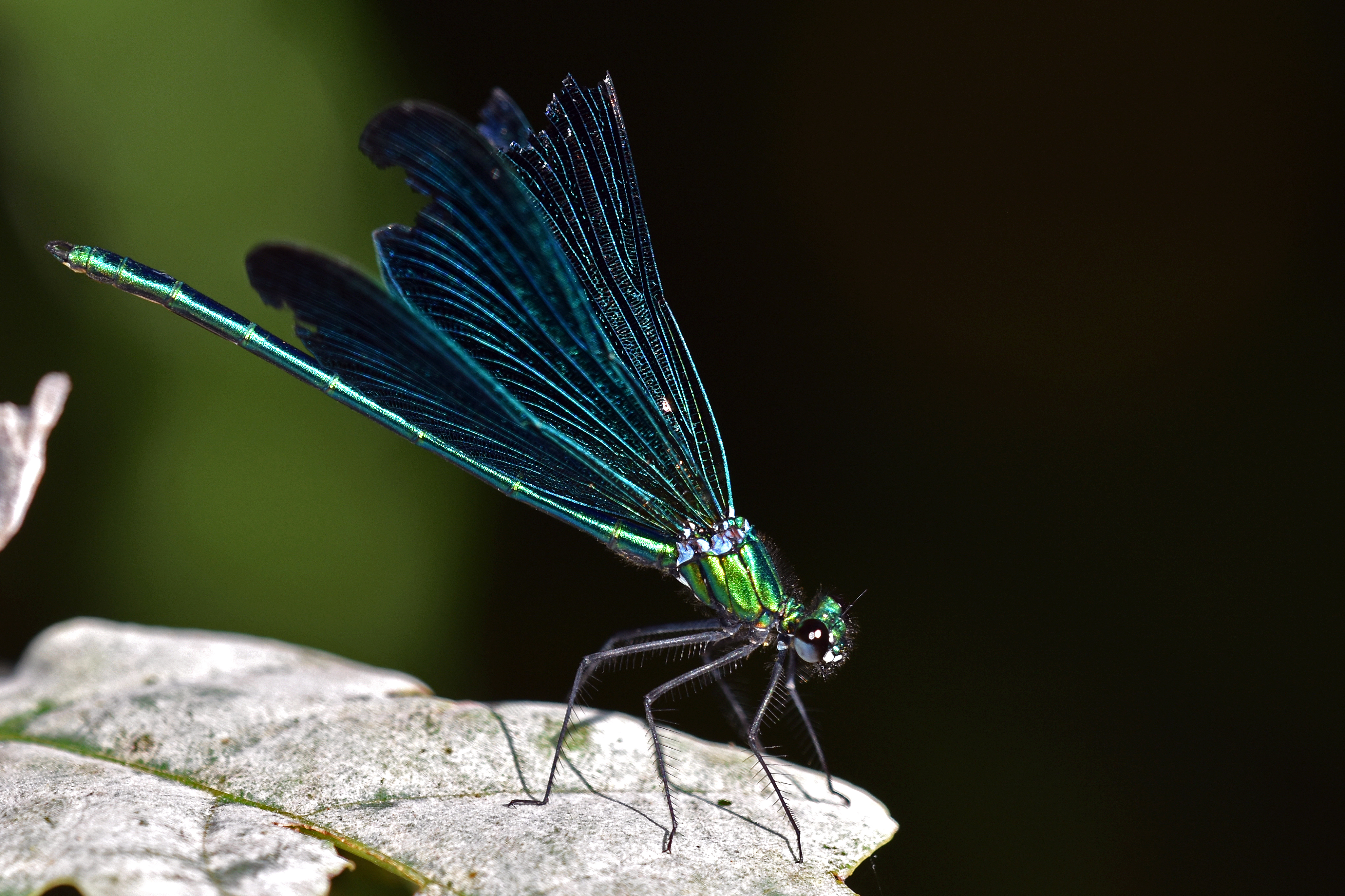
Males of Calopteryx splendens and C. virgo can be separated in the field by the extent of the melanic wing colouration, with smaller dark wing patches in C. splendens (covering about 50% of the wing) and entirely melanized wings in C. virgo (a Spanish subspecies is shown below). The primary function of this wing pigmentation is sexual signalling and species recognition.
Territories and perching sites
Males typically threaten each other via wing displays, and one male usually gives way.
Calopterygid males are well known for their aggressive territorial disputes, which normally end after a few seconds, with resident males winning most of the disputes. However, if the contests escalate and go on for a longer period, there may be collisions, hitting or biting, and the winner is usually the male with higher energy (fat) reserves.
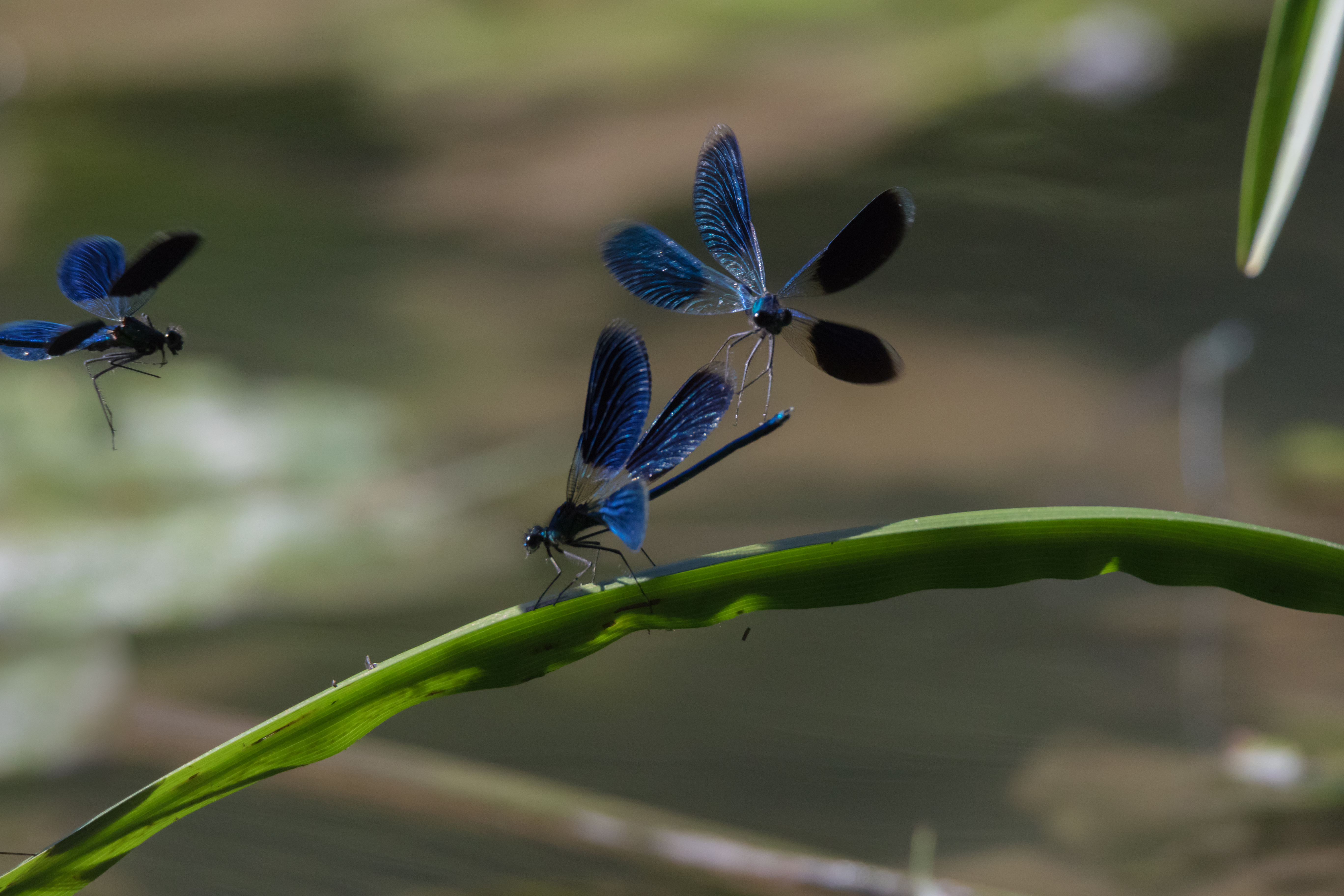
Calopterygid males defend a small territory – perhaps 50m long – beside a river or stream that contains both a place for them to perch and a patch of submerged vegetation that females can use for oviposition. However, some males do not establish territories (see below).
Males defend their territories against other males by means of ritualised flight contests, which generally follow a fixed pattern. Territory owners chase intruders of their own and other species, and they also display to rival males by flashing their coloured wings whilst in flight.
In territorial flights, males fly towards an intruder, circle around him, move up and down, or side to side, in front of him, or pursue him. This is done quickly, using complicated manoeuvres in which the wings are presented to the opponent and their conspicuousness is enhanced by a low wing beat frequency of 10–18 beats per second.
Not all males establish a territory.
Males calopterygids adopt either territorial or non-territorial behavioural strategies. Non-territorial males do not defend potential oviposition sites but instead try to copulate with females visiting the territories of other males.
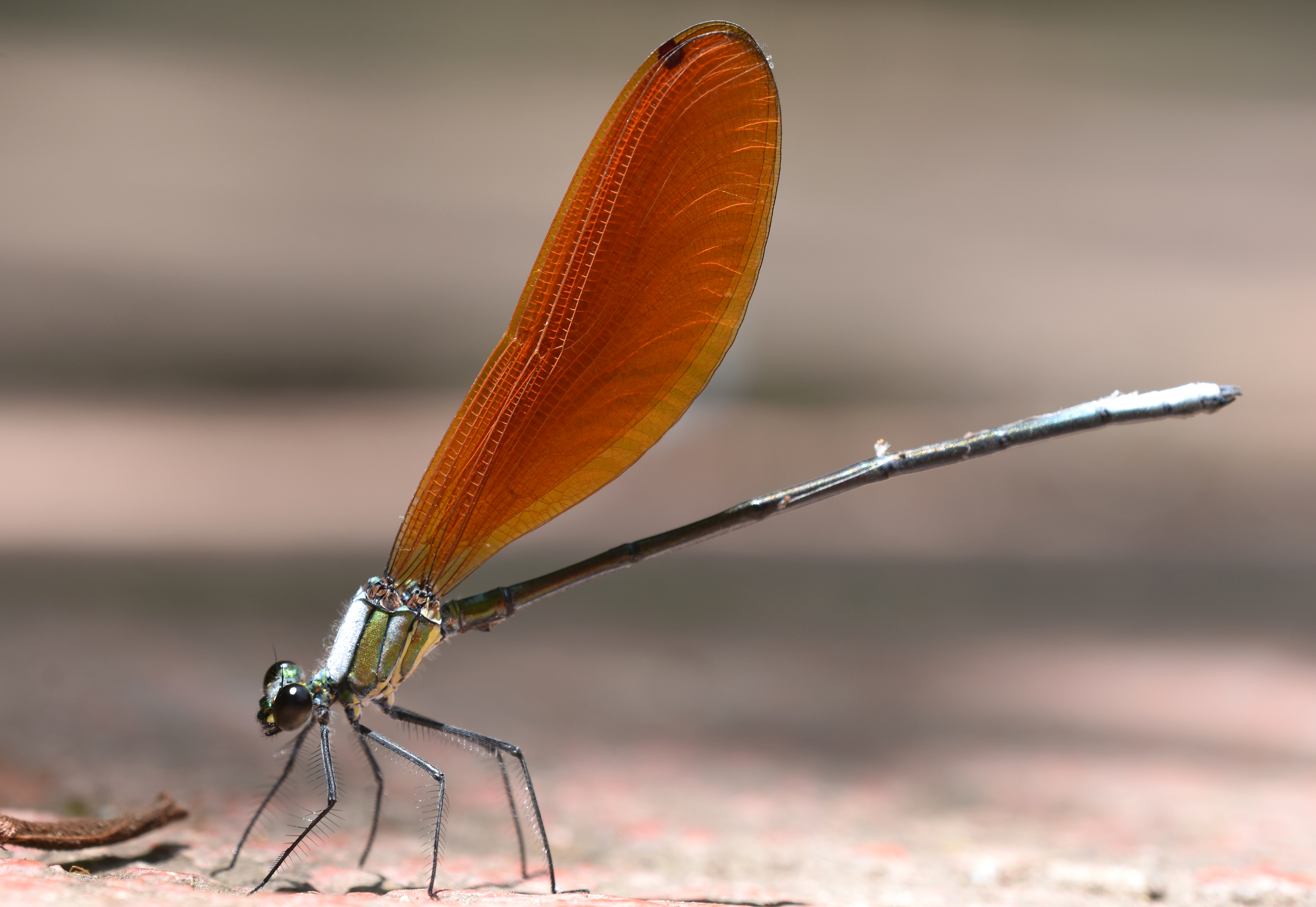
In the beautiful Mnais damselflies (below), found in SE Asia to Japan, the non-territorial males are clear-winged morphs that lurk in concealed spots around the margins of the orange-winged, territorial males’ territories. The non-territorial ‘sneaks’ attempt to copulate with any female that they can catch! I described this behaviour in a previous blog: Mnais damselflies: fighters and sneaks!
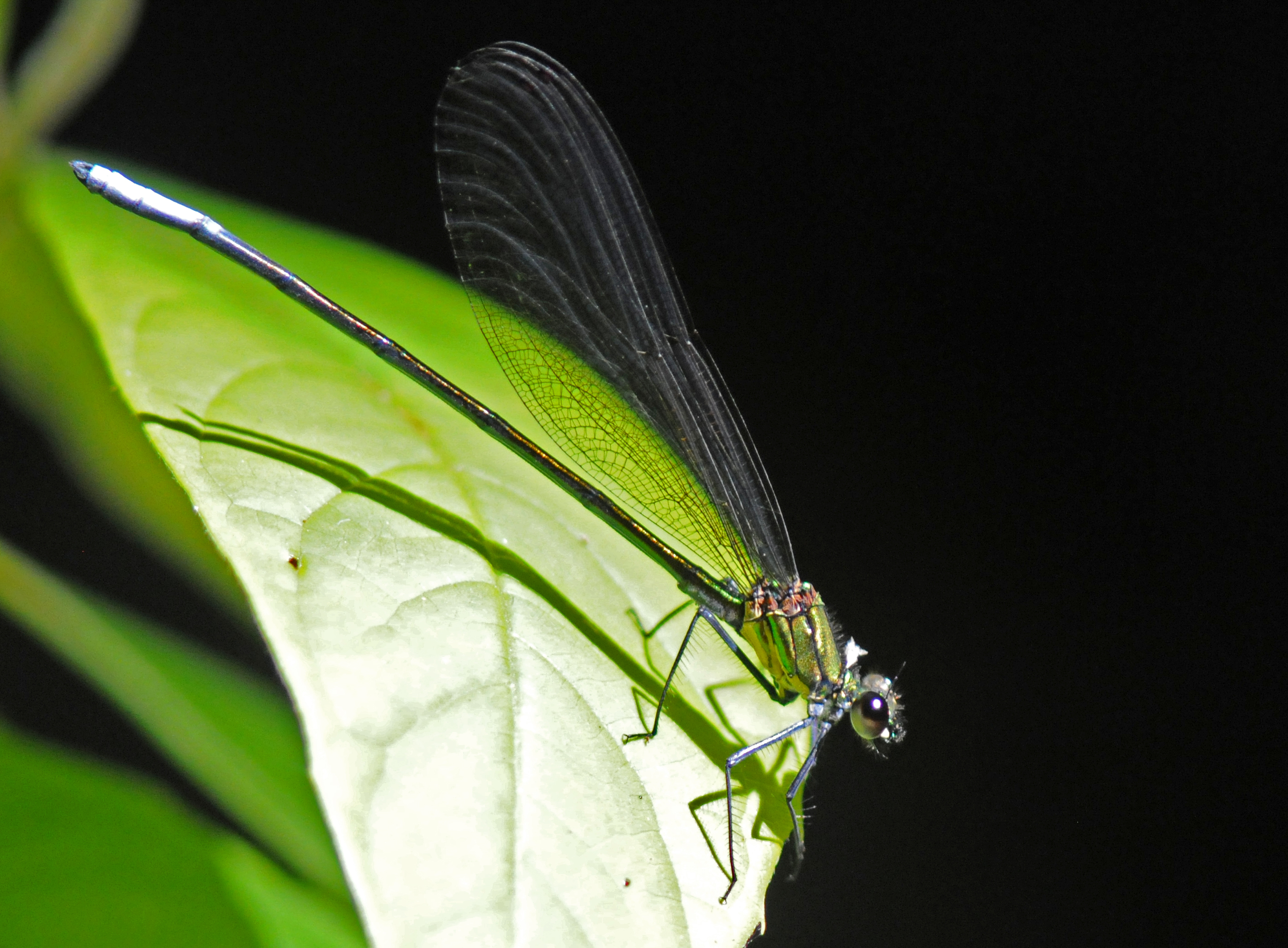
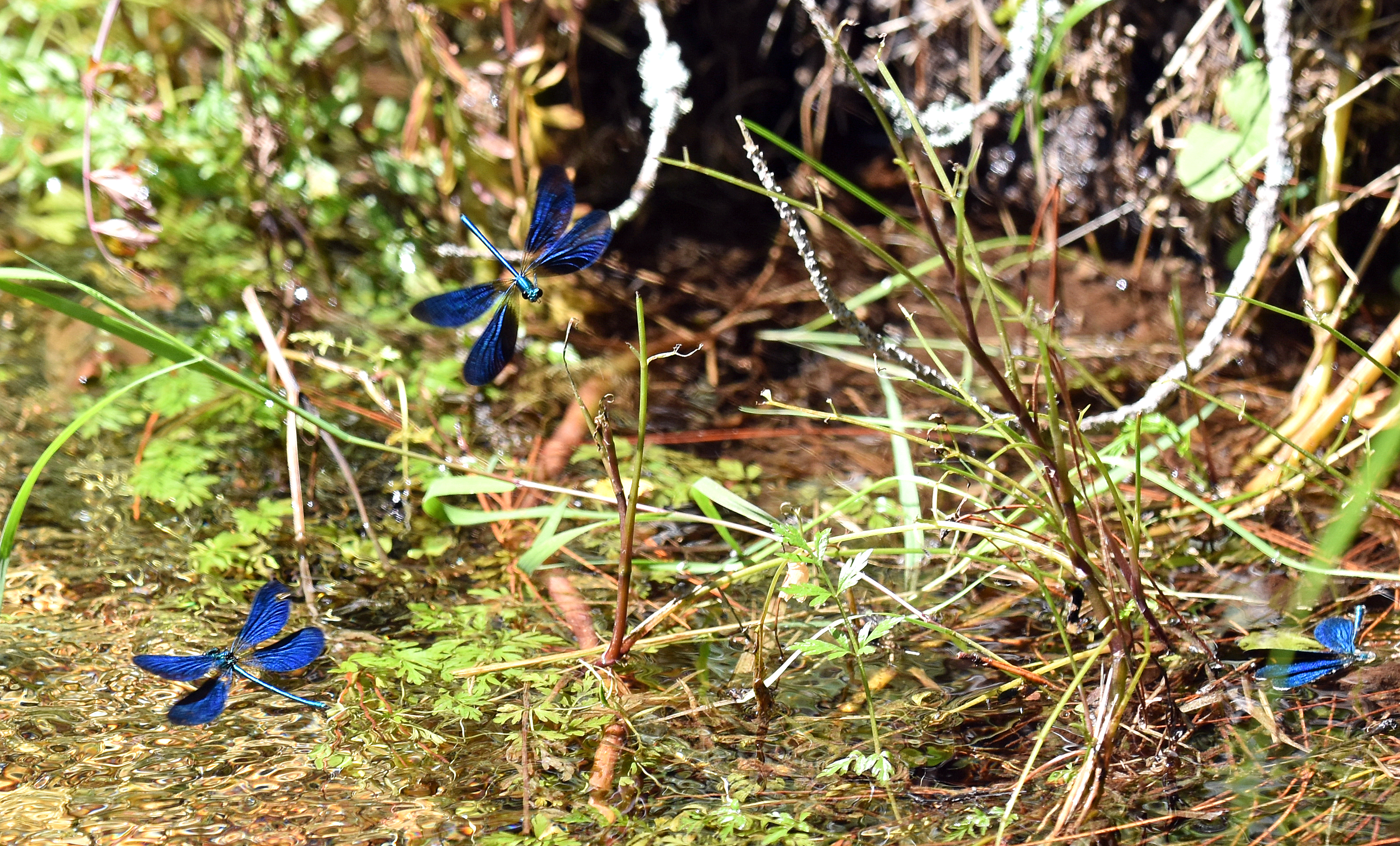
In Europe and the UK, non-territorial Calopteryx splendens males either: i) patrol over a large section of a river, with no particular attachment to any particular site, or ii) exhibit ‘satellite tactics’ where they focus on a selected area but do not own a territory and do not defend one.
The boundaries of the territories occupied by individual Calopteryx males are effectively marked out by special patrolling flights flown several times a day around the territory. There may also be a neutral zone, where adults of both sexes do not react to each other. A sort of ‘time out’ zone I suppose! Males usually have one preferred primary perch in their territory as well as several secondary ones.
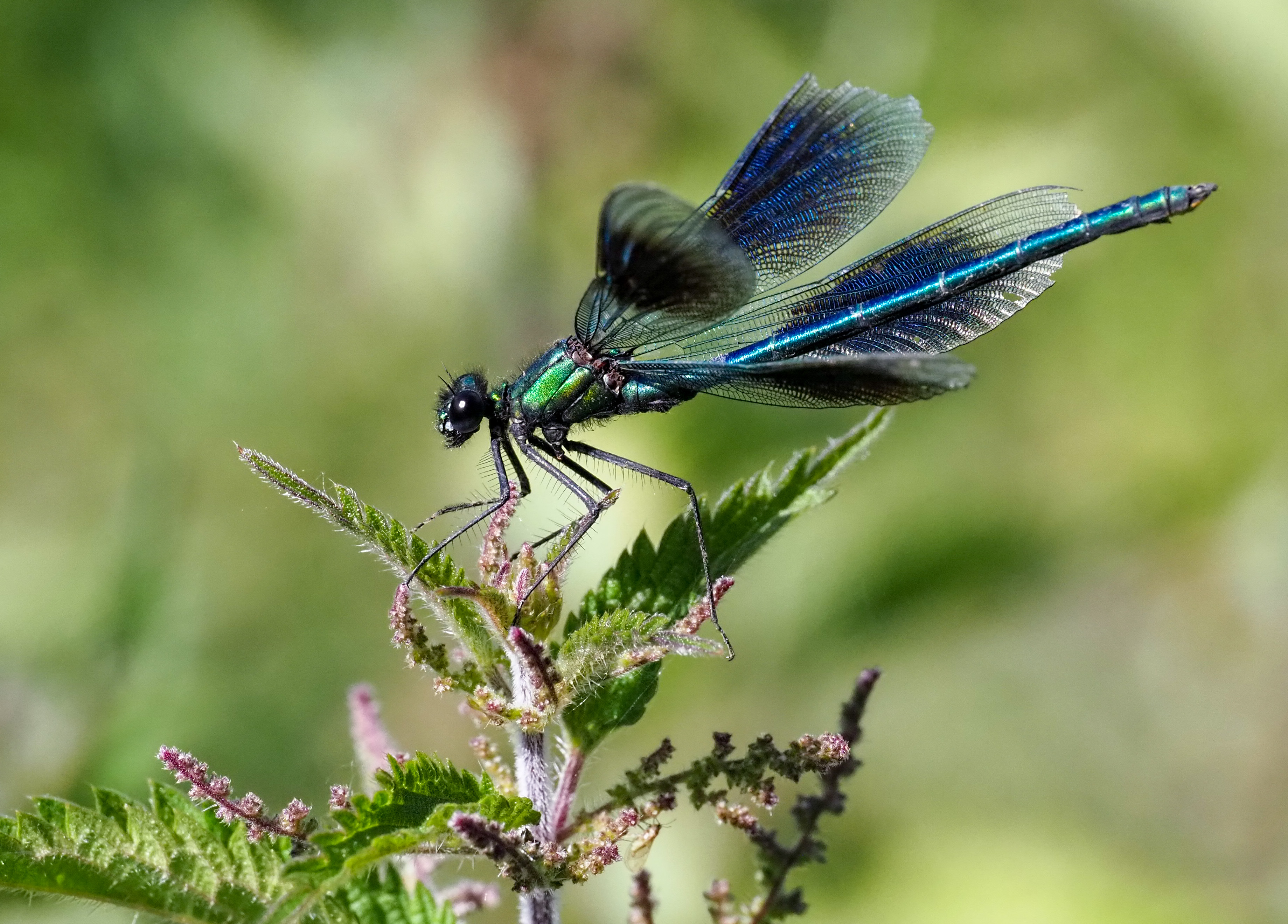
Cham (2020) described a situation when high numbers of C. splendens were concentrated into small areas of a stream as a result of low water levels. His photos show multiple males competing for prominent perches, like the C. virgo male shown below.
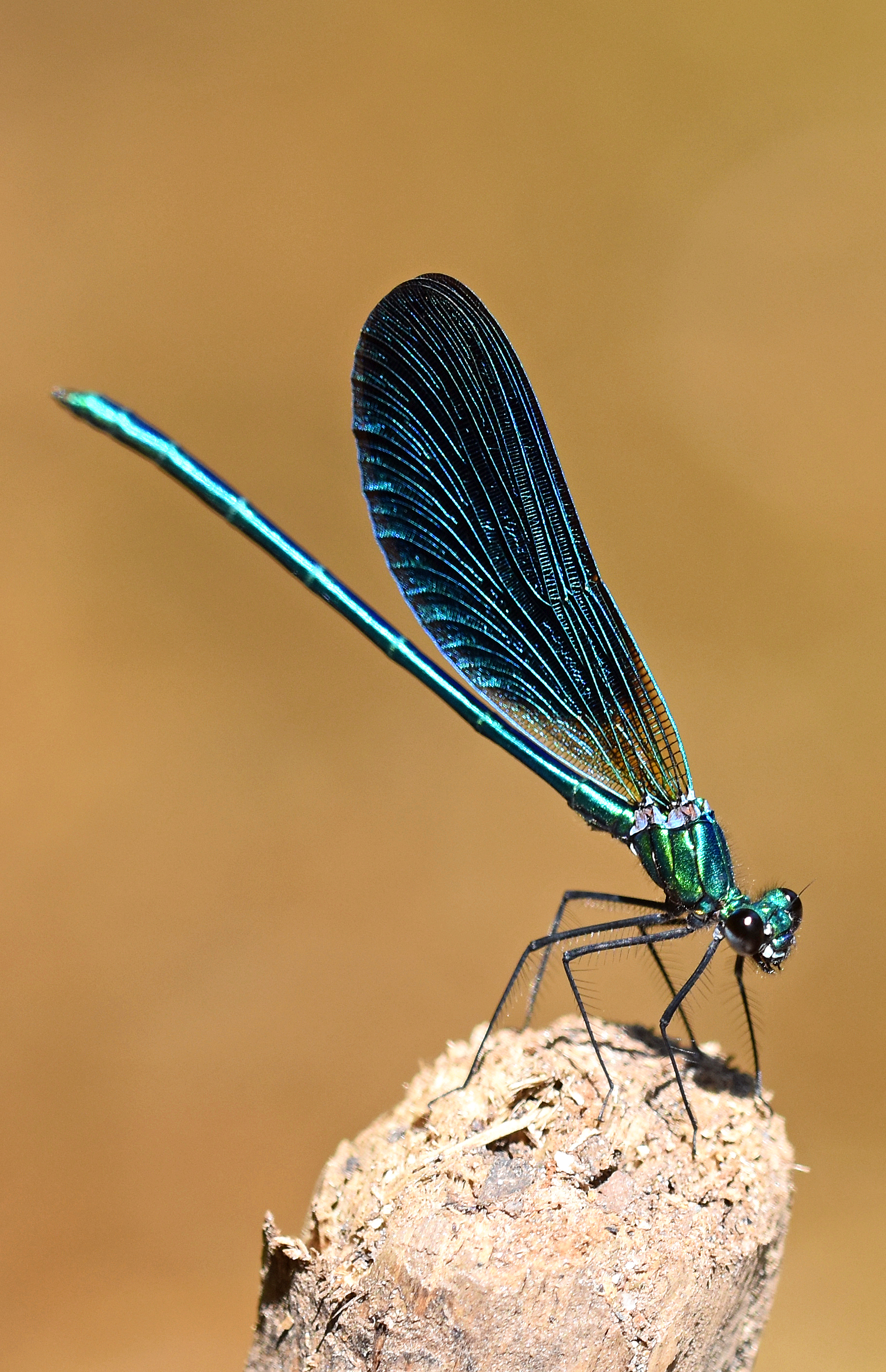
Males leave their territories at the end of the day and aggregate in roost sites somewhere along the riverbank. They usually sleep close together, sometimes less than a few centimetres apart, then return to their own territories in the morning!
Heymer (1972) observed three different types of territorial males:
i) those which quickly abandon their territories due to inclement weather;
ii) those that are regularly forced out by rivals and constantly shift territories, a result; and
iii) those that win contests with intruders and thereby hang onto their territories for a long time.
Territorial males of both Calopteryx splendens and C. virgo usually defend a clump of floating vegetation, i.e. the egg laying substrate (see below) against all other male intruders, by a combination of display flights, active chasing, or fighting.
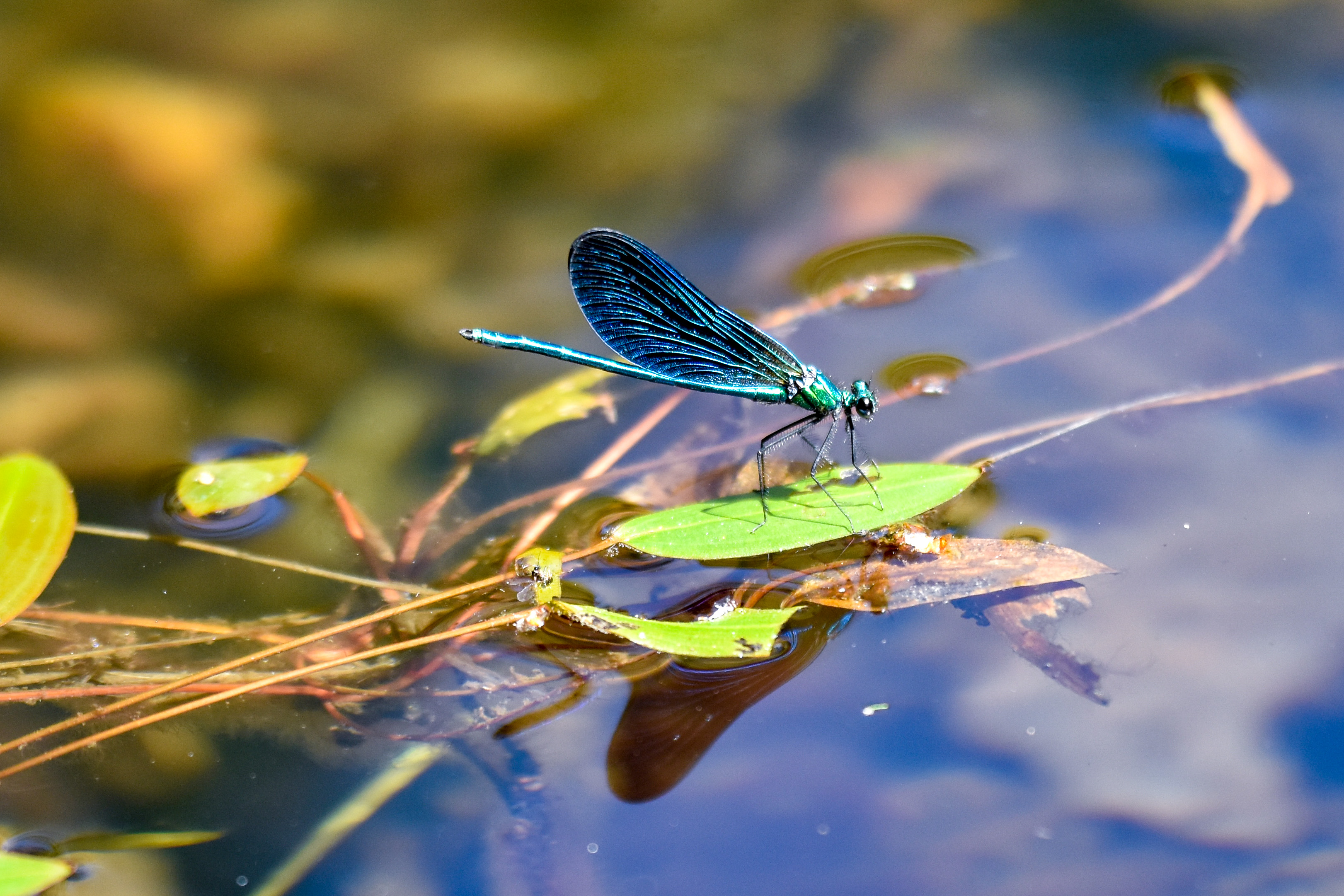
Demoiselle territories are usually highly localized. For example, at a study site in southern Poland, Calopteryx splendens territories varied in size from 0.5 to 2.0 m2 (Golab et al., 2017).
It was originally thought that male calopterygids could not distinguish mates from non-mates who are ovipositing on their territories. I.e. a male did not know whether the female laying her eggs in his territory was one he had mated with or not! However, a study by Hooper (1995) suggested otherwise: males of Calopteryx splendens xanthostoma can apparently discriminate visually between mates and non-mates on their territories, possibly by recognising the pigmented pterostigma on the wings of females. Whether this applies to all Demoiselles, I don’t know. Nice to think they know who they ‘slept with’!
Aggression
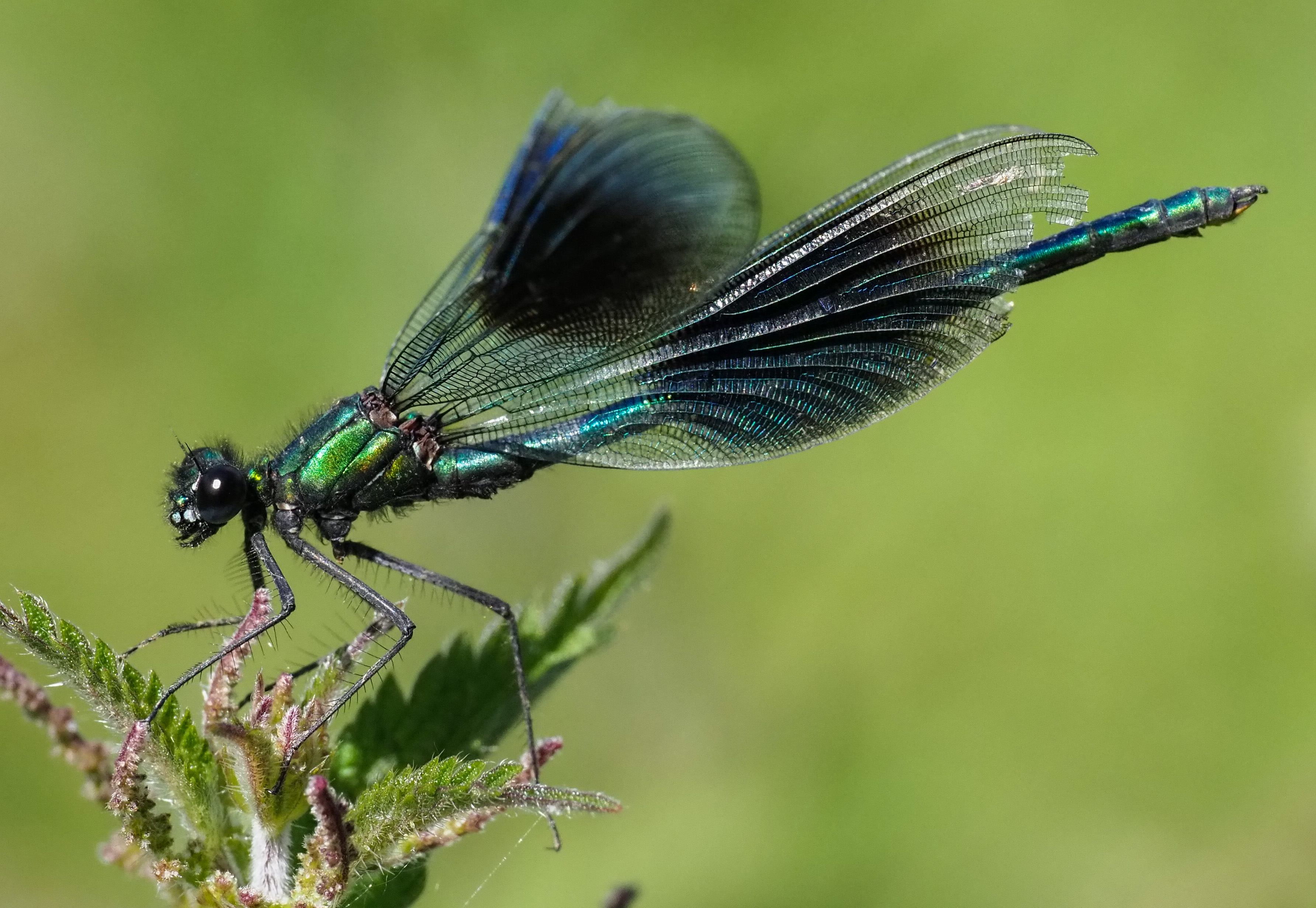
Despite being dainty little damselflies with charming names, male demoiselles regularly take chucks out of each other! However, this usually only happens at higher population densities when the normal territorial system breaks down (see Cham, 2020). At lower levels of crowding, males compete with each other via wing displays, and one male typically gives way.
21 June 24
In fights involving Calopteryx splendens males, which occur at high population densities when territoriality breaks down, frequent biting can occur. Opponents grasp each other in flight and try to bite one another’s body, wings, or extremities. They grapple with each other using their legs, and once they get a grip, they are able to bite each other.
Courtship and mating
Observations of courtship behaviour in C. splendens xanthostoma in France showed that males carried out a characteristic hovering flight around the perched female, predominately using just their forewings (Plaistow, 1997). The hindwings were held relatively stationary and away from the body in a distinctive ‘cross display’. Males also threw themselves onto the water surface and floated with the current, all the while continuing to hold their hindwings outstretched.
In Calopteryx haemorrhoidalis, courtship commences with a round dance that the males and females perform together on the water surface of the egg-laying site within the territory. The subsequent courtship flight is somewhat similar in all four Western European Calopteryx species. The male lands on the wing tips of the female, then runs quickly along the leading edge of the wing before attaching the abdominal pincers in the prothorax pits of the female (Heymer, 1973). In other words, they form a tandem.
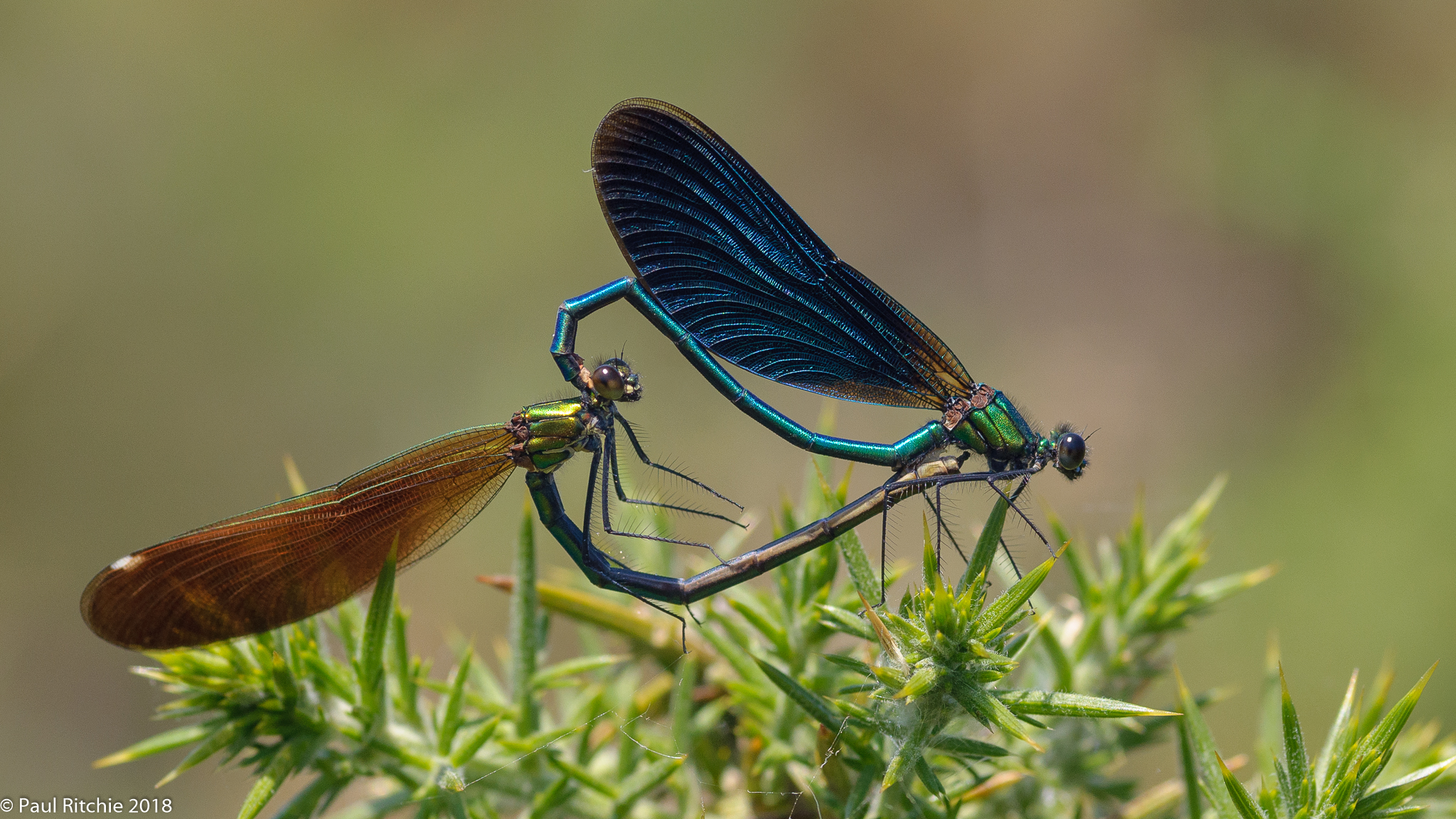
Territorial males of the Spanish subspecies Calopteryx haemorrhoidalis asturica, court females using a cross display and/or a courtship arc (Yu et al., 2024). The males fly in an arc around and in front of the perched female – mainly using their forewings – or they can land on the surface of the water, or a substrate, to perform a cross display, with the abdominal tip bent upwards to reveal the pink colouration.
In Calopteryx splendens, females not only choose males who have more wing pigmentation (below) but also those that can defend a territory by a flowing river with oviposition plant substrates.
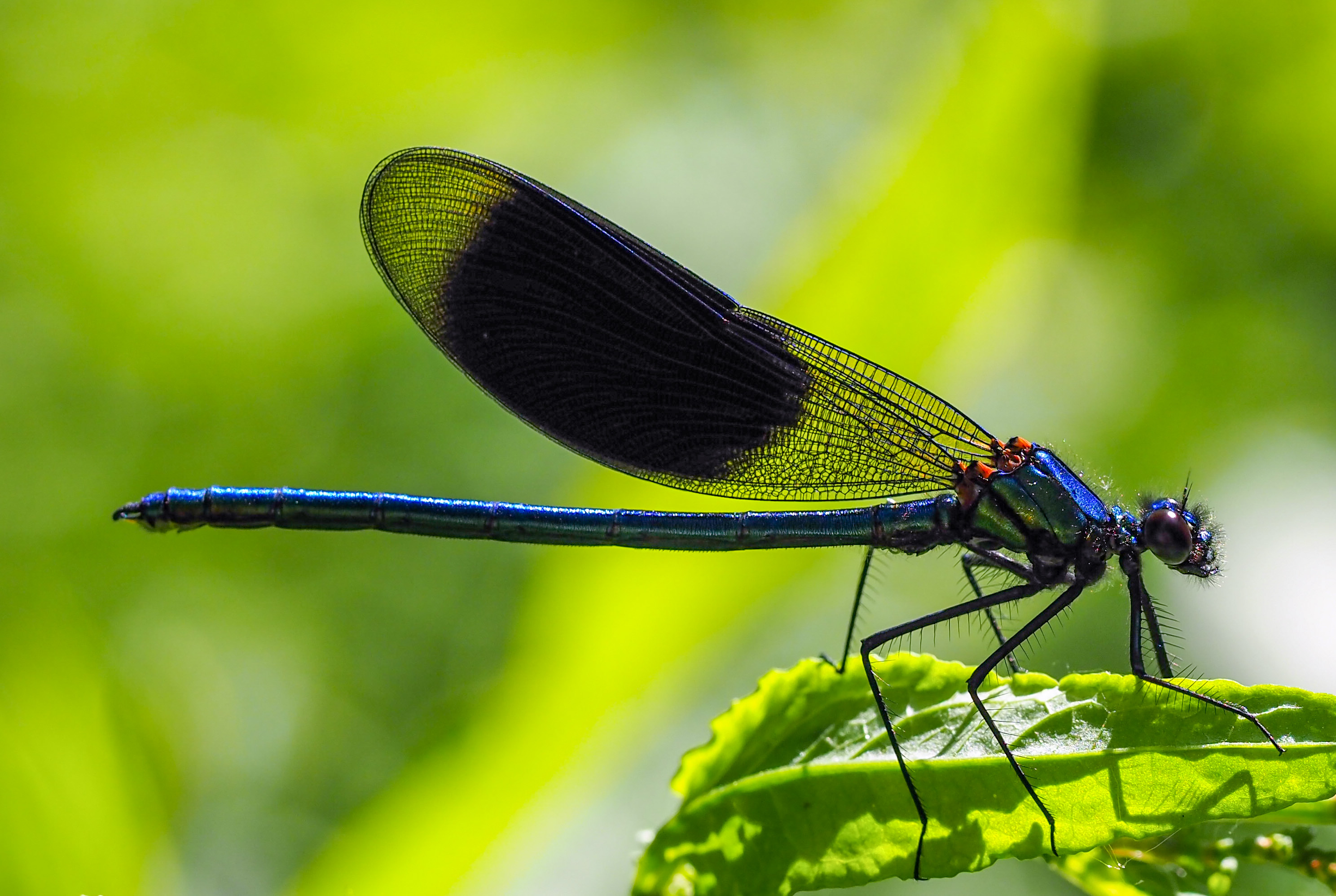
Photo by Raymond JC Cannon
Calopterygids have relatively short copulations, ranging from one to five mins in duration, and most of this time is dedicated to sperm removal by the male before depositing his own sperm.
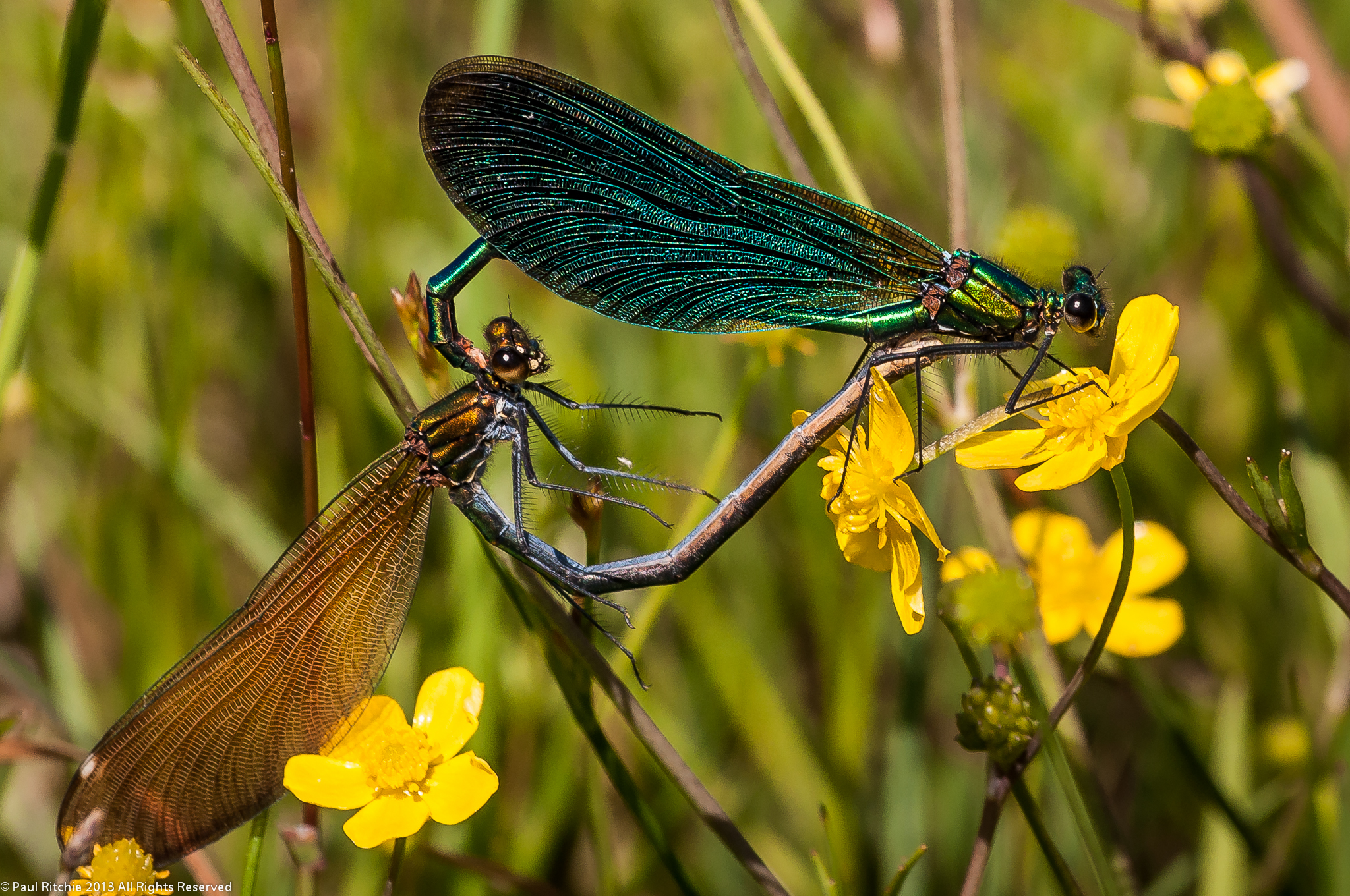
Once a female approaches a territory, the resident male starts to court her by showing her the quality of his territory by means of patrol flights and so-called dive displays: alighting on the water surface for a few seconds and changing his wing-beating frequency.
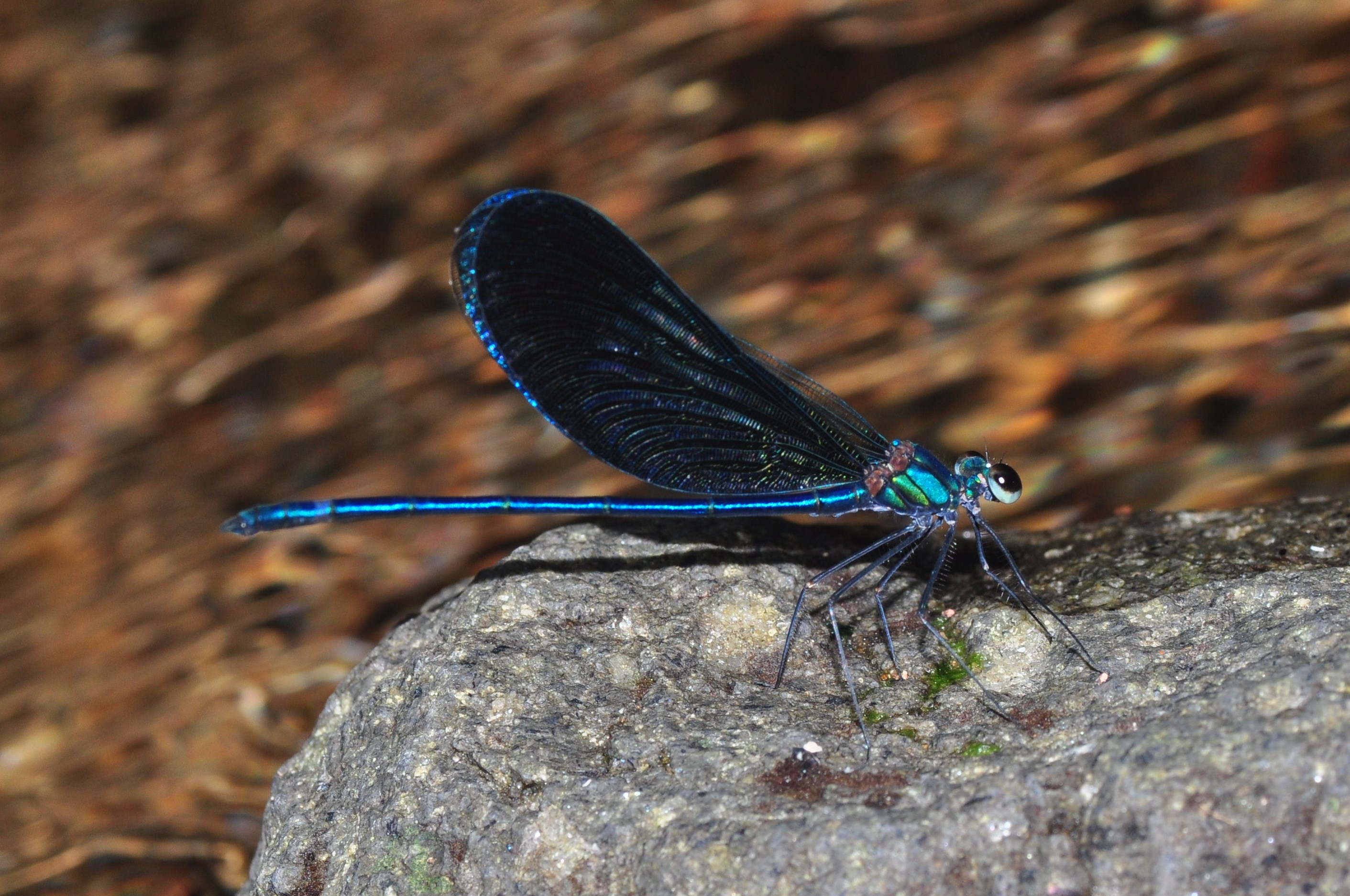
In the Asian Great Blue Metalwing, Neurobasis kaupi (below), during courtship, the male shows the oviposition site to the female prior to copulation by touching the water surface with his hindwing tips. This creates a visible wake, and the female then joins in the testing of current by trailing her legs in the water.
Female refusal behaviour
The behaviour of demoiselles often changes markedly when population densities are high. For example, at low male densities, when things are not too crowded, courting males – of three European species, Calopteryx splendens, C. haemorrhoidalis and C. xanthostoma – can be temporarily refused by ovipositing females by simply clapping their wings open and shut. However, at higher densities, when there may be as many as six males along a 10m stretch of river bank, females do not exhibit any wing clapping but flie immediately from any males pursuing them.
When a C. splendens male approaches a female she usually claps her wings open and shut, as a refusal signal, and then takes off. However, if the male retreats, the female may come to rest on a nearby perch and eventually accepts mating. These sequences, of female resistance followed by acceptance, have been interpreted as the female testing, or evaluating the male in some way, a behaviour not uncommon in insects.
There are a series of excellent videos of Demoiselle behaviour in the paper by Rüppell & Hilfert-Rüppell (2014) in the International Journal of Odonatology which is licensed under a Creative Commons Attribution-NonCommercial-NoDerivatives 4.0 International License.
Calopteryx splendens – female wing clapping, male retreating:-
Calopteryx splendens – female escape by male quarrelling:-
At high densities, territorial behaviour in Calopteryx species is replaced by alternative reproductive behaviour. Pursuing males often impede each other whilst displaying their wings, and females can easily escape. But if numbers get so high that they cannot retreat, females are seized and brought to copulation.
Cham (2020) found that as population densities increased and resources decreased, male Calopteryx splendens gave up on trying to defend their territories and adopted alternative, non-territorial strategies.
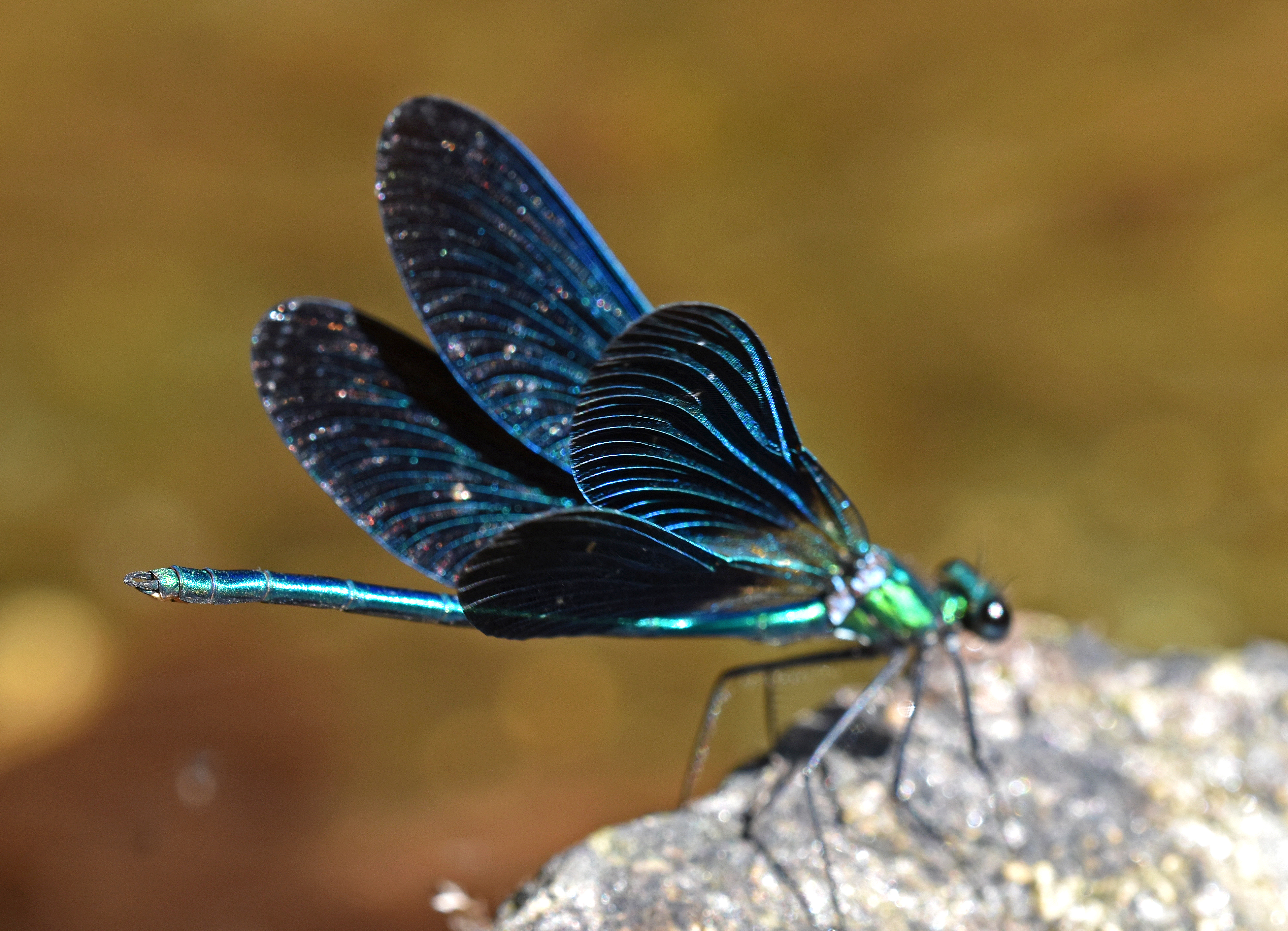
Photo by Raymond JC Cannon
Predation
The chromatic component of their wing colouration makes male Demoiselles highly apparent to a predator, but not necessarily visible to their prey, mainly flies. However, the female wing colouration is more cryptic, both to predators and prey, and also to male damselflies. The fact that the females are harder to spot by conspecifics is thought to reduce harassment by males.
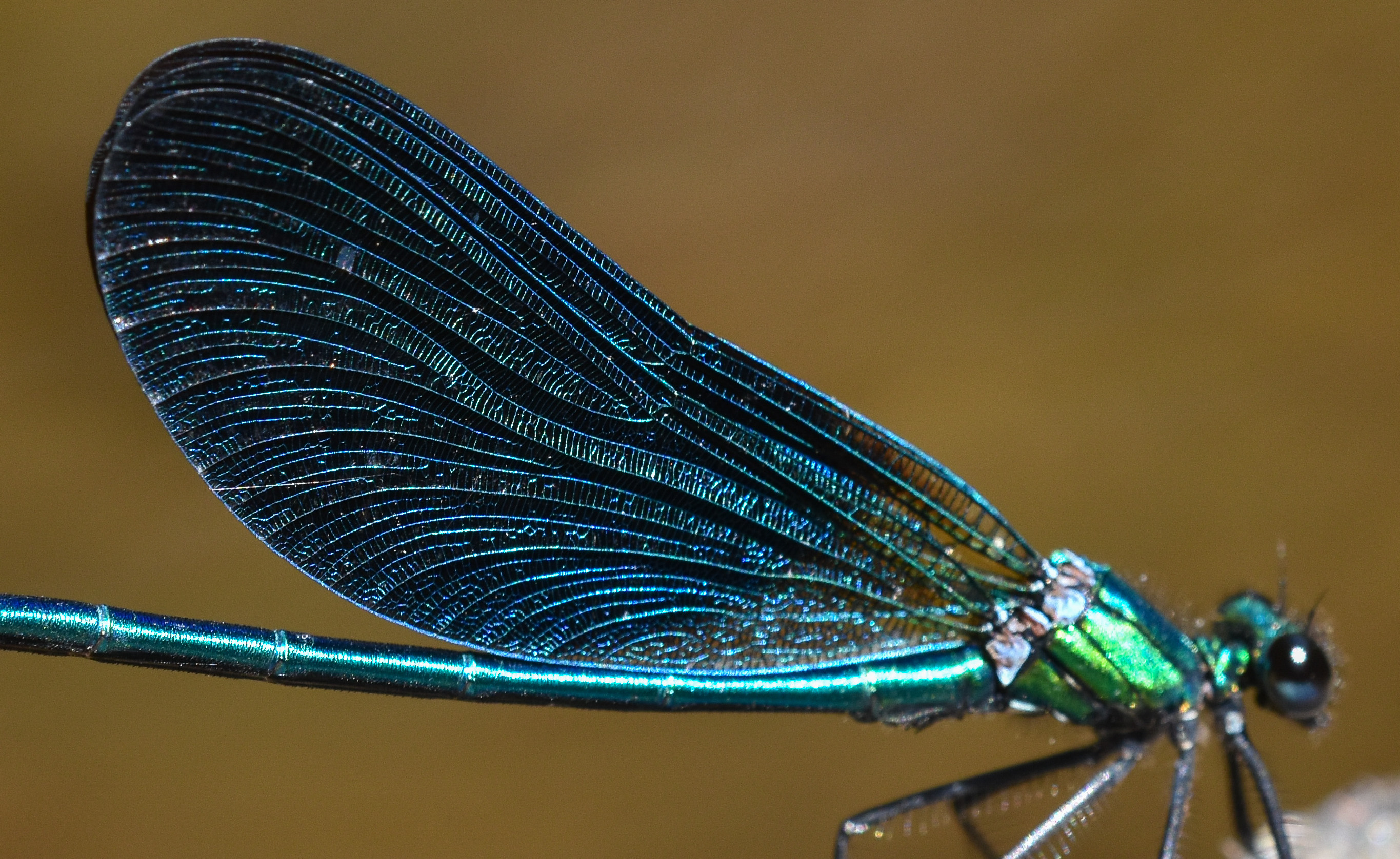
Photo by Raymond JC Cannon
Males of Calopteryx splendens with wings that have narrower pigmented colour patches were less predated by birds. This implies that colourful ornamentation is costly, and the risk of predation is much higher for C. virgo (above), which has a greater degree of wing melanisation.
A male who sports a costly ornament (i.e. coloured wings) is, in effect, demonstrating that he is a high-quality individual able to bear the costs of displaying and the risks of predation, and is therefore an excellent potential partner!
“males are paying a large cost in terms of conspicuousness, while females remain mostly cryptic” (Outomuro and Johansson, 2015).
Wagtails (genus Motacilla) are avian predators of C. splendens in some regions, often capturing them in flight and removing the wings prior to consumption.
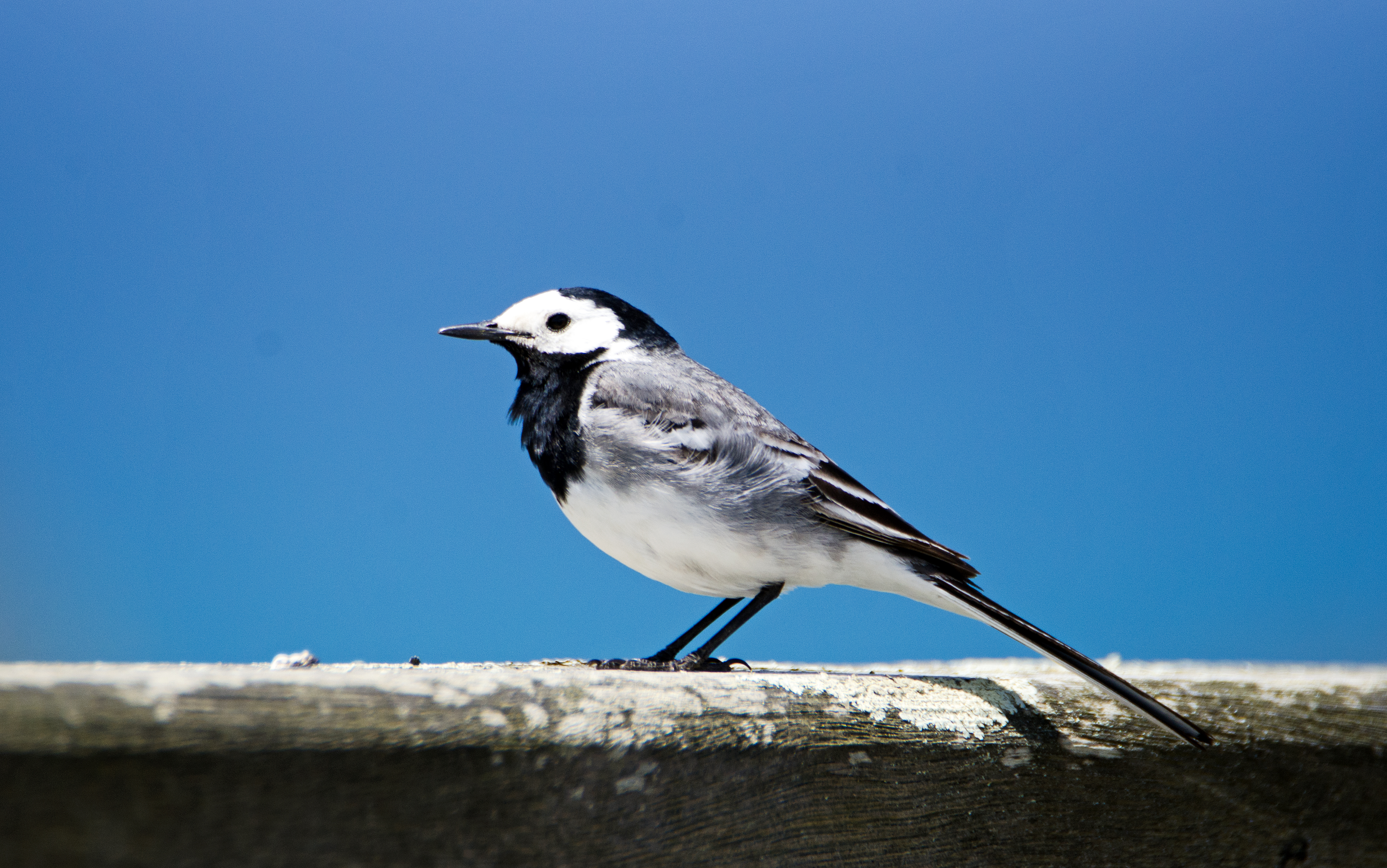
Photo by Raymond JC Cannon
Flight
Demoiselles flap all four wings up and down at the same time during normal straight flights. However, they can also hold all four or two wings still for a moment, or even just one wing. Furthermore, during courtship flights, they switch to a completely different flight style, high-frequency, and out of phase.
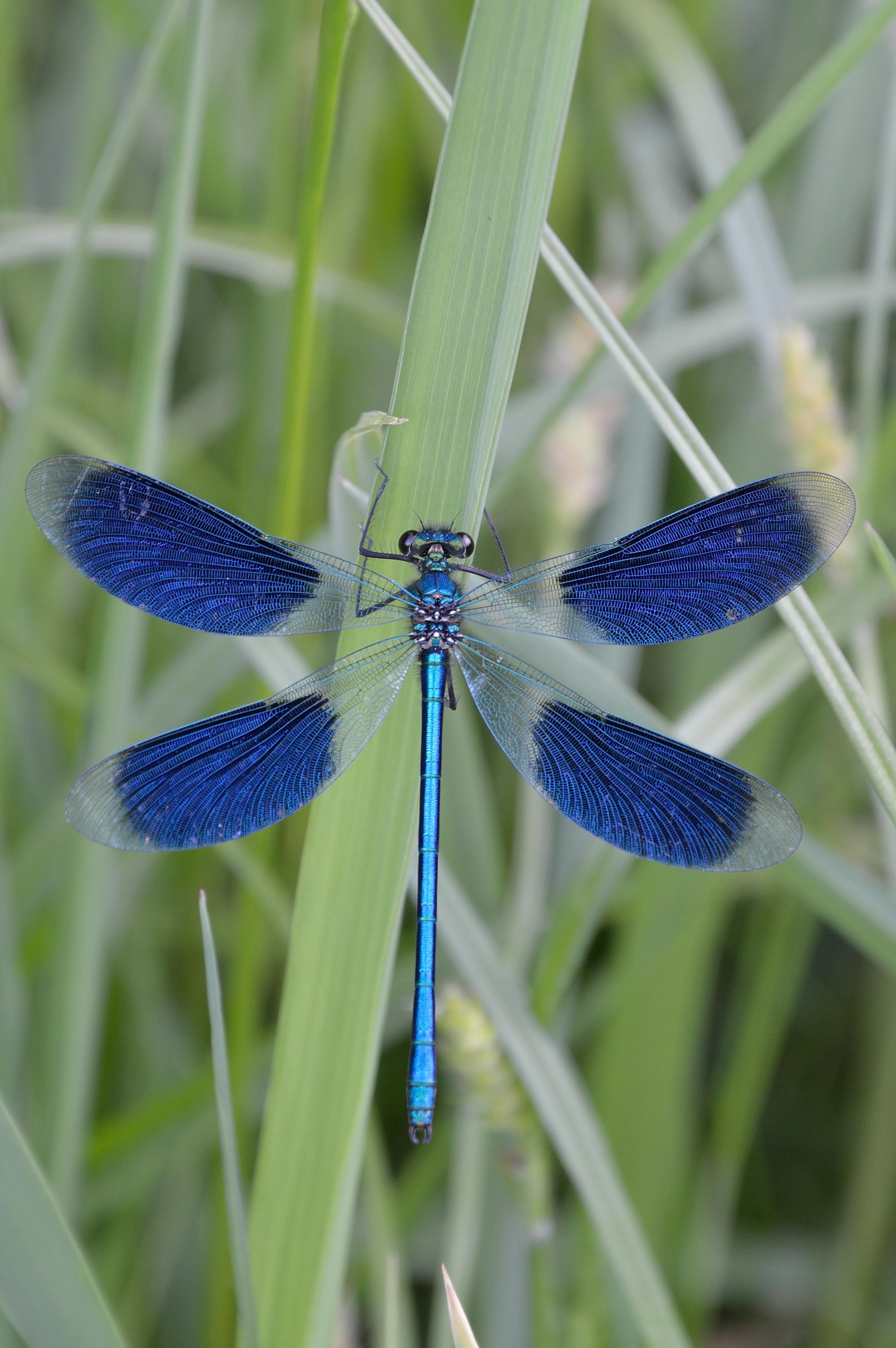
As described above, male Calopteryx damselflies are usually able to grasp the female and form a precopulatory tandem, and the females may have little option but to mate when grabbed by the neck in this way. The tandem pair usually proceed with copulation. However, females are very agile and are often able to escape from chasing males; they are also a little larger, with longer wings.
Oviposition
Male Calopteryx splendens raise the distal (end) segments of their abdomen to reveal a prominent light cream coloured underside to visiting females. This is a signal that this is a suitable place to oviposit. After copulation in C. splendens, females are usually accompanied either in tandem or at a close distance by the male, whilst they lay their eggs (Cordoba-Aguilar, 2015).
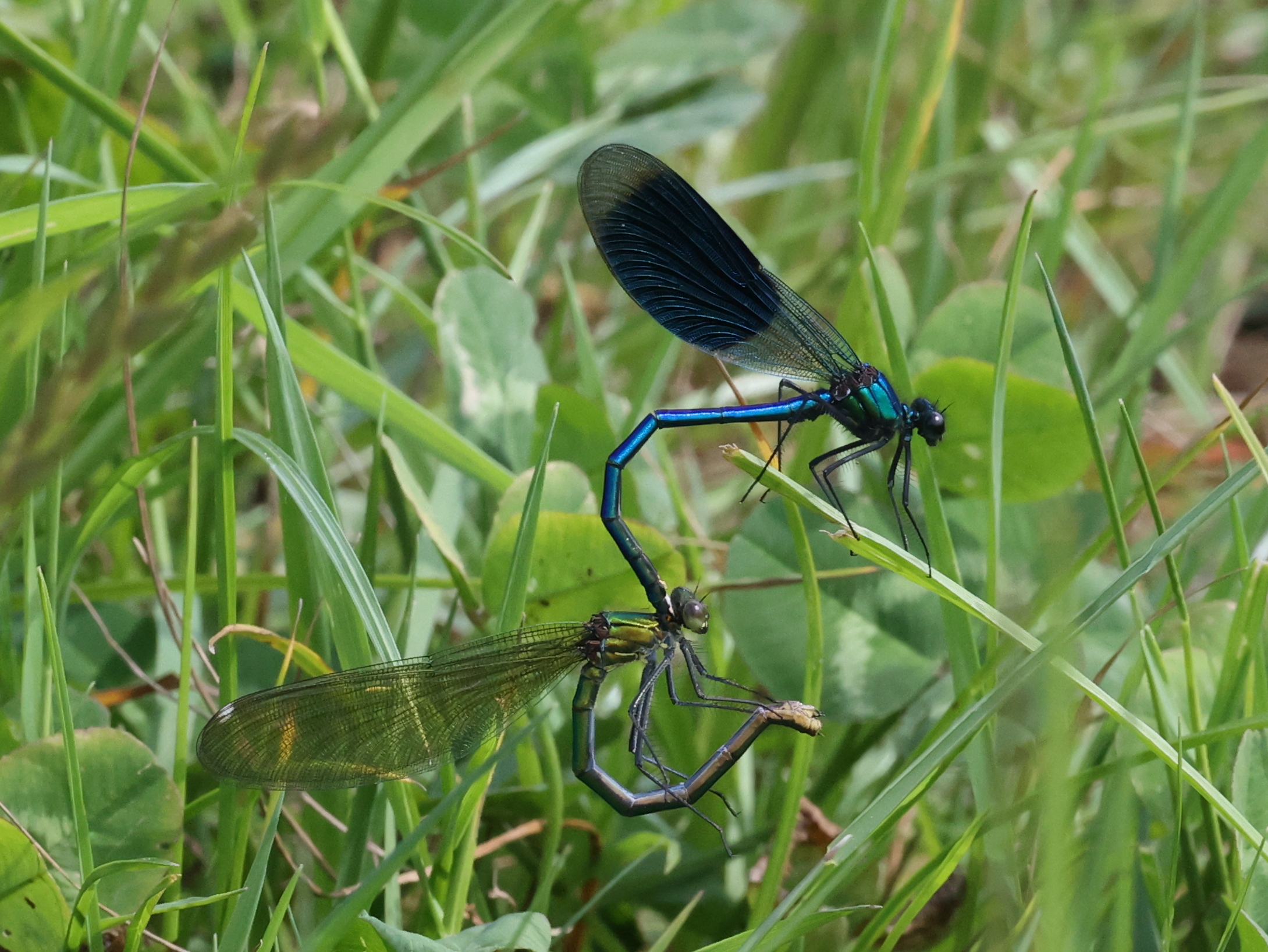
Non-territorial C. splendens males swoop down from a perch and attempt to grab females that are ovipositing on territories defended by other males (Plaistow, 1997). They exhibit no courtship display towards females, and the tactic is generally unsuccessful, with the resident, territorial male chasing off the intruding male. However, on the few occasions when non-territorial males are successful in getting a female in tandem, copulation takes place in bank-side vegetation, after which the females return to the territory from which they had been abducted (Plaistow, 1997).
Courtship is not easy to photograph, especially as the behaviour usually happens over water. Nevertheless, there are a wide variety of subtle behaviours exhibited by Demoiselles which photographers may like to try and capture. I know that, God willing, I will be out and about, roaming the banks of streams and rivers later this year, looking for opportunities to observe and record these fascinating insects.
References
Cham, S. Observations of male aggression in Calopteryx splendens (Harris)(Banded Demoiselle) and territorial behaviour at high population density. Journal of the British Dragonfly Society, 44.
Chaput-Bardy, A., Gregoire, A., Baguette, M., Pagano, A., & Secondi, J. (2010). Condition and phenotype-dependent dispersal in a damselfly, Calopteryx splendens. PloS one, 5(5), e10694.
Córdoba-Aguilar A (2000) Reproductive behaviour of the territorial damselfly Calopteryx haemorrhoidalis asturica Ocharan (Zygoptera: Calopterygidae). Odonatologica 29(4):295–305.
Córdoba-Aguilar A (2002) Wing pigmentation in territorial male damselflies, Calopteryx haemorrhoidalis: a possible relation to sexual selection. Animal Behaviour 63, 759–766.
Córdoba-Aguilar, A., & Cordero-Rivera, A. (2005). Evolution and ecology of Calopterygidae (Zygoptera: Odonata): status of knowledge and research perspectives. Neotropical entomology, 34, 861-879.
Golab, M. J., & Brodin, T. (2024). Looks or personality: what drives damselfly male mating success in the wild?. The European Zoological Journal, 91(1), 81-93.
Golab, M. J., Gołąb, P. A., Contreras-Garduño, J., Zając, T., & Sniegula, S. (2017). The effects of habitat deterioration and social status on patrolling behavior in the territorial damselfly Calopteryx splendens. Polish Journal of Ecology, 65(1), 122-131.
Golab, M. J., Sniegula, S., & Brodin, T. (2022). Cross-latitude behavioural axis in an adult damselfly Calopteryx splendens (Harris, 1780). Insects, 13(4), 342.
Gomez-Llano, M. A., Bensch, H. M., & Svensson, E. I. (2018). Sexual conflict and ecology: species composition and male density interact to reduce male mating harassment and increase female survival. Evolution, 72(4), 906-915.
Heymer, A. (1972). Social and Territorial Behavior of Calopterygidae [Odon. Zygoptera]. In Annals of the Entomological Society of France (NS) (Vol. 8, No. 1, pp. 3-53). Taylor & Francis.
Heymer, A. (1973). Étude du Comportement Reproducteur et Analyse des Mécanismes Déclencheurs Innés (Mdi) Optiques chez les Calopterygidae [Odon. Zygoptera]. In Annales de la Société entomologique de France (NS) (Vol. 9, No. 1, pp. 219-255). Taylor & Francis.
Hilfert-Rueppell, D., & Rueppell, G. (2009). Males do not catch up with females in pursuing flight in Calopteryx splendens (Odonata: Calopterygidae). International Journal of Odonatology, 12(2), 195-203.
Hooper, R.E. (1995). Individual recognition of mates and non-mates by male Calopteryx splendens xanthostoma (Charpentier)(Zygoptera: Calopterygidae). Odonatologica, 24 (3), 347-352.
Karjalainen, S., & Hämäläinen, M. (2013). Demoiselle damselflies-winged jewels of silvery streams. Caloptera, Helsinki.
Kuchta, S. R., & Svensson, E. I. (2014). Predator-mediated natural selection on the wings of the damselfly Calopteryx splendens: differences in selection among trait types. The American Naturalist, 184(1), 91-109.
Opaev, A. S., & Panov, E. N. (2016a). Space use in territorial and non-territorial male Calopteryx splendens (Odonata: Calopterygidae). Odonatologica, 45(1/2), 57-76.
Opaev, A. S., & Panov, E. N. (2016b). Variations of space use in males of the banded demoiselle (Calopteryx splendens, Zygoptera, Odonata): Alternative tactics or an age-dependent trend?. Entomological Review, 96, 525-536.
Outomuro, D., & Johansson, F. (2015). Bird predation selects for wing shape and coloration in a damselfly. Journal of Evolutionary Biology, 28(4), 791-799.
Outomuro, D., & Ocharan, F.J. (2006). Bites and wing damage as a result of territorial combat in Calopteryx (Odonata: Calopterygidae). Bulletin of the Aragonese Entomological Society , 39 , 421-422.
Outomuro, D., Söderquist, L., Johansson, F., Ödeen, A., & Nordström, K. (2017). The price of looking sexy: Visual ecology of a three‐level predator–prey system. Functional Ecology, 31(3), 707-718.
Outomuro, D., Torralba-Burrial, A., & Ocharan, F. J. (2010). Distribution of the Iberian Calopteryx damselflies and its relation with bioclimatic belts: Evolutionary and biogeographic implications. Journal of Insect Science, 10(1), 61.
Orr, A. G., & Hämäläinen, M. (2007). The metalwing demoiselles of the eastern tropics. Kota Kinabalu, Malaysia: Natural History Publications (Borneo). J. R. Soc. Interface, 7.
Panov, E. N., & Opaev, A. S. (2013). Behavior of males in a reproductive aggregation of the banded demoiselle Calopteryx splendens (Insecta, Odonata). Entomological review, 93, 805-813.
Plaistow, S. J. (1997). Variation in non-territorial behaviour in male Calopteryx splendens xanthostoma (Charpentier)(Zygoptera: Calopterygidae). Odonatologica, 26(2), 171-181.
Rüppell, G., & Hilfert-Rüppell, D. (2013). Biting in dragonfly fights. International Journal of Odonatology, 16(3), 219-229.
Rüppell, G., & Hilfert-Rüppell, D. (2014). Slow-motion analysis of female refusal behaviour in dragonflies. International Journal of Odonatology, 17(4), 199-215.
Rüppell, G., & Hilfert-Rüppell, D. (2019). Touching water by males of Calopteryx virgo L.(Insecta: Odonata) in threatening display. International Journal of Odonatology, 22(1), 31-36.
Rüppell, G., & Hilfert-Rüppell, D. (2023). Double function of flight in Calopteryx splendens (Odonata: Calopterygidae) males. International Journal of Odonatology, 26.
Rüppell, G., & Hilfert-Rüppell, D. (2024). Coloured Wings Beat Differently. In Dragonfly Behavior (pp. 42-46). Springer, Berlin, Heidelberg.
Sánchez-Guillén, R. A., Ceccarelli, S., Villalobos, F., Neupane, S., Rivas-Torres, A., Sanmartín-Villar, I., … & Cordero-Rivera, A. (2020). The evolutionary history of colour polymorphism in Ischnura damselflies (Odonata: Coenagrionidae). Odonatologica, 49(3-4), 333-370.
Svensson, E. I., & Friberg, M. (2007). Selective predation on wing morphology in sympatric damselflies. The American Naturalist, 170(1), 101-112.
Svensson, E. I., & Waller, J. T. (2013). Ecology and sexual selection: evolution of wing pigmentation in calopterygid damselflies in relation to latitude, sexual dimorphism, and speciation. The American Naturalist, 182(5), E174-E195.
 Ray Cannon's nature notes
Awesome photos. Great read 👍👍👍
Thank you Michael!😃
Thank you for providing fascinating insights into the amazing biology of damselflies. Brilliant photos and videos too.
Thank you Markus!😁