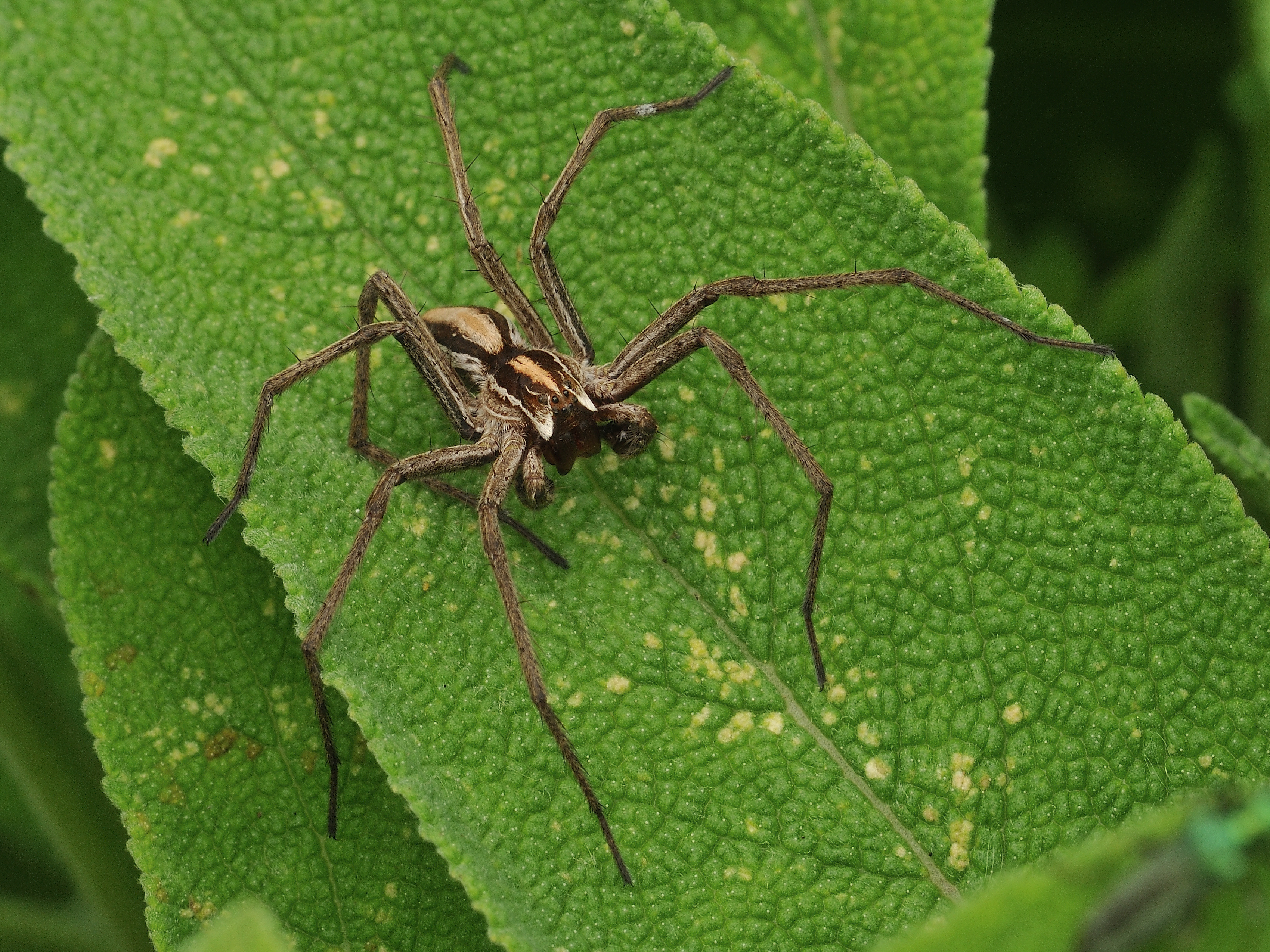
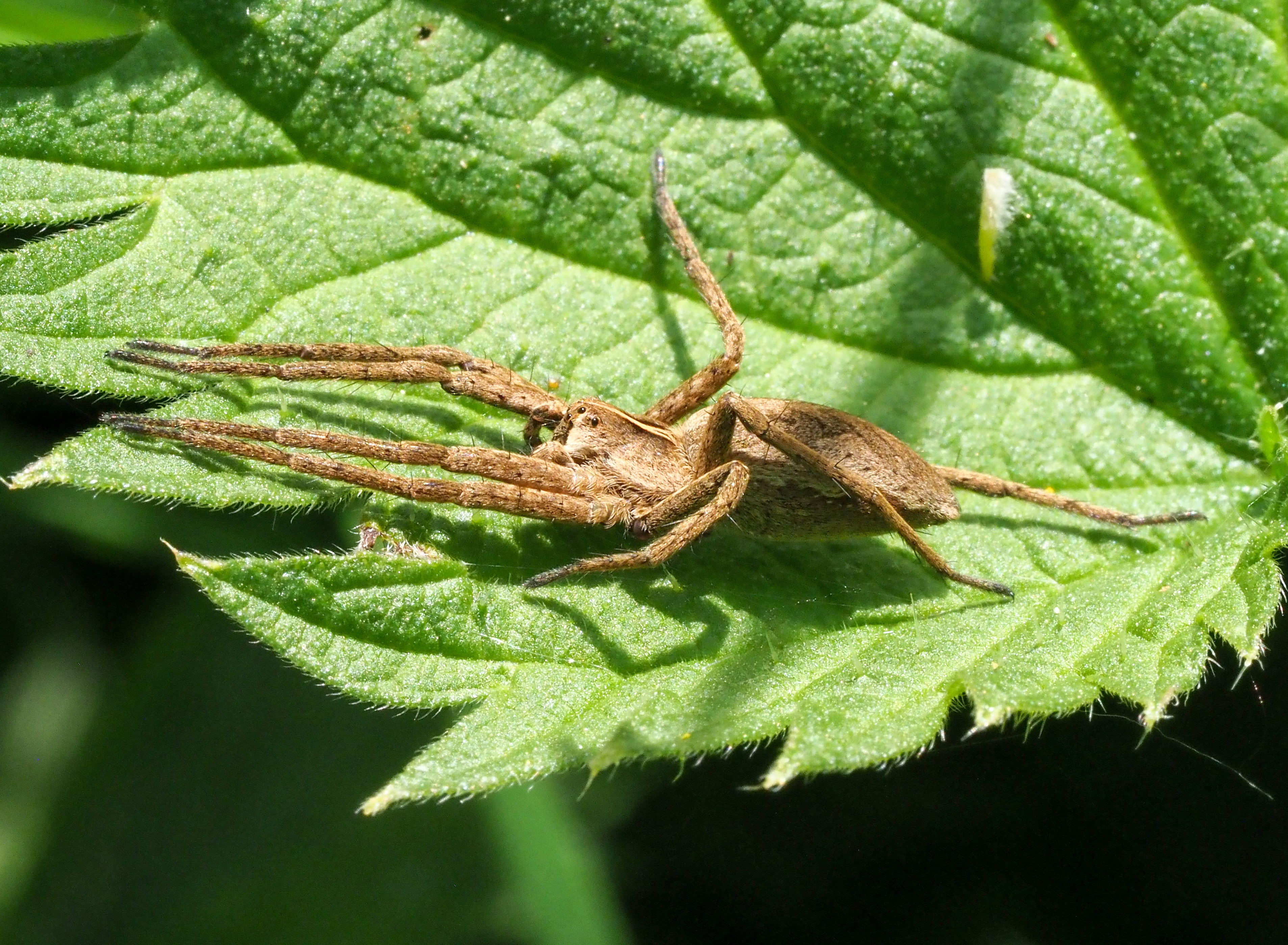
The nursery web spider Pisaura mirabilis is a species of the family Pisauridae, commonly occurring in deciduous forests, meadows, and abandoned grasslands. I have photographed these spiders many times over the years, but until I started to investigate their behaviour, I had no idea they were so interesting!
The sexes are about the same size in Pisaura mirabilis, but males have longer legs which they use to wrap the female’s legs with a silken thread, before and during copulation. They do not catch their prey in a web, but instead actively hunt for insects to eat, and in the male’s case, to give to the female.
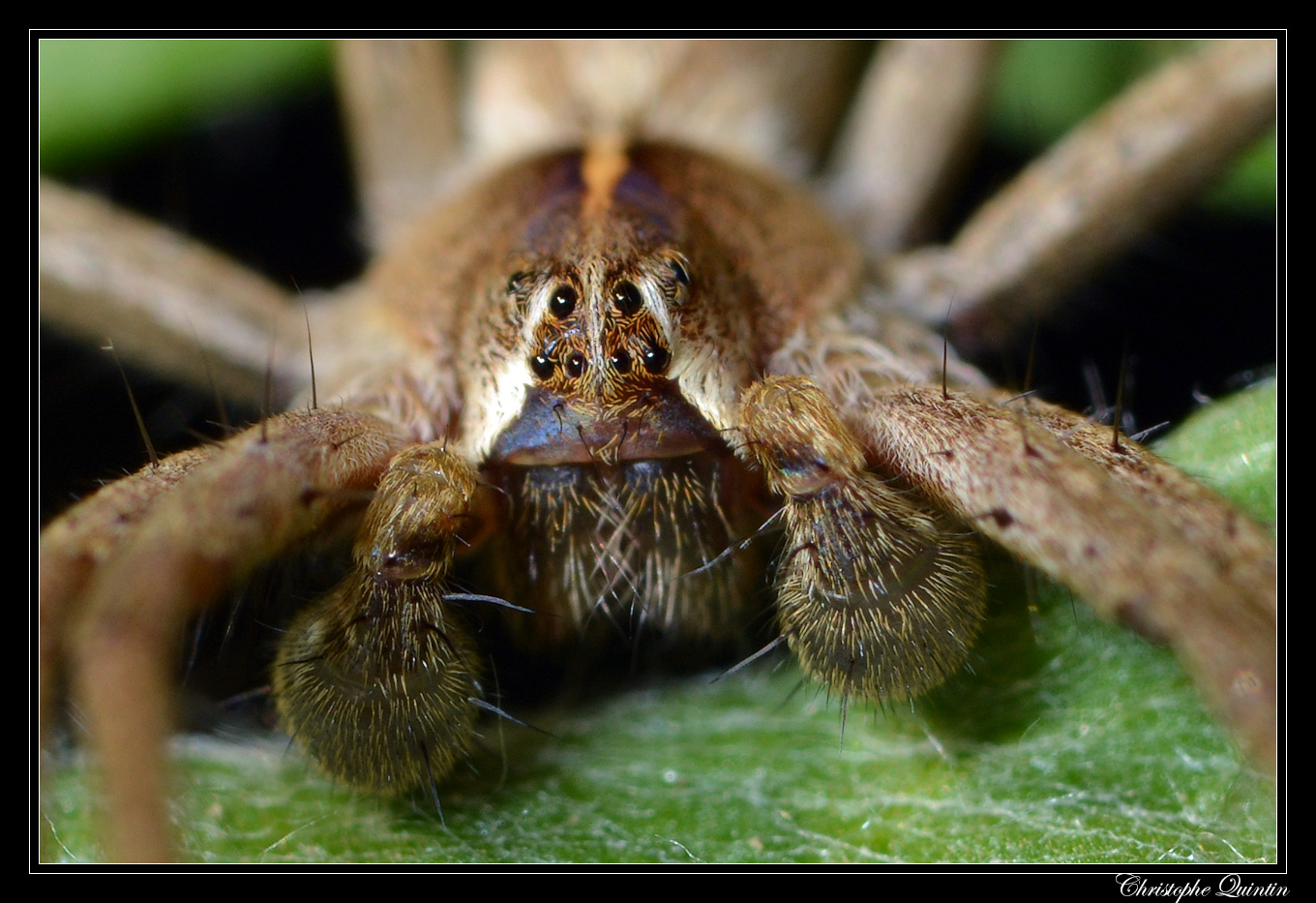
The males are readily separated from females by the presence of two enlarged pedipalps, or palpal bulbs, at the front of their head (see below).
For more pictures of the male, see here, and here.
Both sexes explore their habitats in the field, and can recognise and locate each other via silken draglines, which they deposit throughout the herbage as they move around.
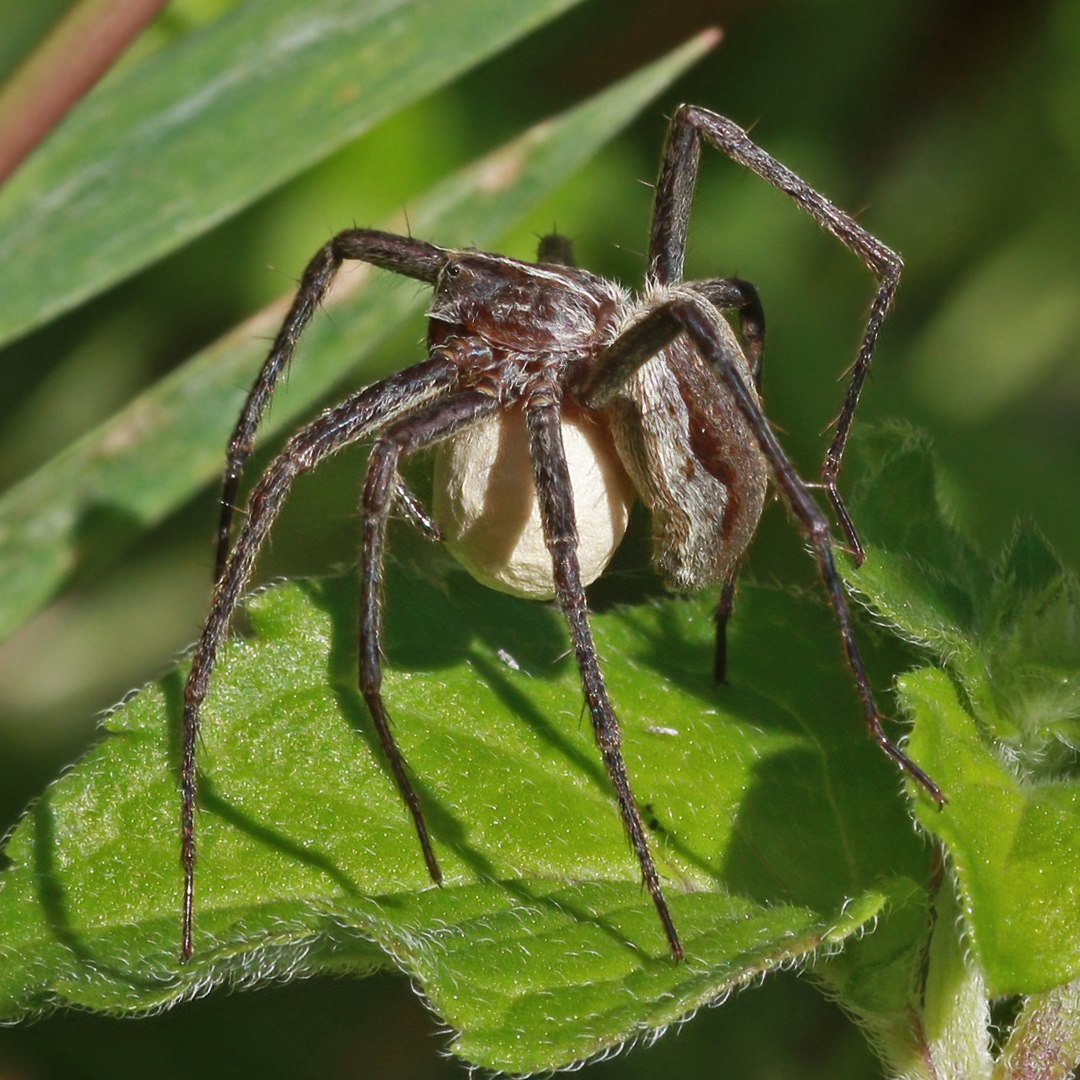
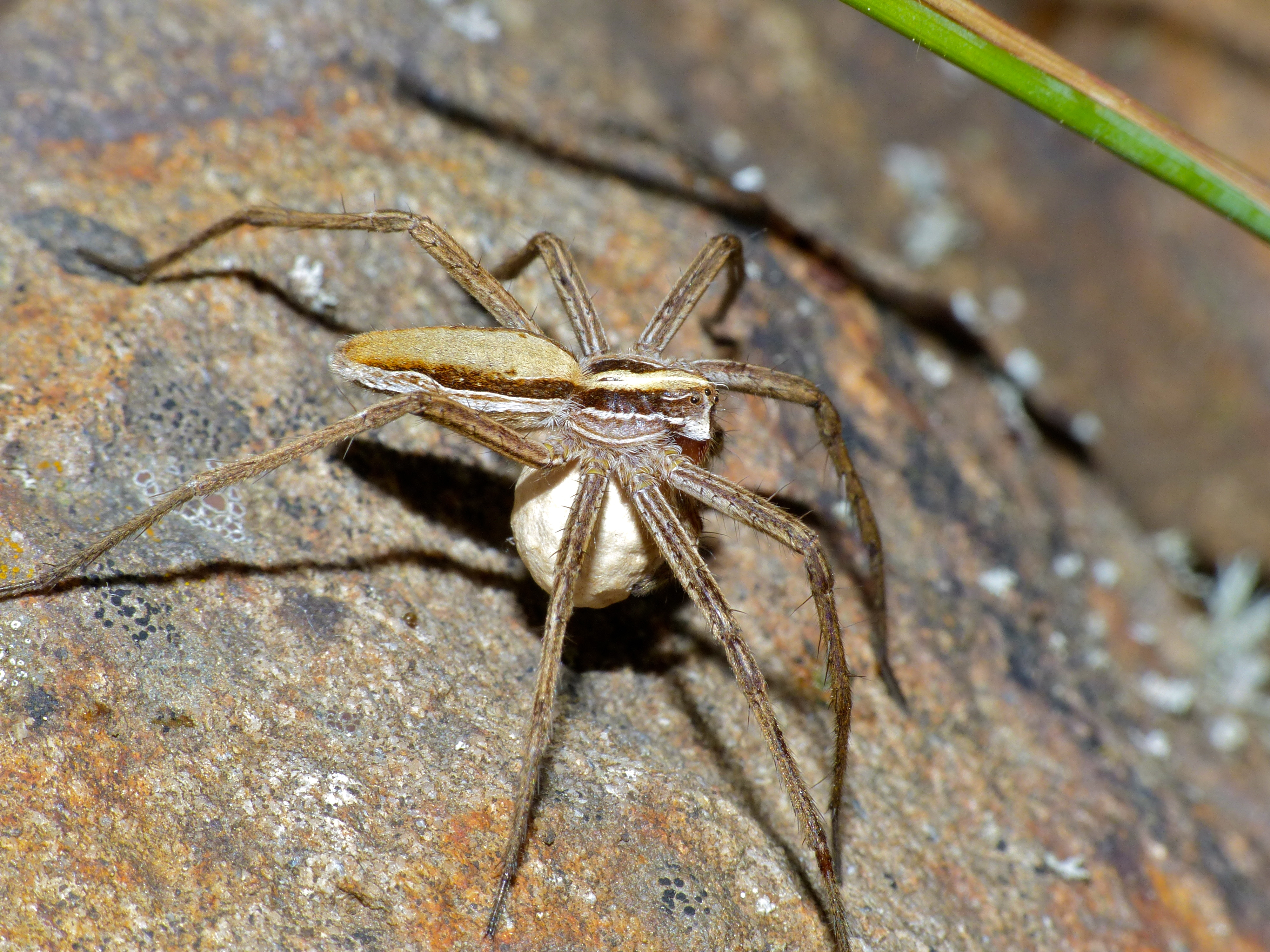
Soon after the males reach adulthood, they find and wrap a prey item in white silk and carry it around in their chelicerae, while searching for a mate. This is a distinct change in behaviour, so that instead of eating the prey the male wraps it up with silk, forming a white, round parcel. They only wrap the prey item after it has been paralysed.
The nuptial gift, being round and white, to some extent, resembles the female’s egg sac, and some scientists have hypothesised that as such, it functions as a sensory trap. In other words, the nuptial gift may trick the female into mating, because she acts instinctively, clutching at what may appear to her to be a white, round egg sac.
The brighter the gift, the faster the female spider responds to it. This may make the difference between mating or not, because if the female is slow to respond, another male may rush in and offer her his gift instead! The size of the wrapped gift does not seem to matter to the female, and in any case, she cannot see through the outer silken wrapper, so she has no idea of what is inside, or how nutritious it might be. In other species, both insects and spiders, males may present ‘worthless’ nuptial gifts with nothing inside!
However, presenting the female spider with a worthless (empty) gift, or no gift at all, is a risky strategy, as she might just eat you instead! Males bearing gifts were never cannibalised before mating, whereas 19% of females ate males without gifts (Toft & Albo, 2016).
Male nursery web spiders present their gifts to the females in a characteristic way, tilting their bodies vertically downwards with the spinnerets resting on the ground. This posture exposes the white gift against the dark brown underside of the male spider in a motionless display right in front of the female. The male leans backwards facing the female, effectively saying ‘look at this’!
A successful courtship concludes when the female accepts the gift, piercing the silk cover with her chelicerae, and eating the contents. While the female is eating, the male adopts the mating position and starts to transfer sperm, whilst also maintaining contact with the gift with a silk thread and one leg. Useful to have so many! The male uses the silk thread to maintain contact with the gift during mating, which apparently helps to prolong the copulation.
During mating, the male moves underneath the female and inserts either the right or the left pedipalp into the female genital opening for about 15 minutes on average. During courtship and mating, thanatosis (i.e. pretending to be dead) can sometimes occur if the female starts moving around. The male holds on to the nuptial gift with his chelicerae, and is dragged along in this position by the female!
Females are polyandrous and gain additional nutritional benefits from receiving more nuptial gifts as a result of mating multiple times. Both sexes are promiscuous in this species, i.e. males may mate several times with the same or different females, and females may mate several times with the same or different males.
The courtship and mating behaviour of this species have been thoroughly investigated in the laboratory, and it serves as a model species for investigating many aspects of mate choice and the evolution of nuptial gifts. However, there have been few published observations of this type of behaviour in the field. As is often the case, field observations of courtship and mating by insects and spiders are very difficult, if not impossible, to obtain, however dedicated the naturalist.
Sexually receptive females release silken draglines which contain pheromones that attract males. The female draglines advertise the presence of a receptive female looking to receive nuptial gifts and – subject to a successful courtship – copulate.
When male nursery spiders contact the silken dragline of a female – after searching with their pedipalps – they start to produce vibrational pulses by tremulating their opisthosoma. These tremulations, are short (ca. 0.2 s) low-frequency pulses (57 ± 1.5 Hz), repeated at regular intervals, starting with high amplitude and gradually attenuating (see below).
Pictures of nuptial gift giving, from the male to the female, can be seen on the iNaturalist page for this species. Very detailed descriptions of mating are given in Nitzsche (2011).
Flickr CC BY-SA 2.0
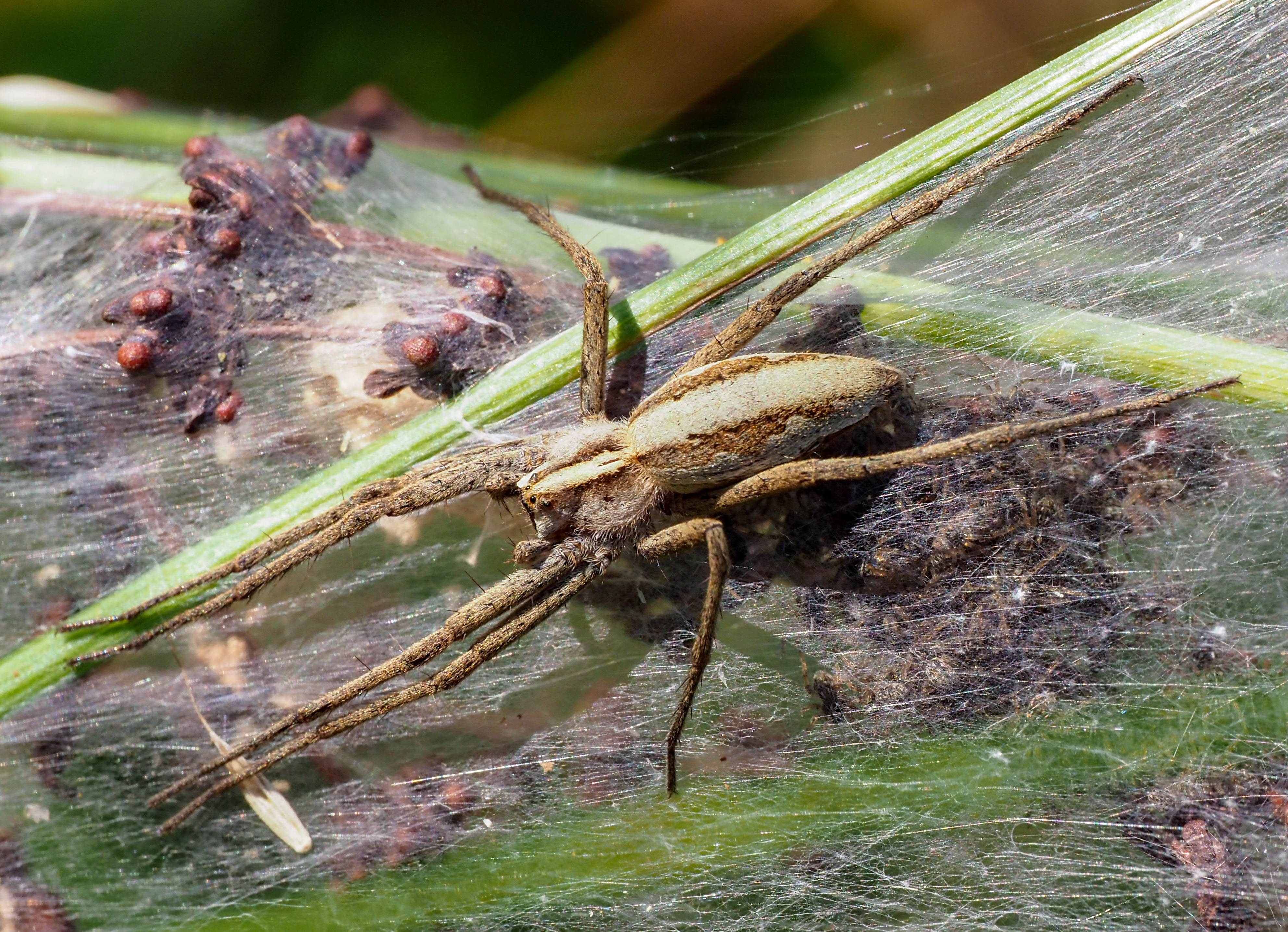
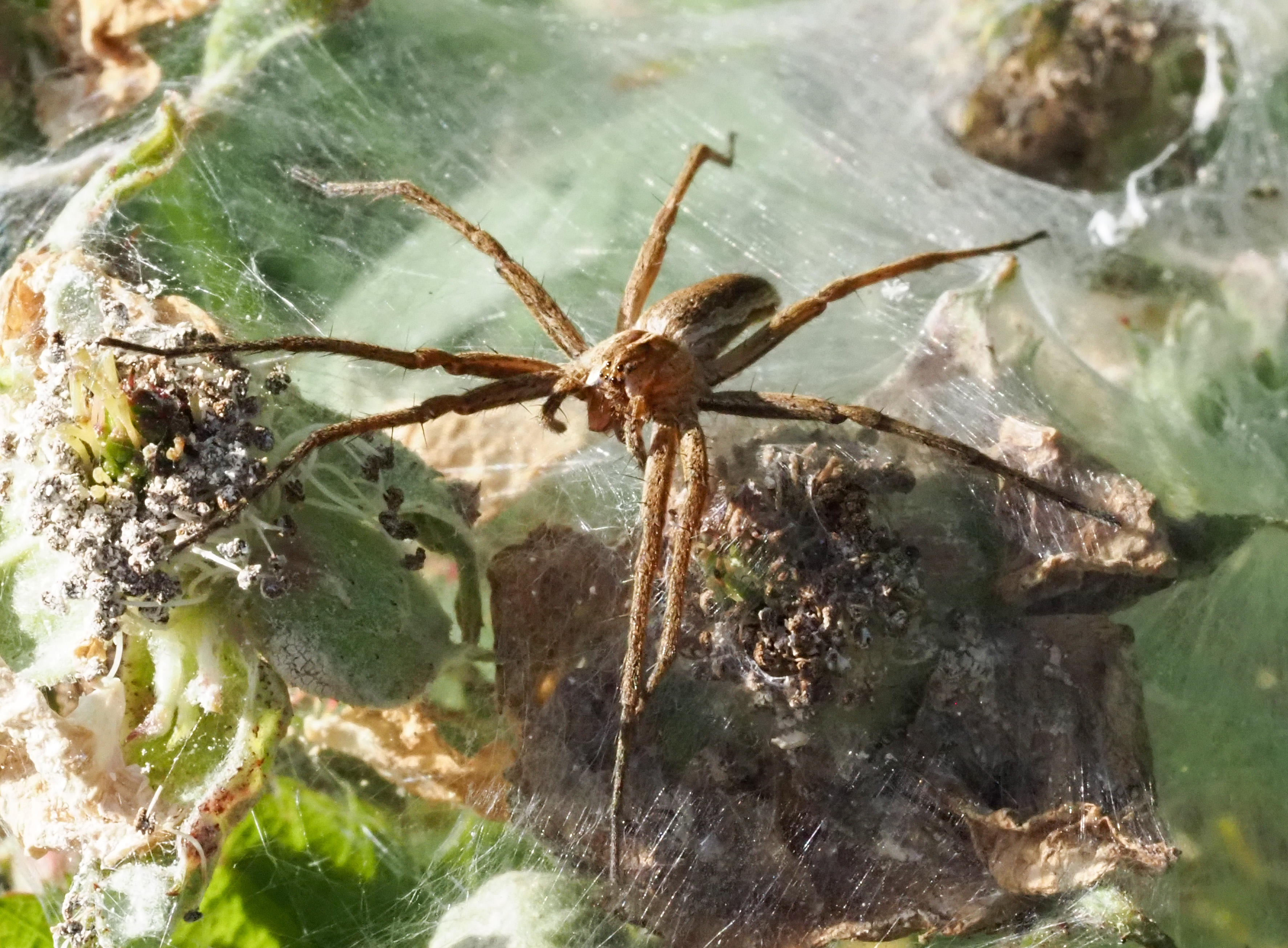
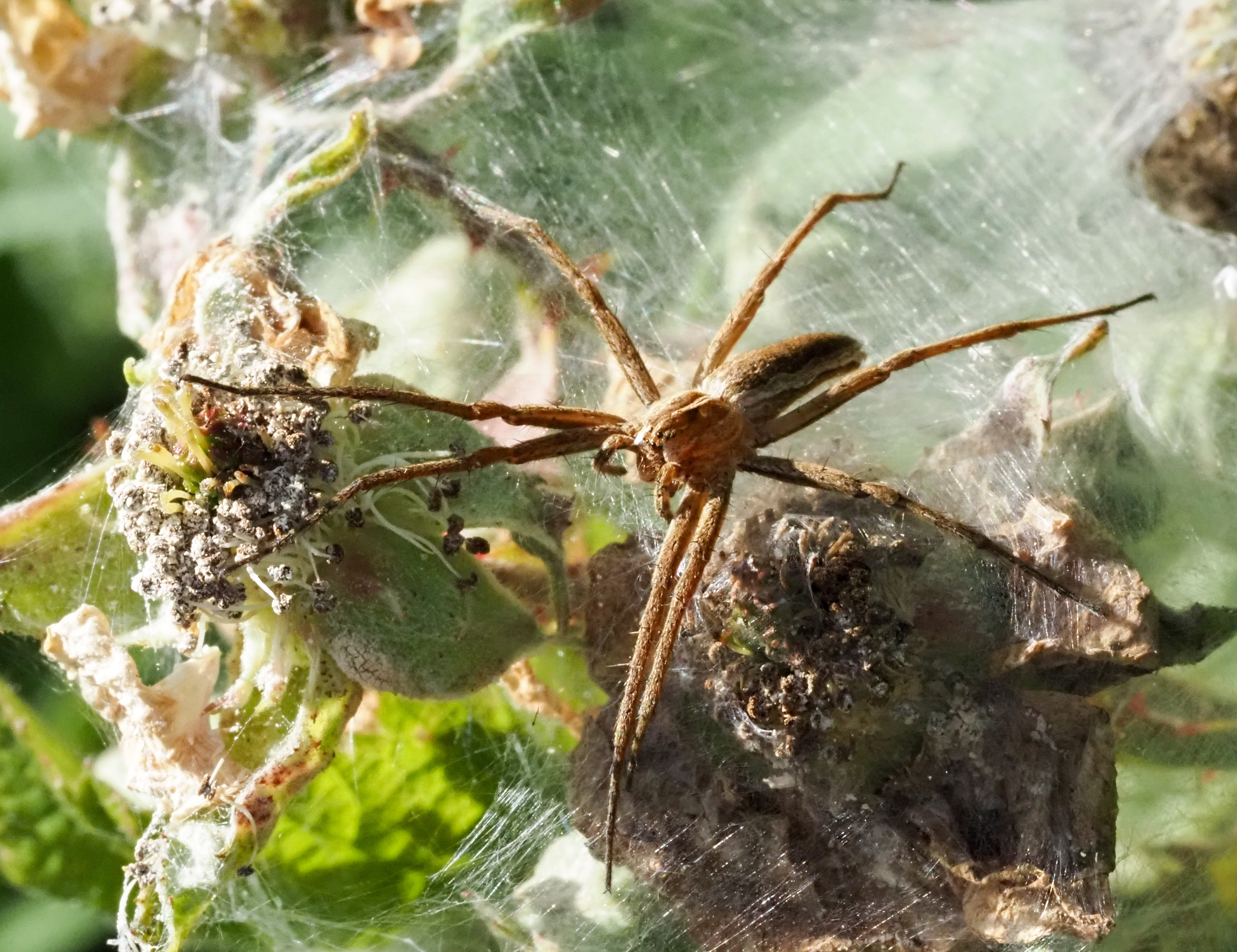
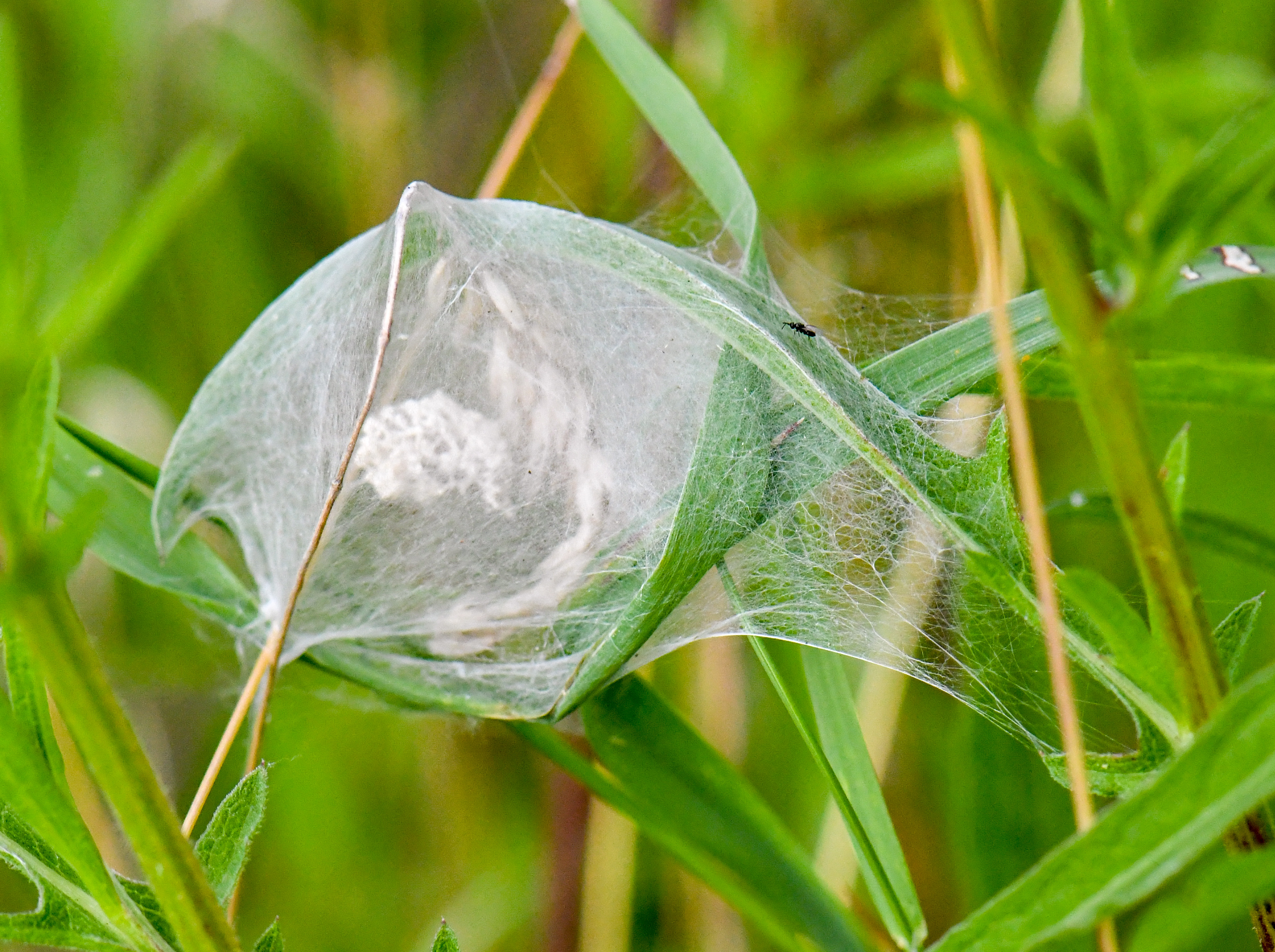
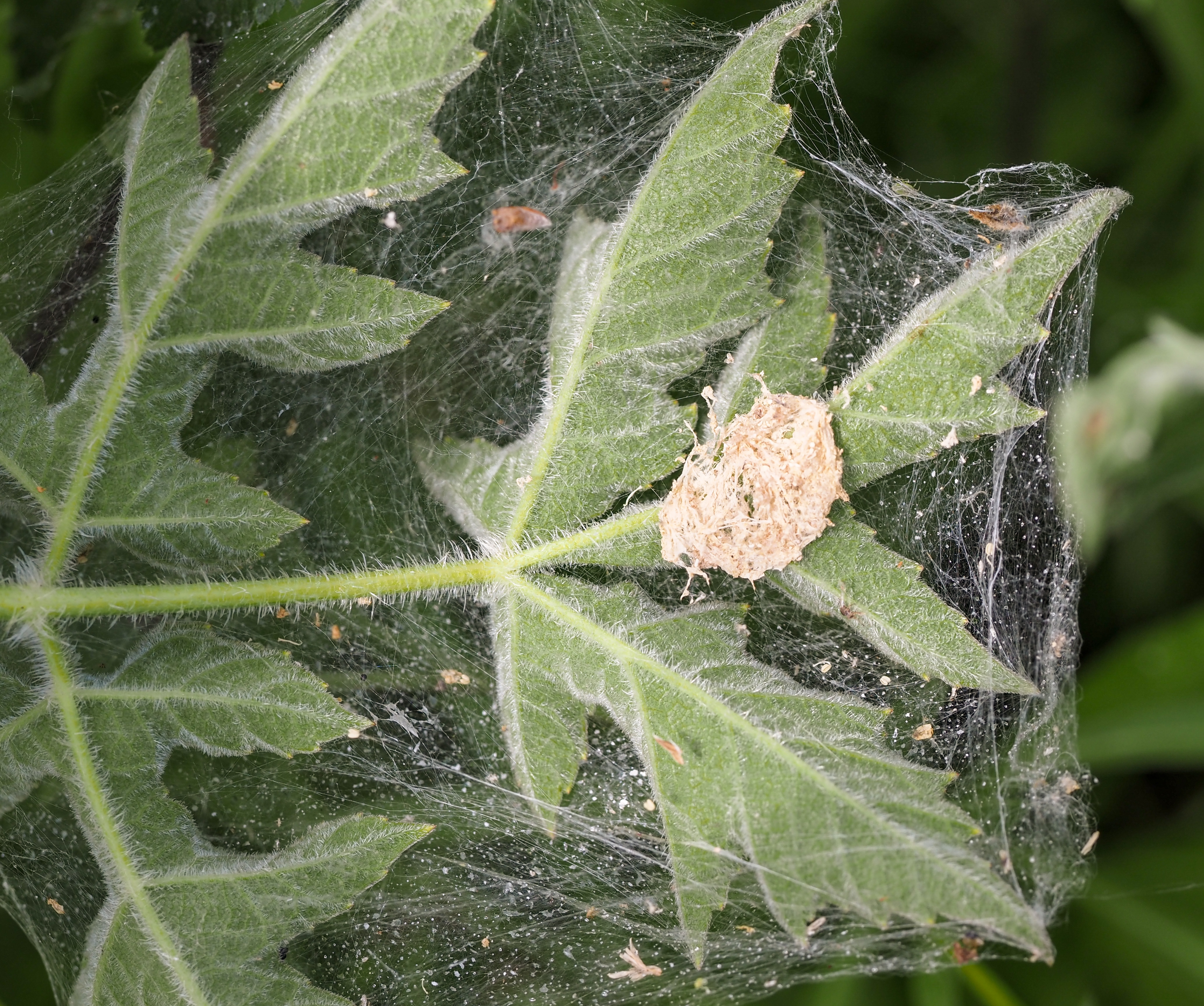
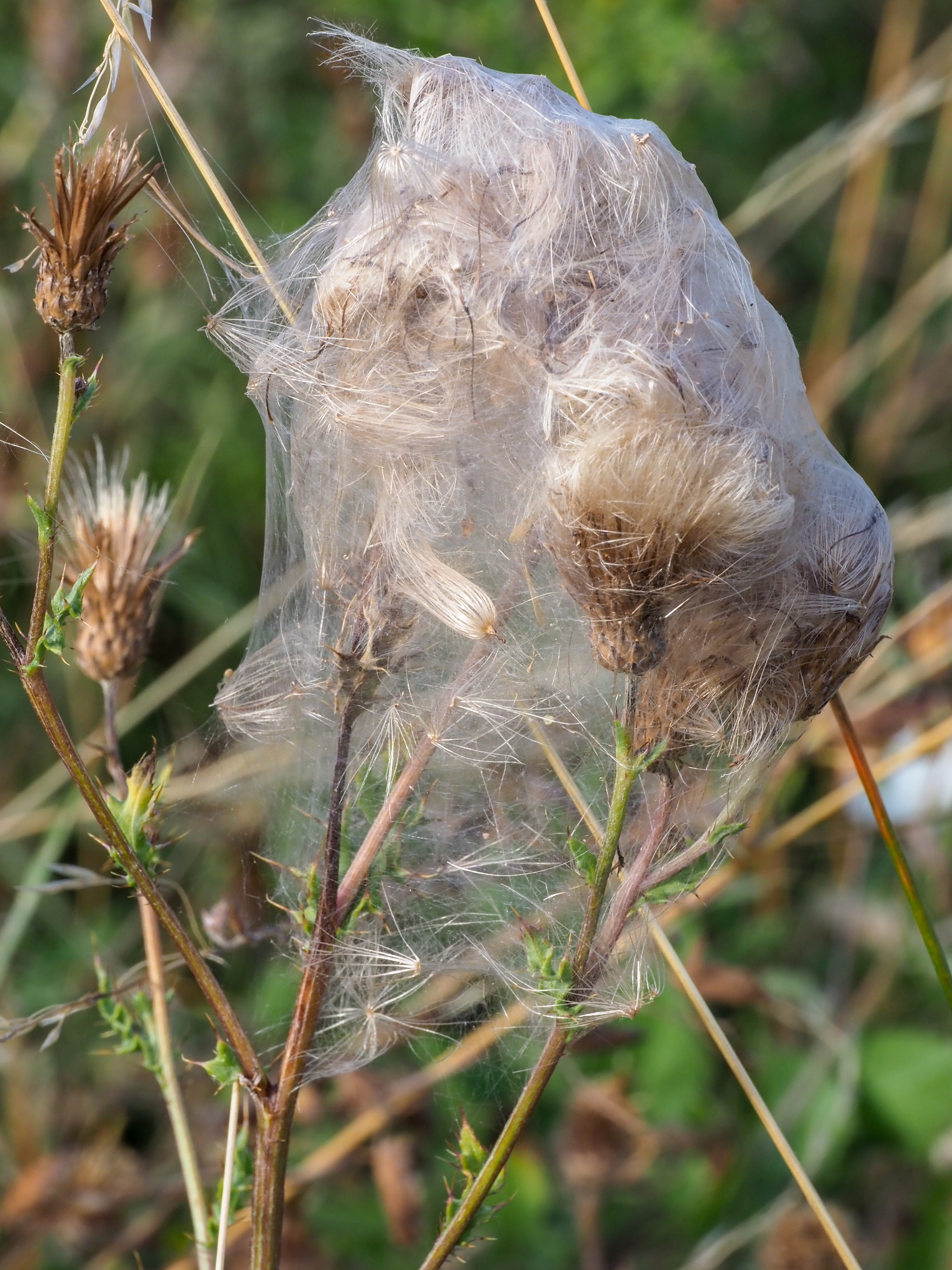
After carrying the pea-sized egg sac for three or four weeks, or so, the female starts to build a nest. She uses silken threads to gather together leaves, blades or seed heads of grass, to create a tent-like structure: the nursery web. In my experience these are hugely variable; the only common feature being the silken tent which encompasses the vegetation in unique shapes. I find these nursery nests aesthetically pleasing, and often photograph them when I stumble across one in the summer; anytime from June to August (see below).
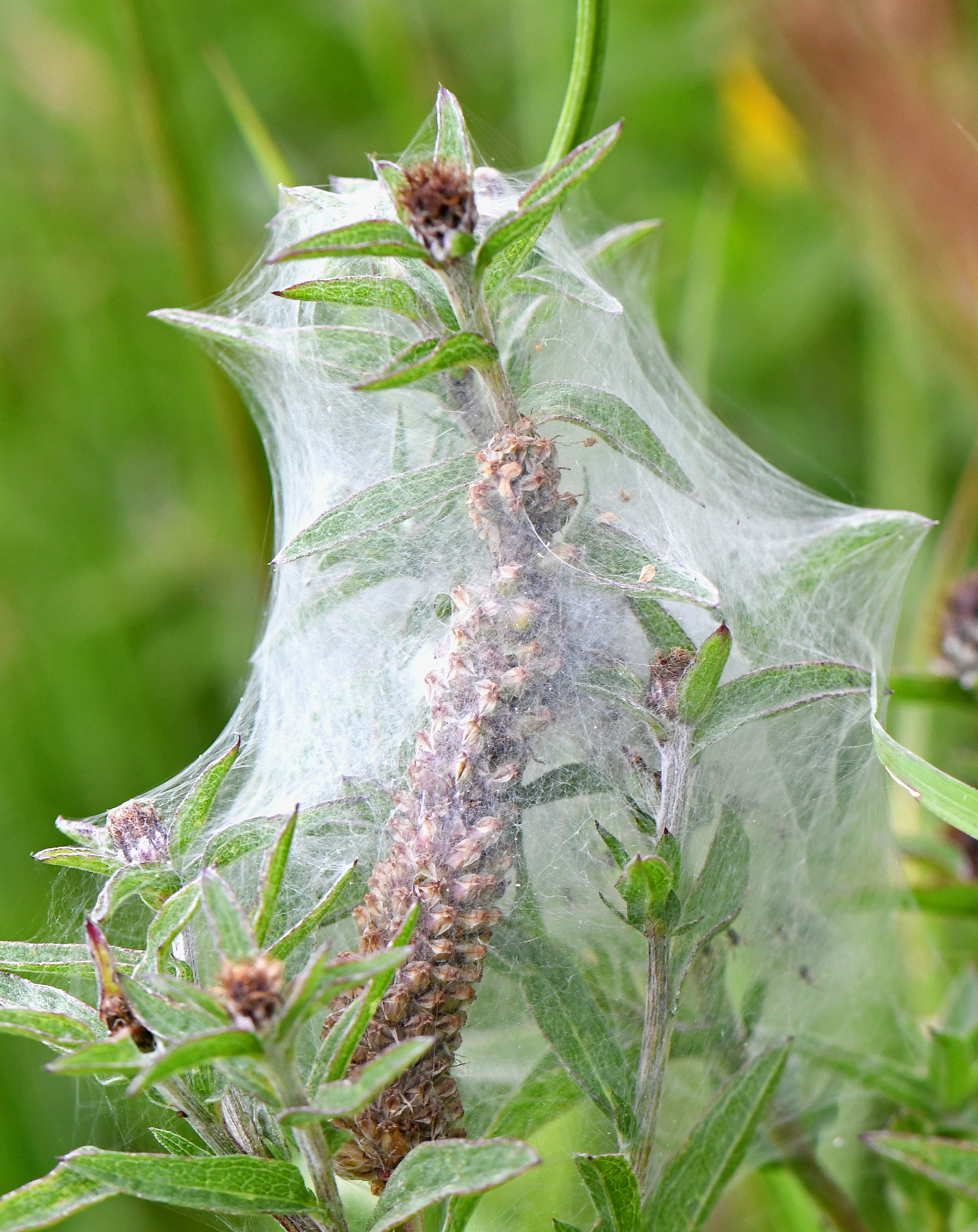
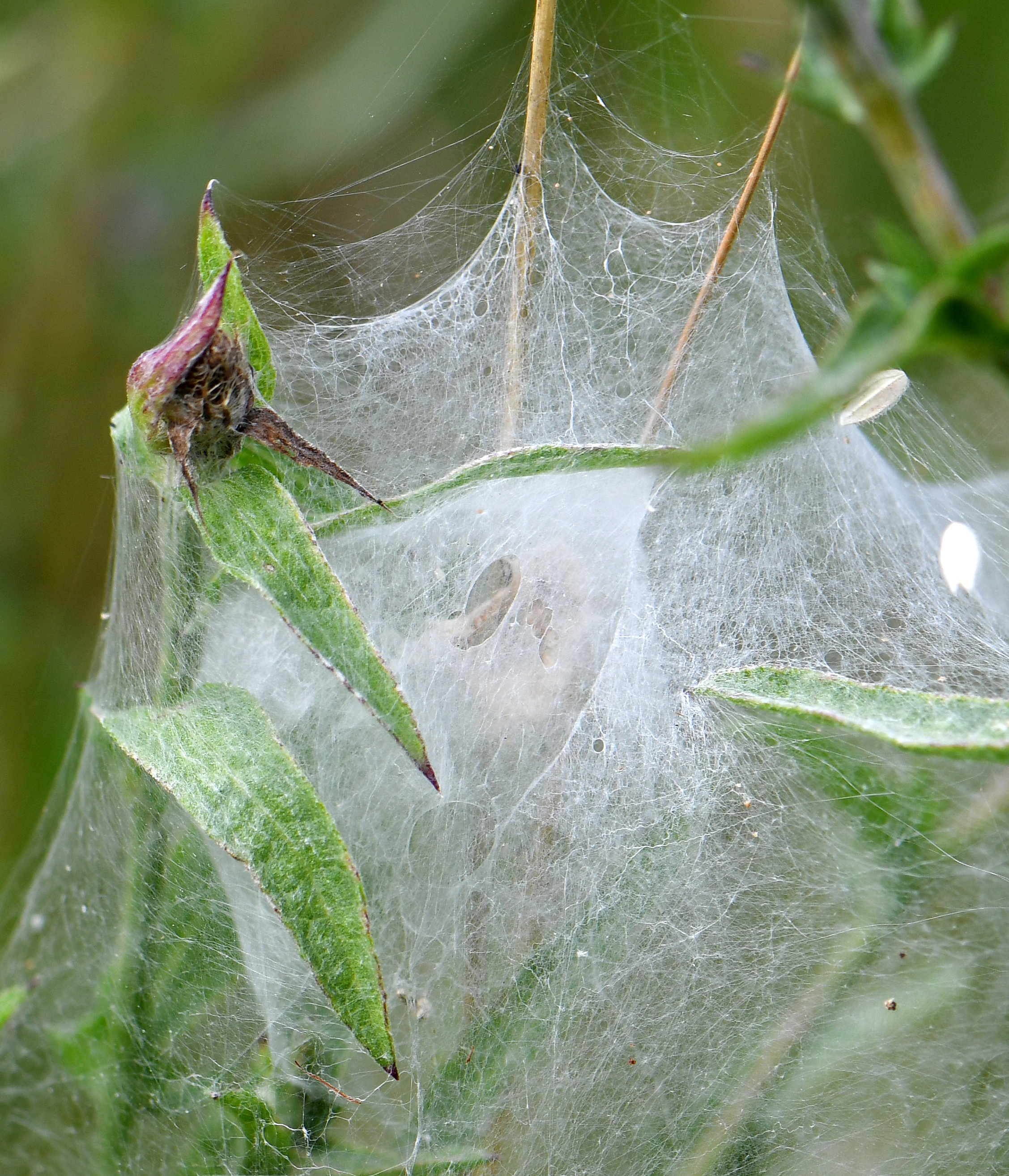
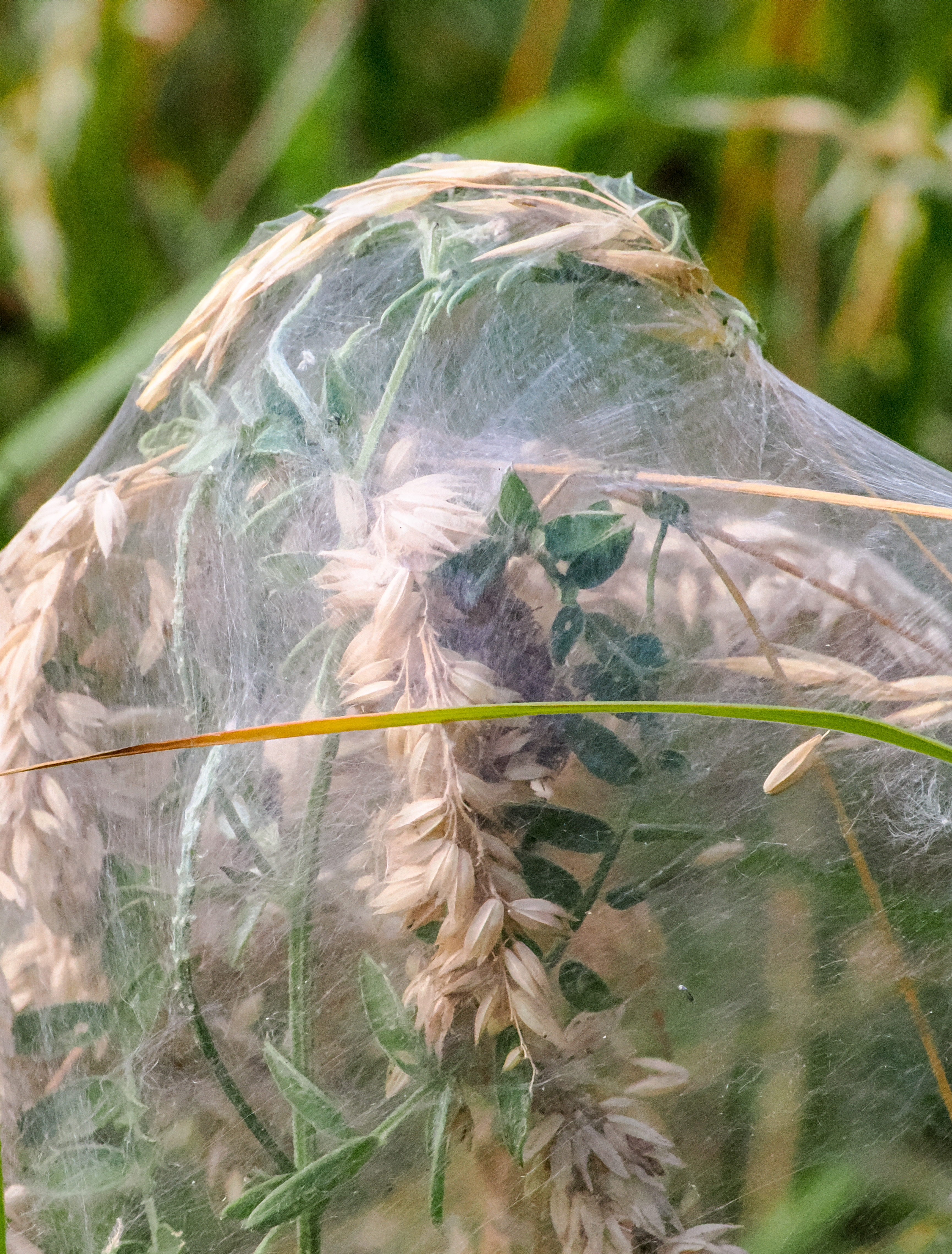
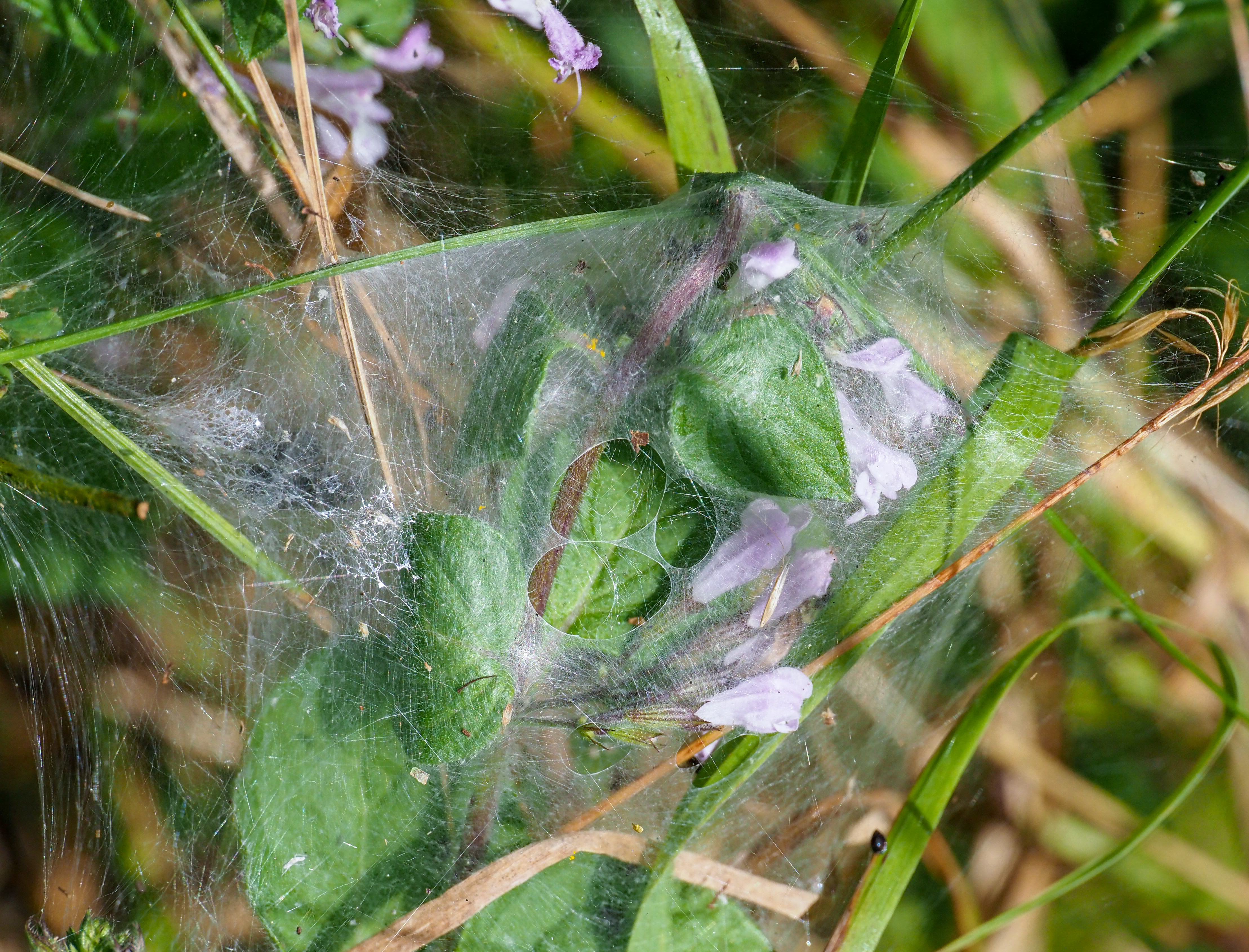
The nests often have an opening – presumably for the female to pass in and out? – and the females will often sit on top of the nest to guard the offspring.
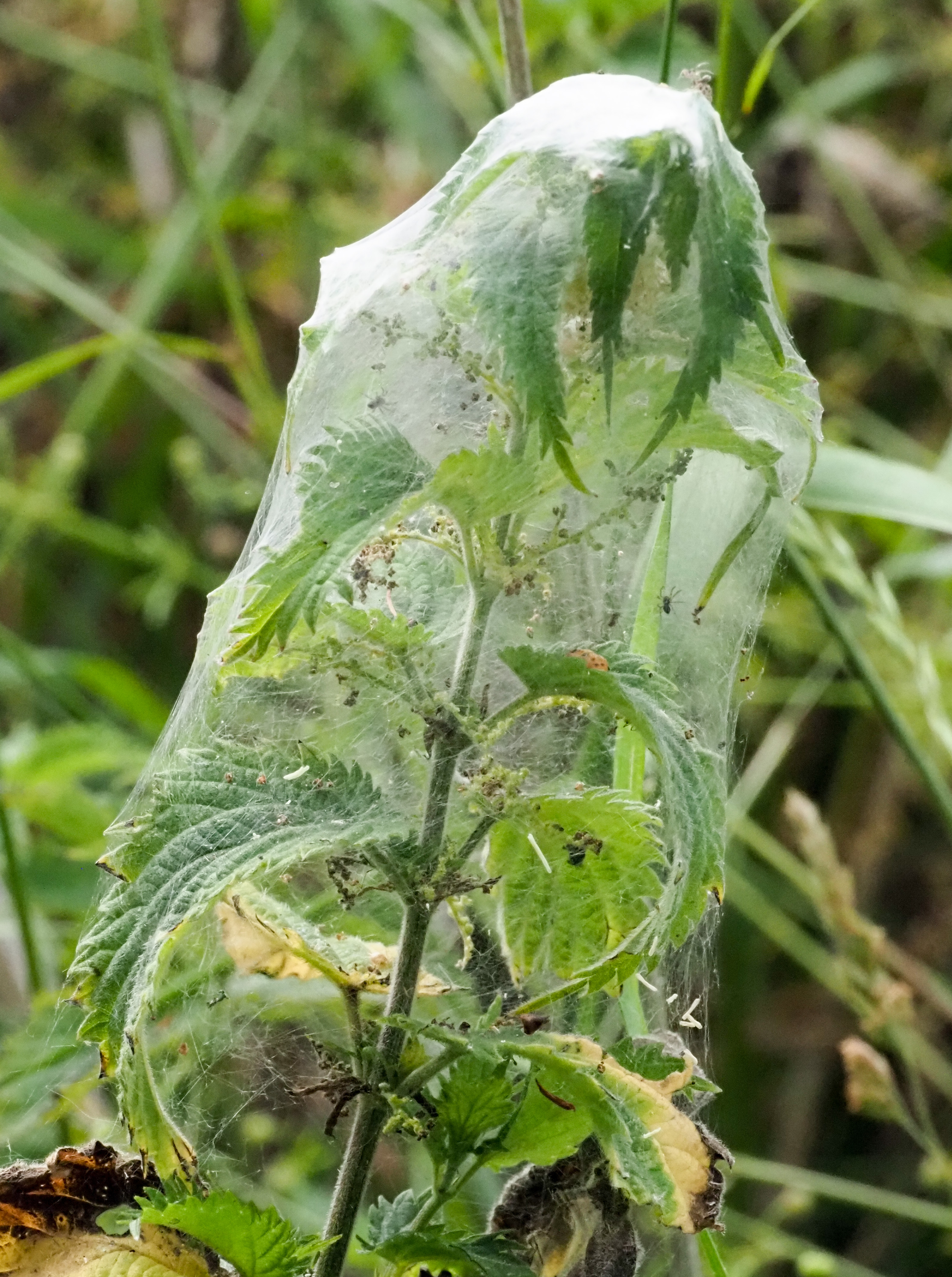
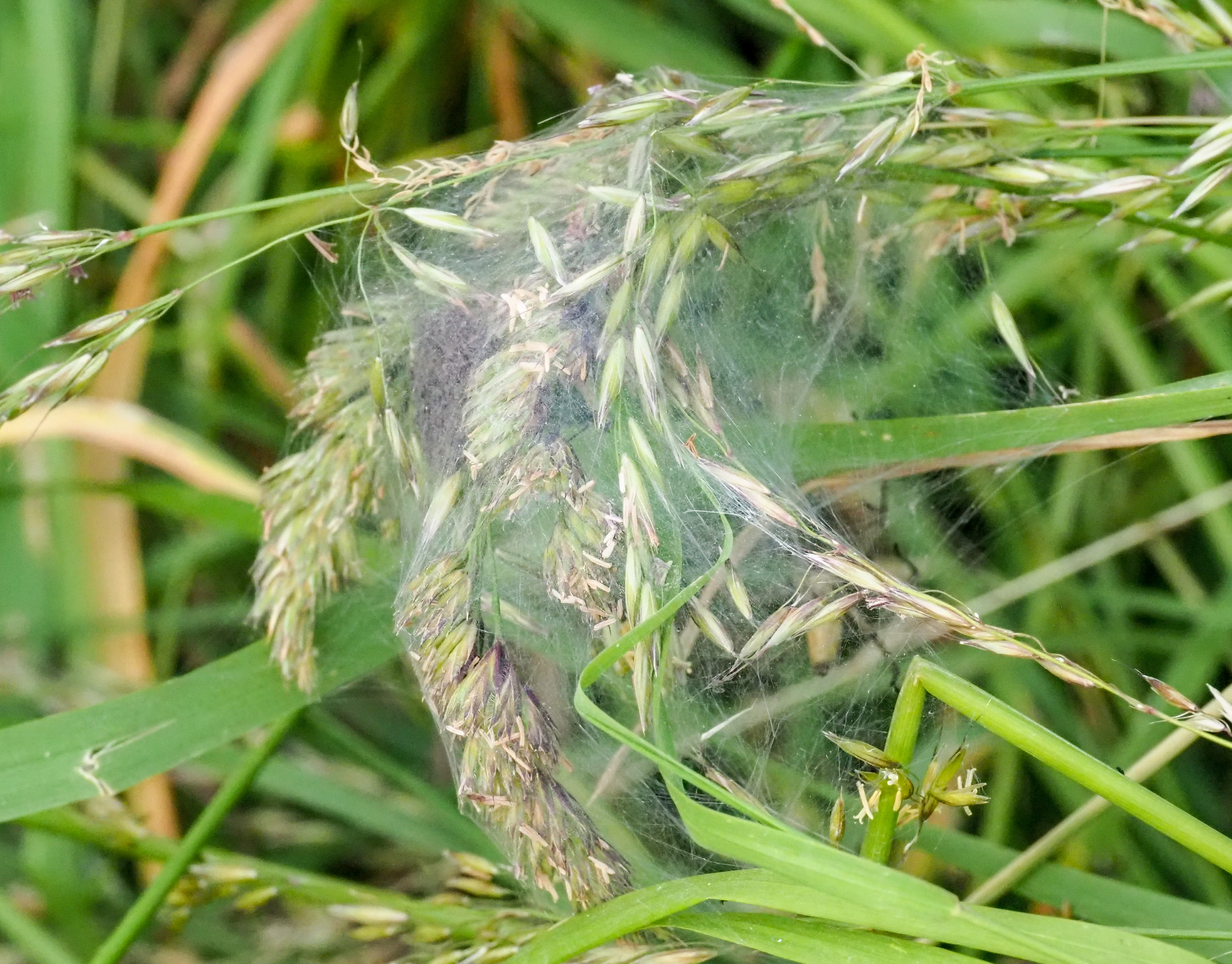

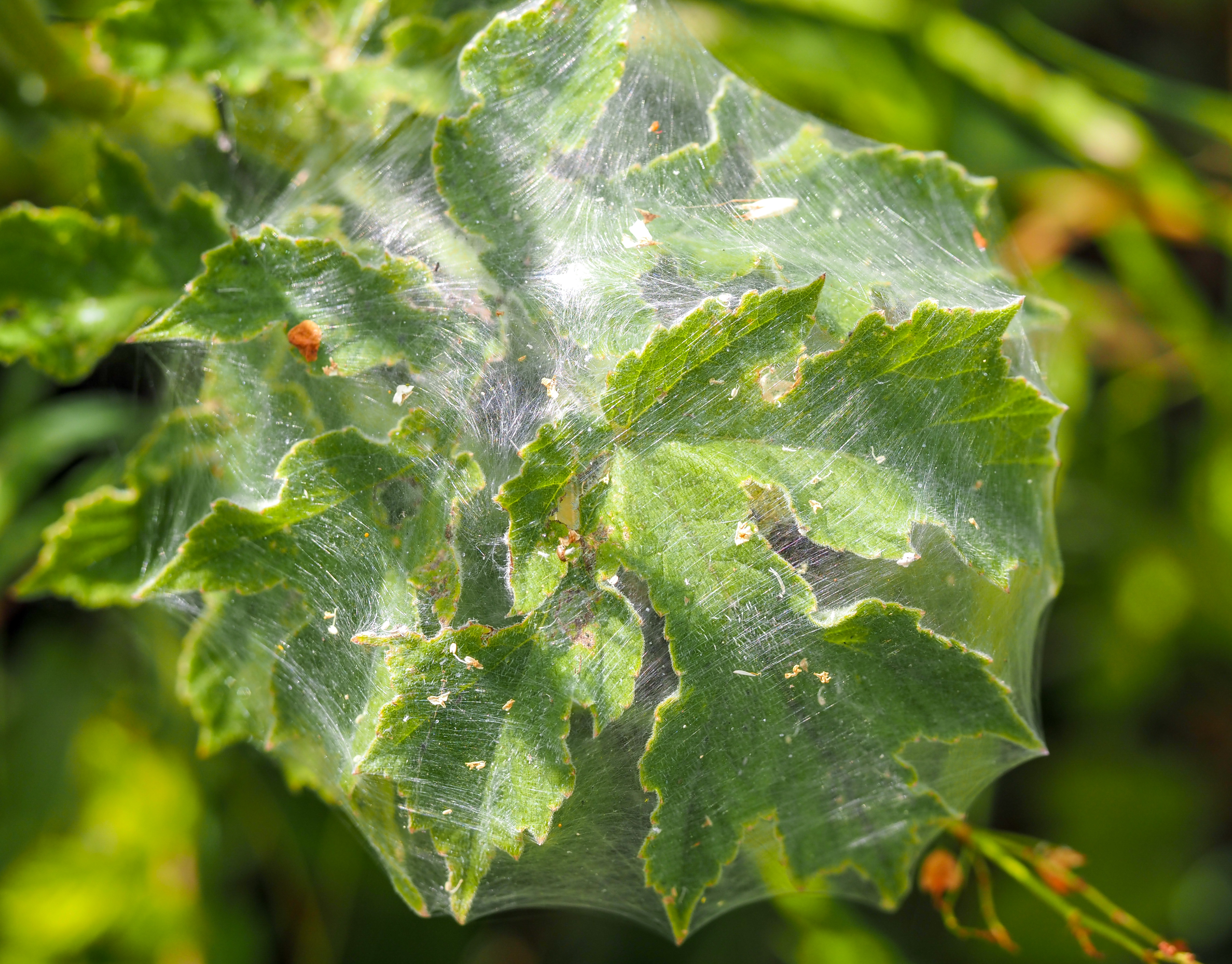
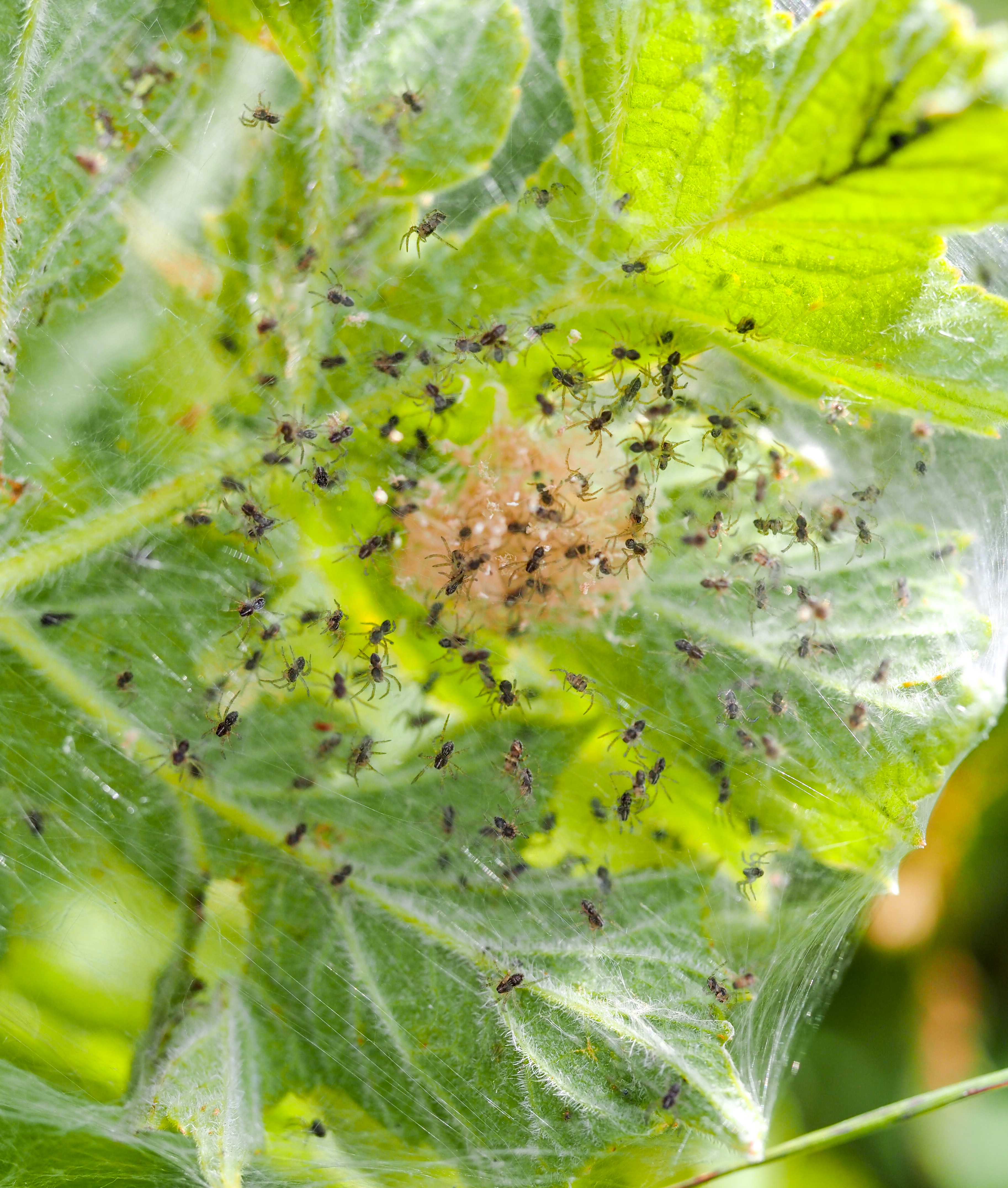
The remains of the egg sac are often visible inside the nest, together with the spiderlings (see below).
Summing up: if you are a nursery web spider looking for a mate, make sure you bring her a gift! Size doesn’t matter, but make it bright and shiny with a juicy insect inside. Hang on to her leg with one of your silken strands and send her your tremulations, both before and during mating. That way she will accept you and probably not eat you! But if she starts to move, pretend to be dead and hang on to her wherever she takes you!
References
Albo, M. J., Winther, G., Tuni, C., Toft, S., & Bilde, T. (2011). Worthless donations: male deception and female counter play in a nuptial gift-giving spider. BMC evolutionary biology, 11, 1-8.
Andersen, T., Bollerup, K., Toft, S., & Bilde, T. (2008). Why do males of the spider Pisaura mirabilis wrap their nuptial gifts in silk: female preference or male control?. Ethology, 114(8), 775-781.
Anderson, A. G., & Hebets, E. A. (2016). Benefits of size dimorphism and copulatory silk wrapping in the sexually cannibalistic nursery web spider, Pisaurina mira. Biology Letters, 12(2), 20150957.
Bristowe, W. S. (1958). The world of spiders. London: Collins.
Eberhard, M. J., Machnis, A., & Uhl, G. (2020). Condition-dependent differences in male vibratory pre-copulatory and copulatory courtship in a nuptial gift-giving spider. Behavioral Ecology and Sociobiology, 74(11), 138.
Eberhard, M. J., Möller, T. A., & Uhl, G. (2021). Dragline silk reveals female developmental stage and mediates male vibratory courtship in the nuptial gift‐giving spider Pisaura mirabilis. Ethology, 127(3), 267-277.
Nitzsche, R. O. (2011). Courtship, mating and agonistic behaviour in Pisaura mirabilis (Clerck, 1757). Arachnology, 15(4), 93-120.
Prokop, P., & Maxwell, M. R. (2012). Gift carrying in the spider Pisaura mirabilis: nuptial gift contents in nature and effects on male running speed and fighting success. Animal behaviour, 83(6), 1395-1399.
Toft, S., & Albo, M. J. (2016). The shield effect: nuptial gifts protect males against pre-copulatory sexual cannibalism. Biology Letters, 12(5), 20151082.
 Ray Cannon's nature notes
wonderfully interesting! Thanks!
Thank you!😁
As we see these spiders and their webs on our nature site, it is interesting to read your post, thank you!
Thank you!😁
i see many parallels of these spiders with the predatory female Photuris fireflies (and their males) in the Western Hemisphere, and their complex mating strategies Involving nuptial gifts, false signsls and Gobbling up of the unlucky unworthy males! Thanks!
i see many parallels of these spiders with the predatory female Photuris fireflies (and their males) in the Western Hemisphere, and their complex mating strategies Involving nuptial gifts, false signsls and Gobbling up of the unlucky unworthy males! Thanks!
i see many parallels of these spiders with the predatory female Photuris fireflies (and their males) in the Western Hemisphere, and their complex mating strategies Involving nuptial gifts, false signsls and Gobbling up of the unlucky unworthy males! Thanks!
I wrote a bit about them in my book Courtship and Mate-finding in insects.😁