One hot day in early August this year (2026), I was delighted to come across large numbers of lycaenid butterflies (Lycaenidae) – so-called ‘blues’, even though some are brown! – in a rapidly drying, uncut meadow dominated by knapweed flowers. It was the wildlife highlight of the summer for me.
It soon became apparent there there were two species resting, basking and flying about in amongst the low foliage: the Common blue butterfly (Polyommatus icarus) and the Brown Argus (Aricia agestis).
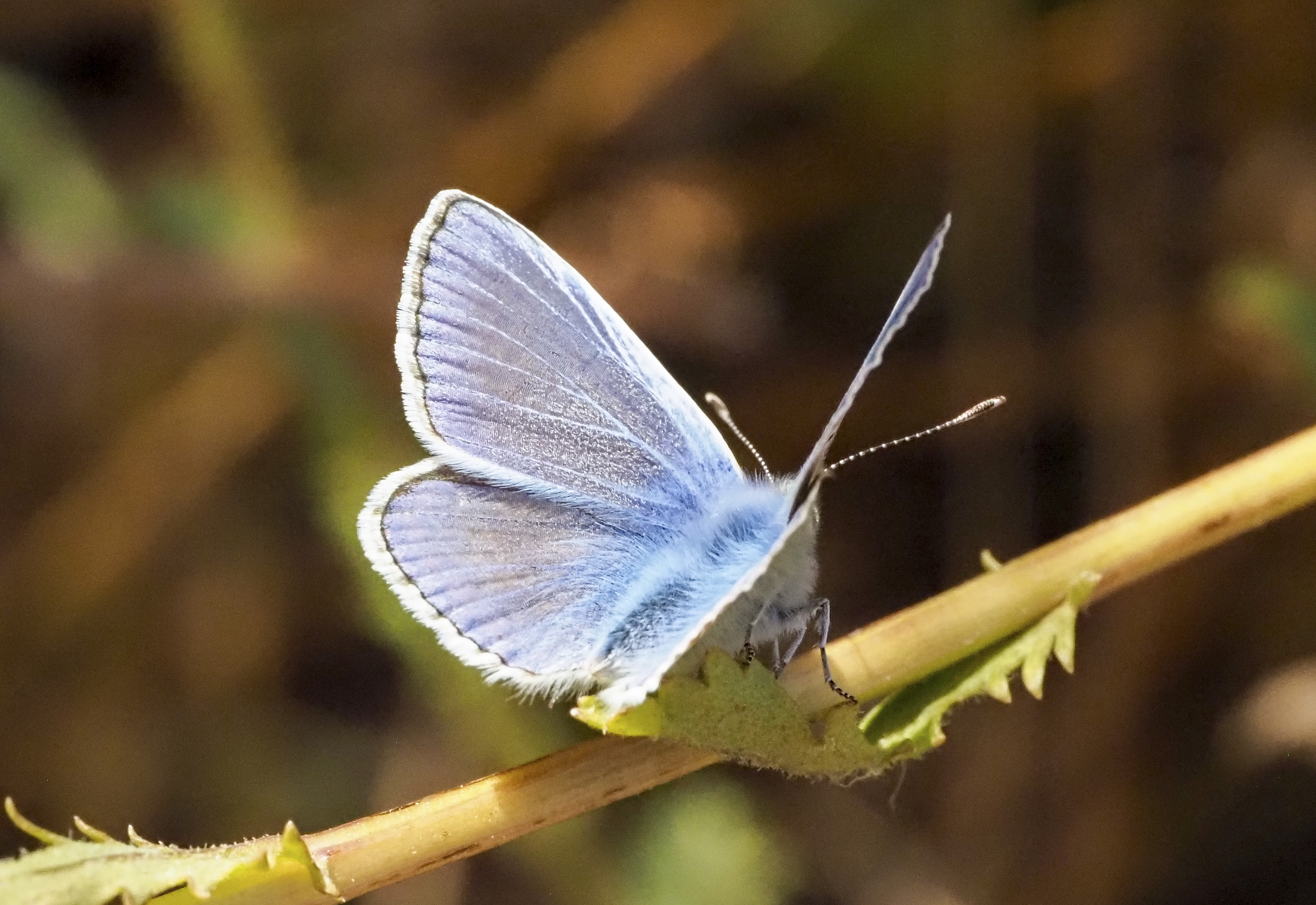
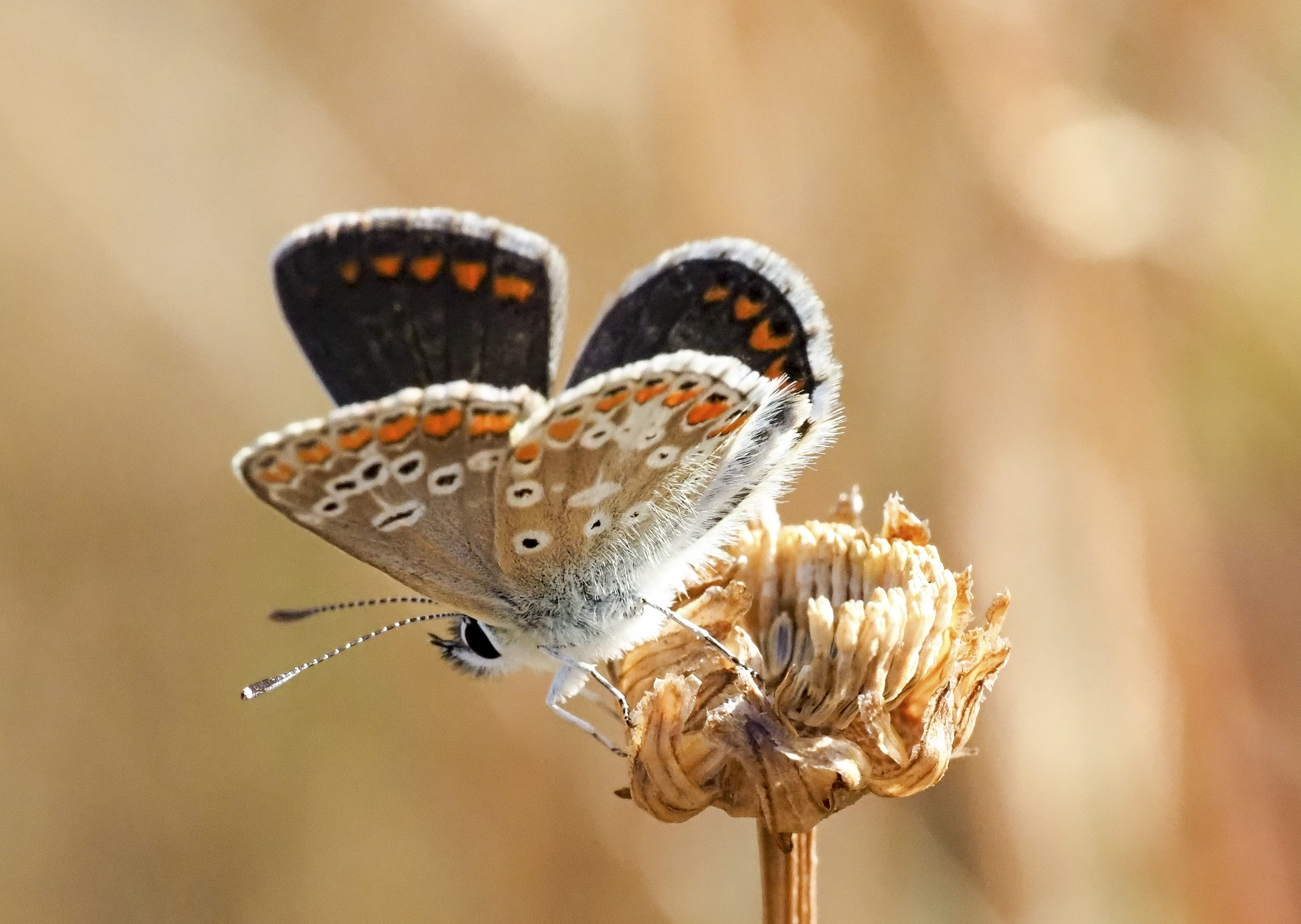
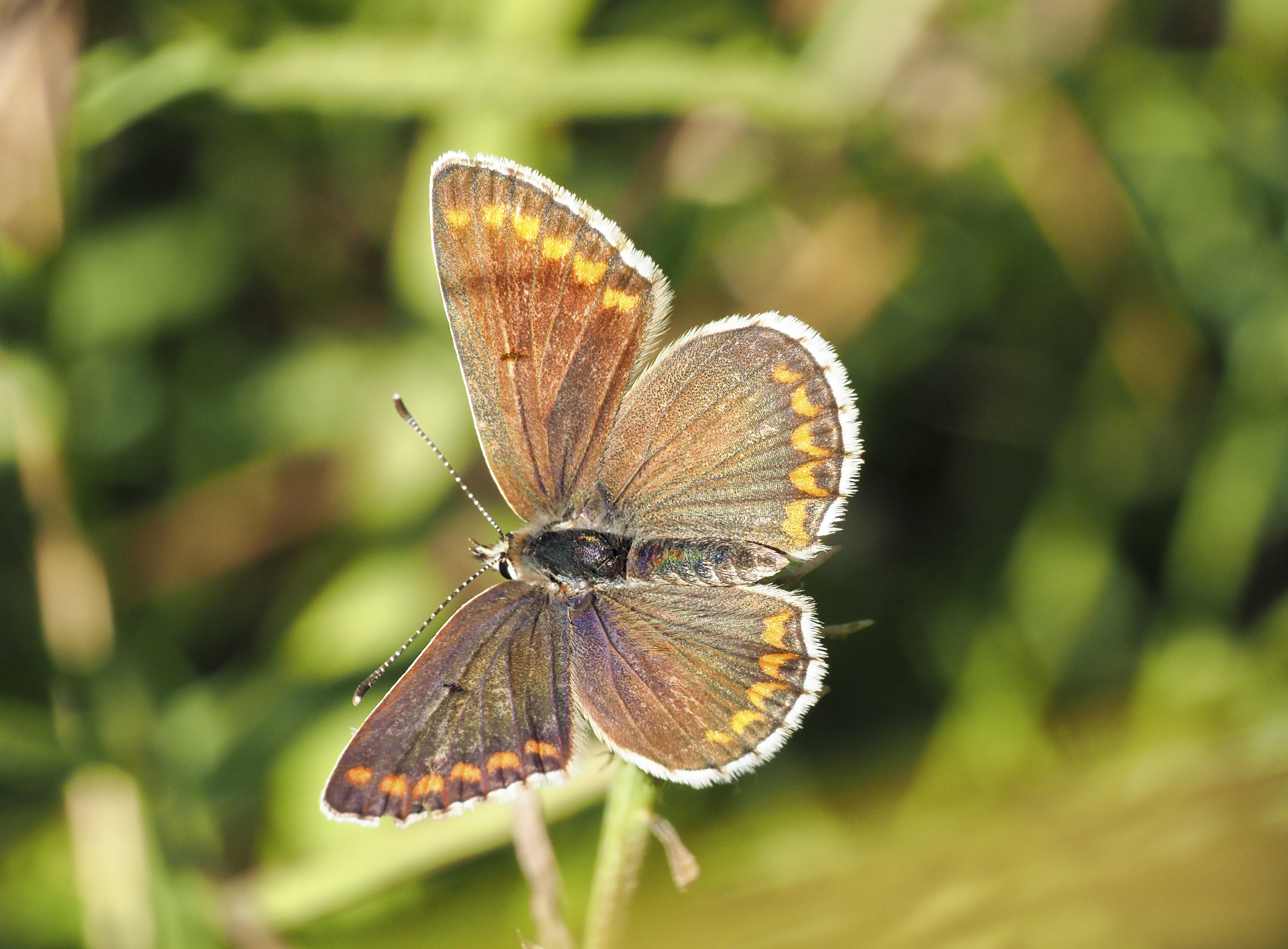
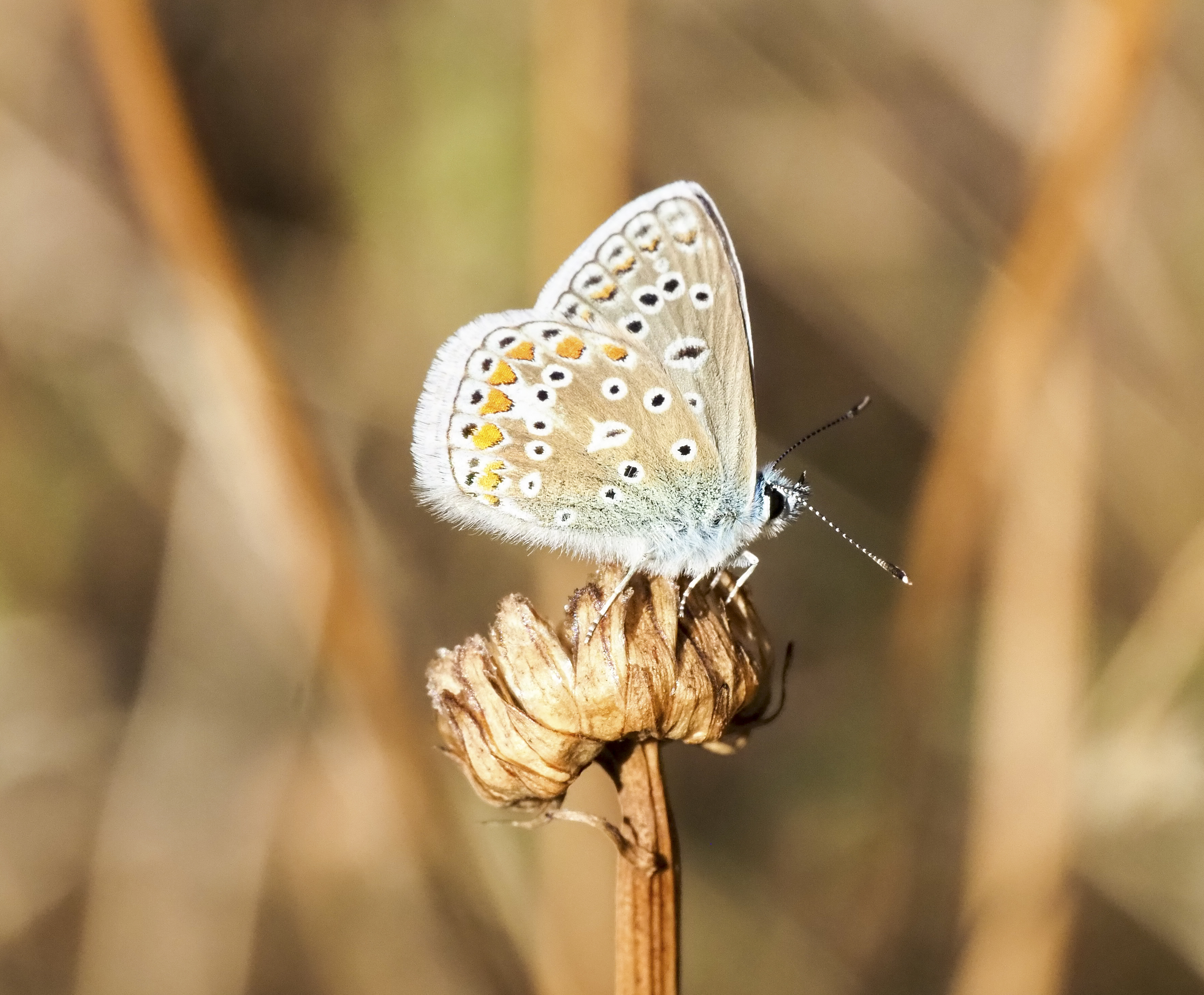
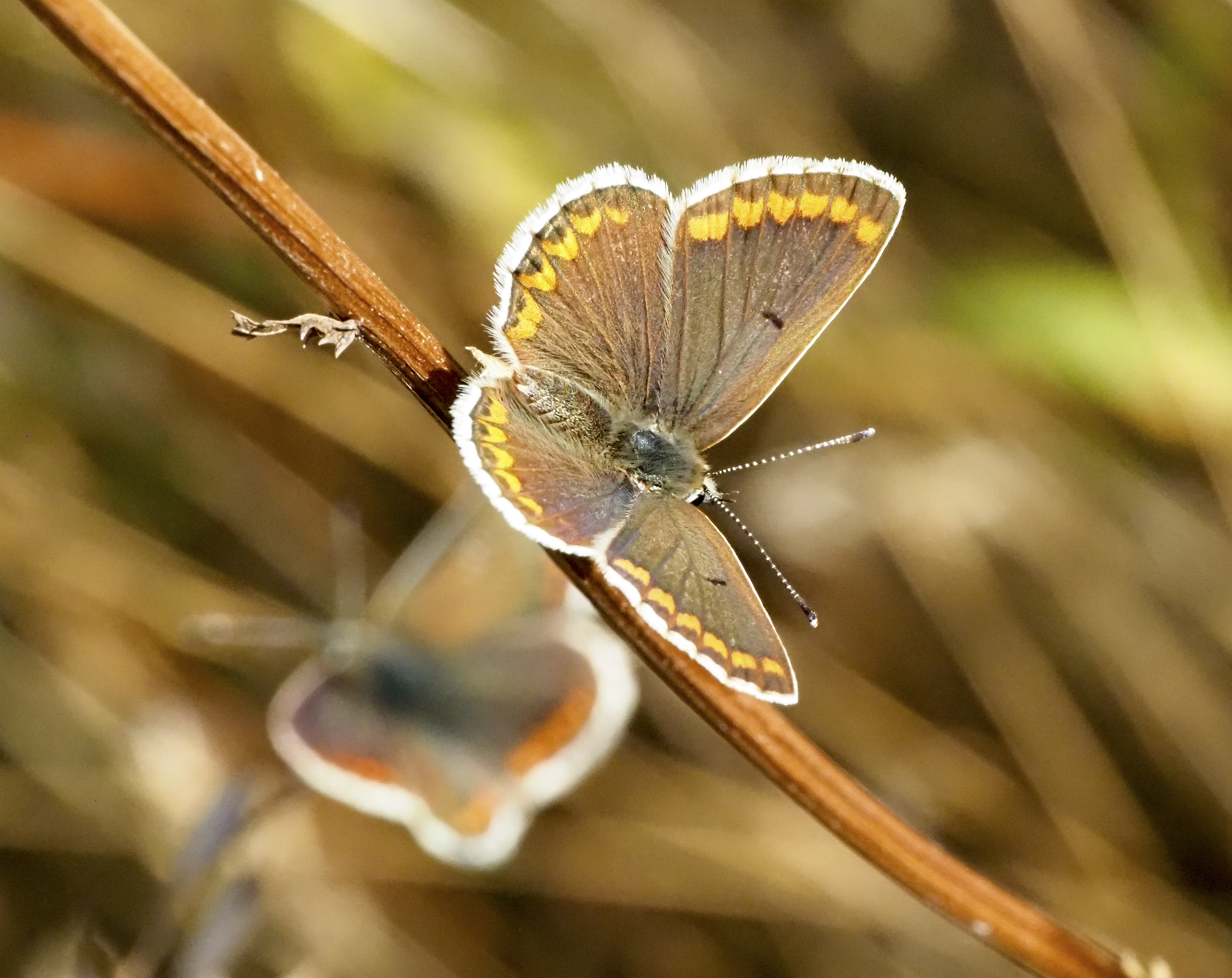
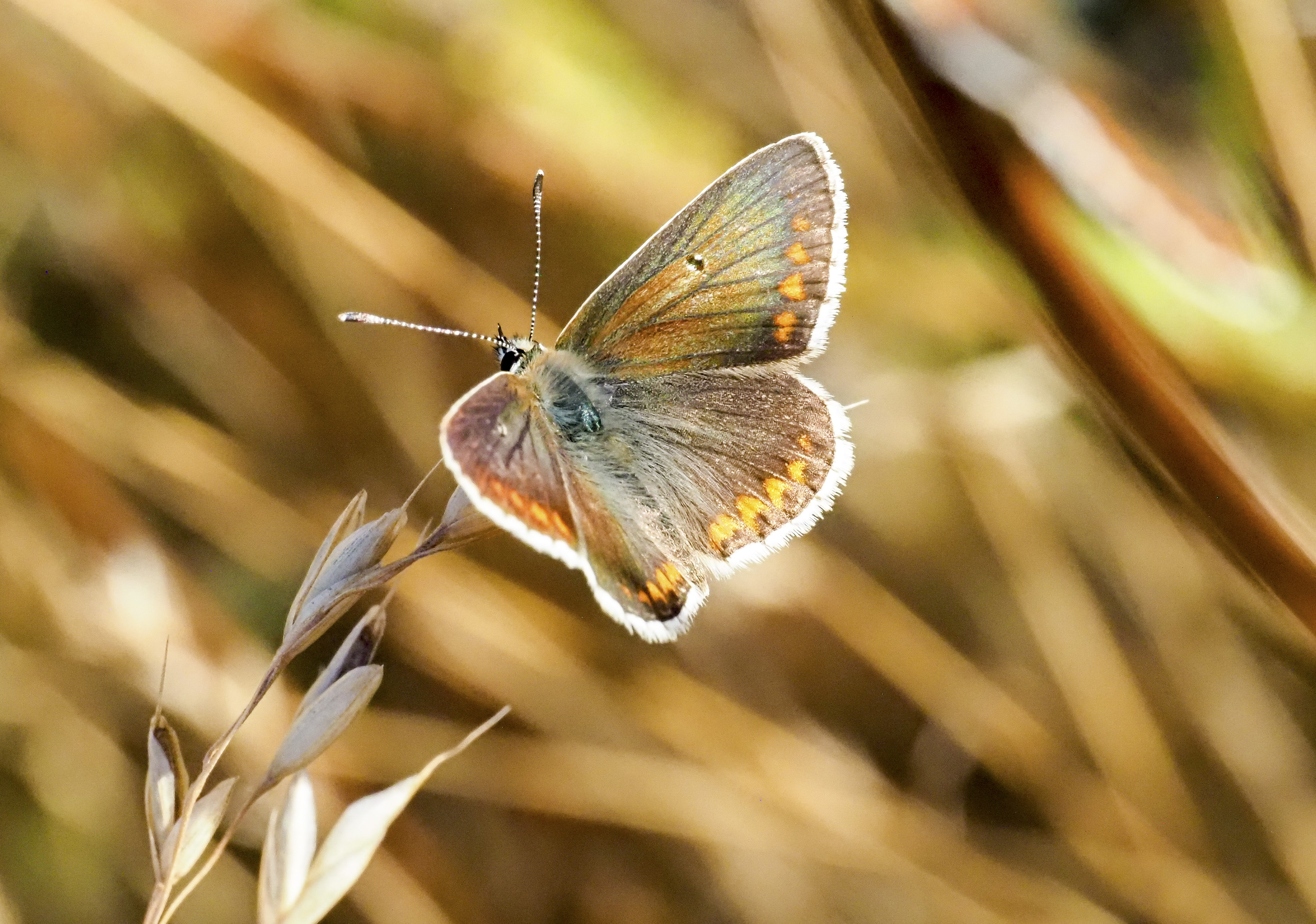
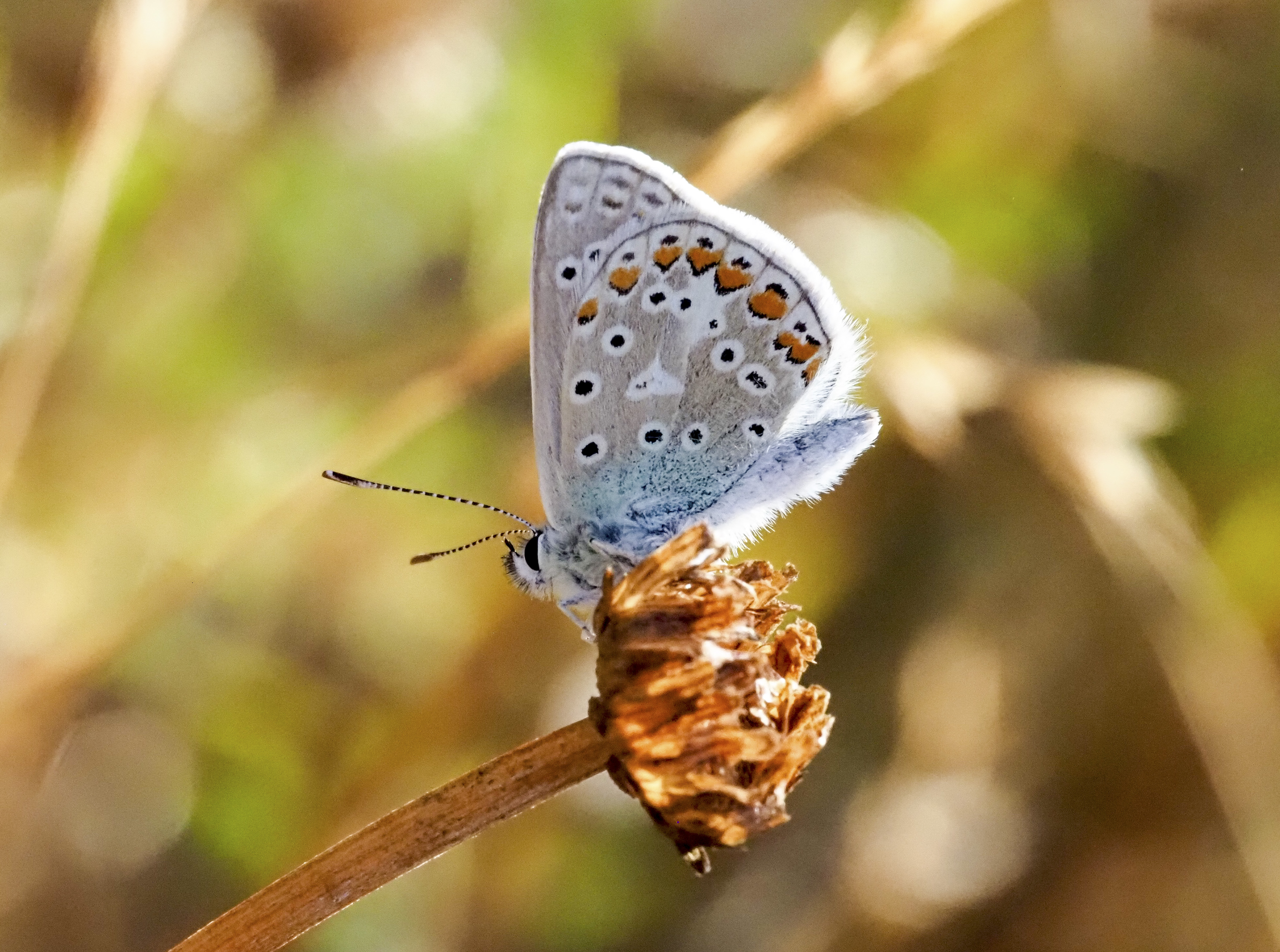
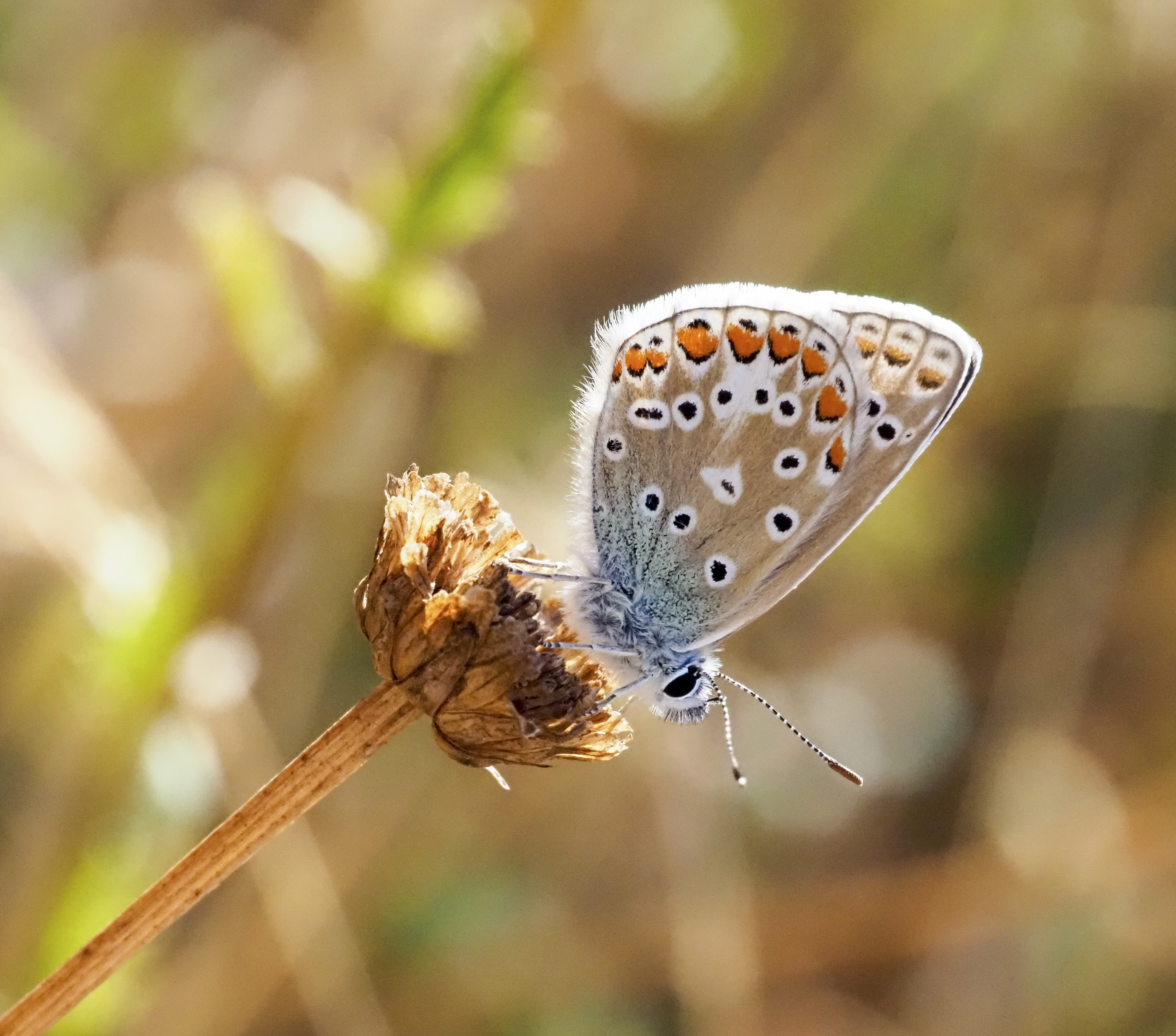
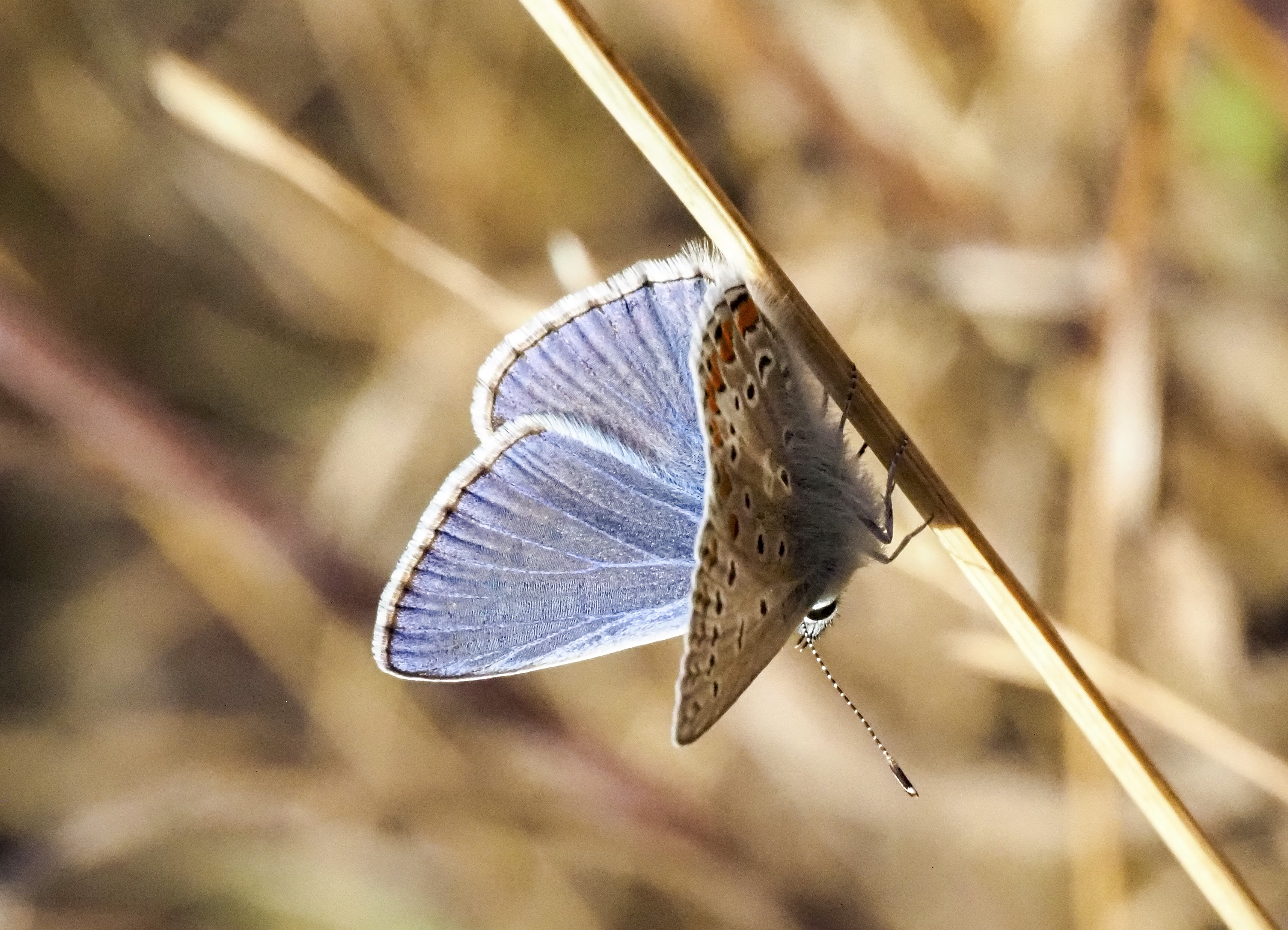
Although the upper wing surfaces of these two butterflies are quite different (see above), the undersides are relatively similar – certainly when viewed from a distance.
As I began photographing some of the hundreds of ‘blues’ and ‘browns’ flying around – I began to wonder: how do they tell each other apart? How do they identify each other as being of a different species? and also, how do they identify males and females of their own and the other species?!
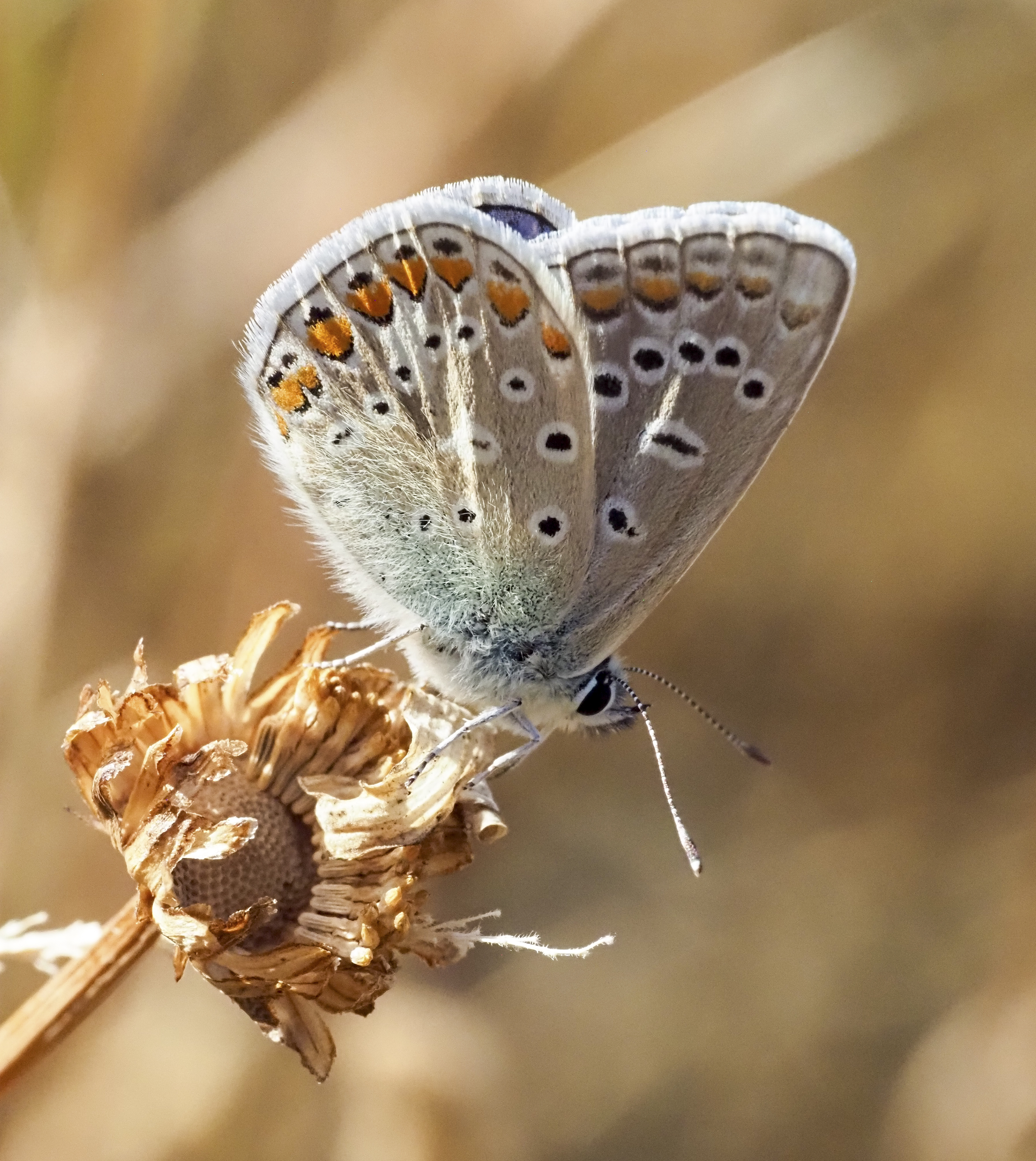
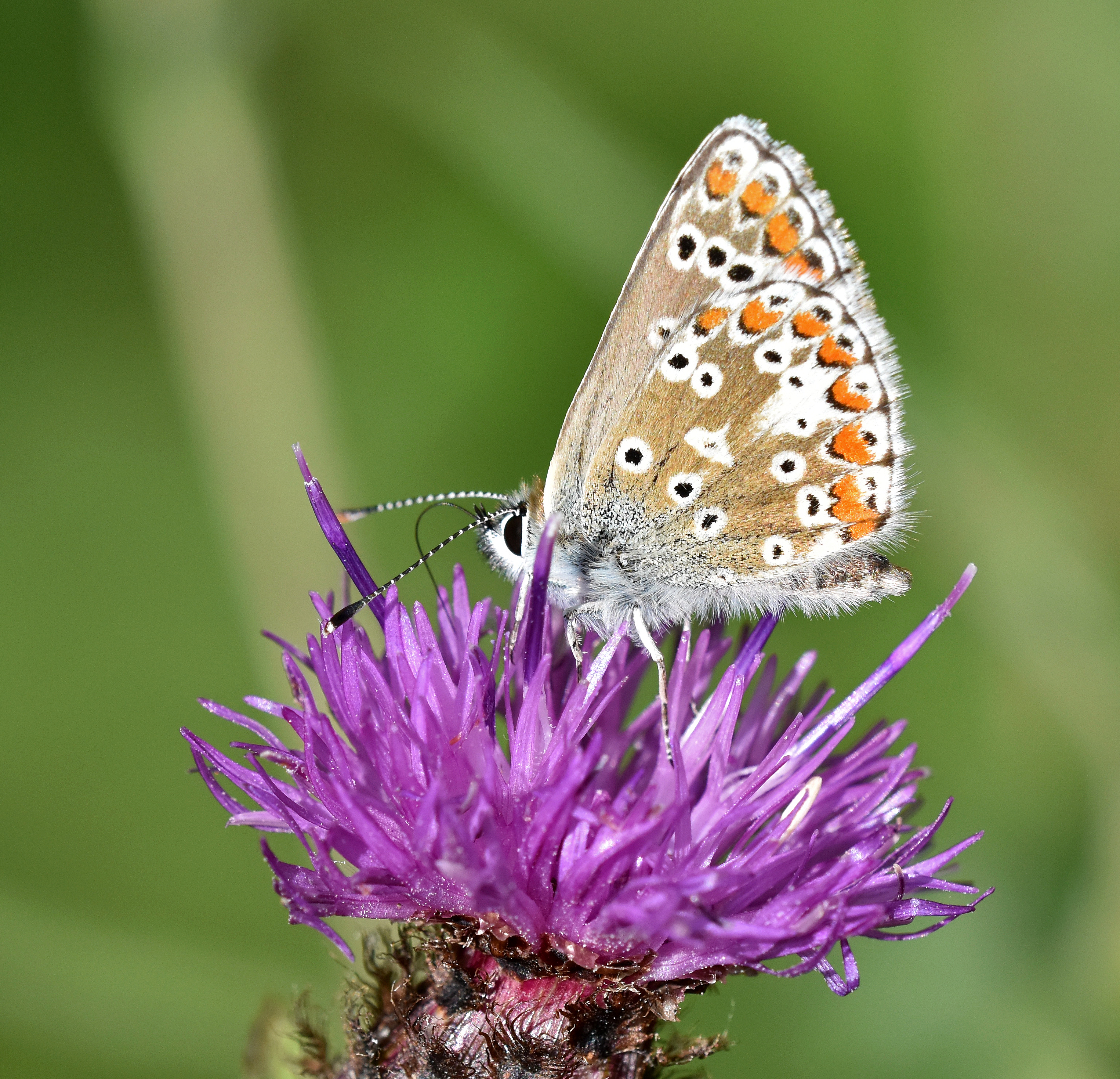
Here are some pictures (below) which show the mix of butterflies in the dry herbage of the knapweed field.
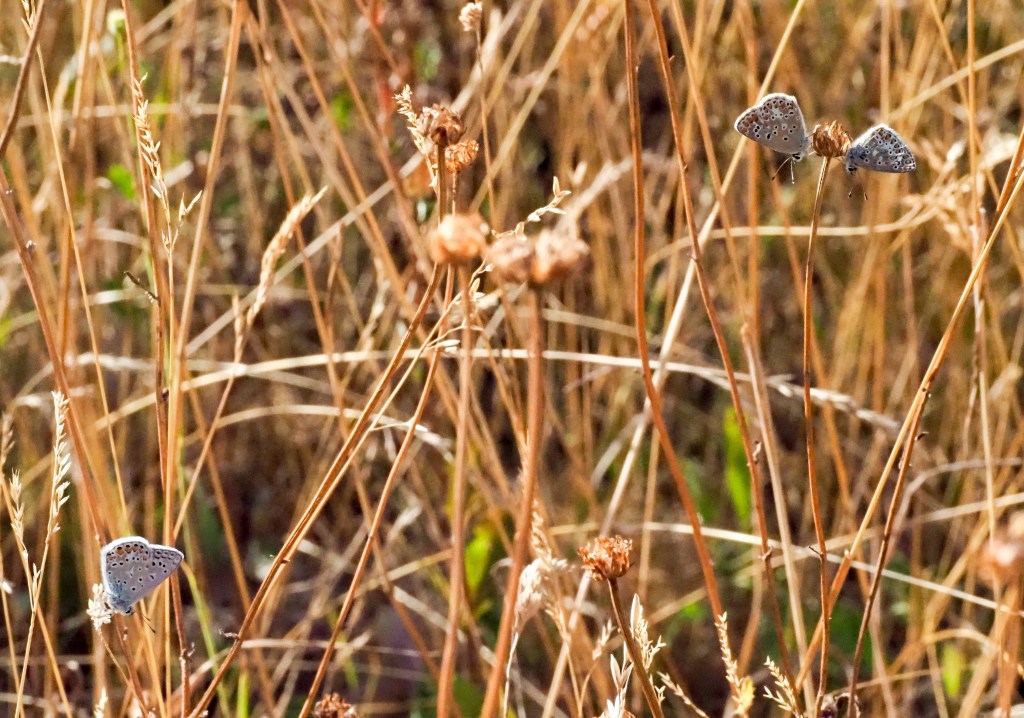
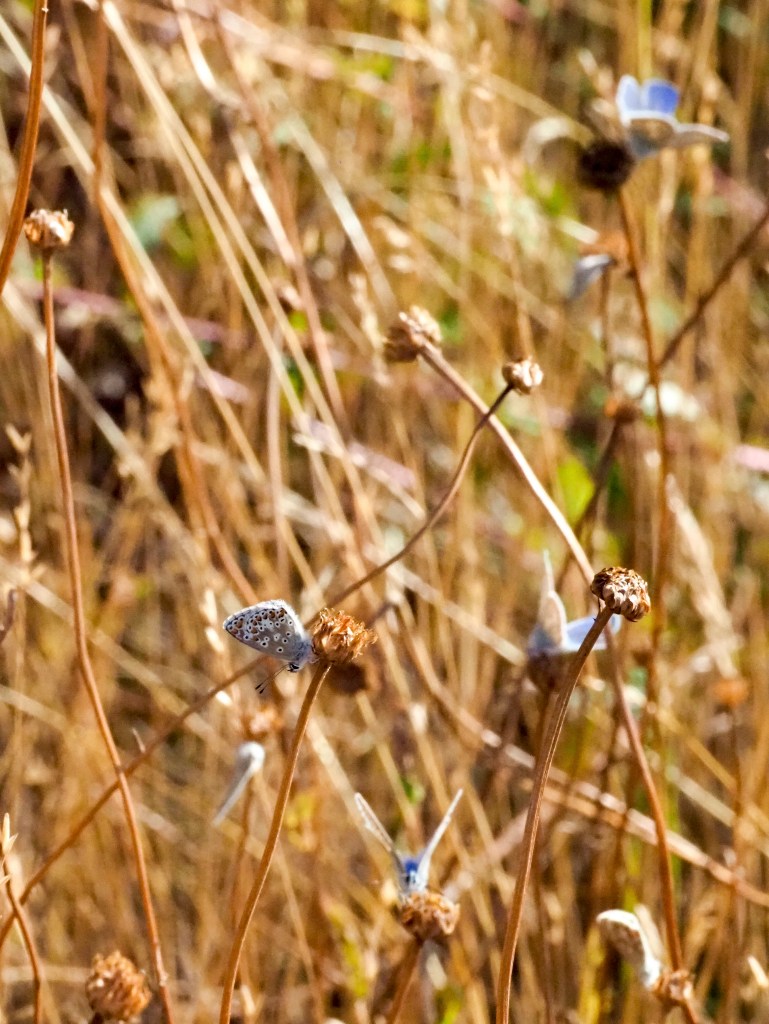
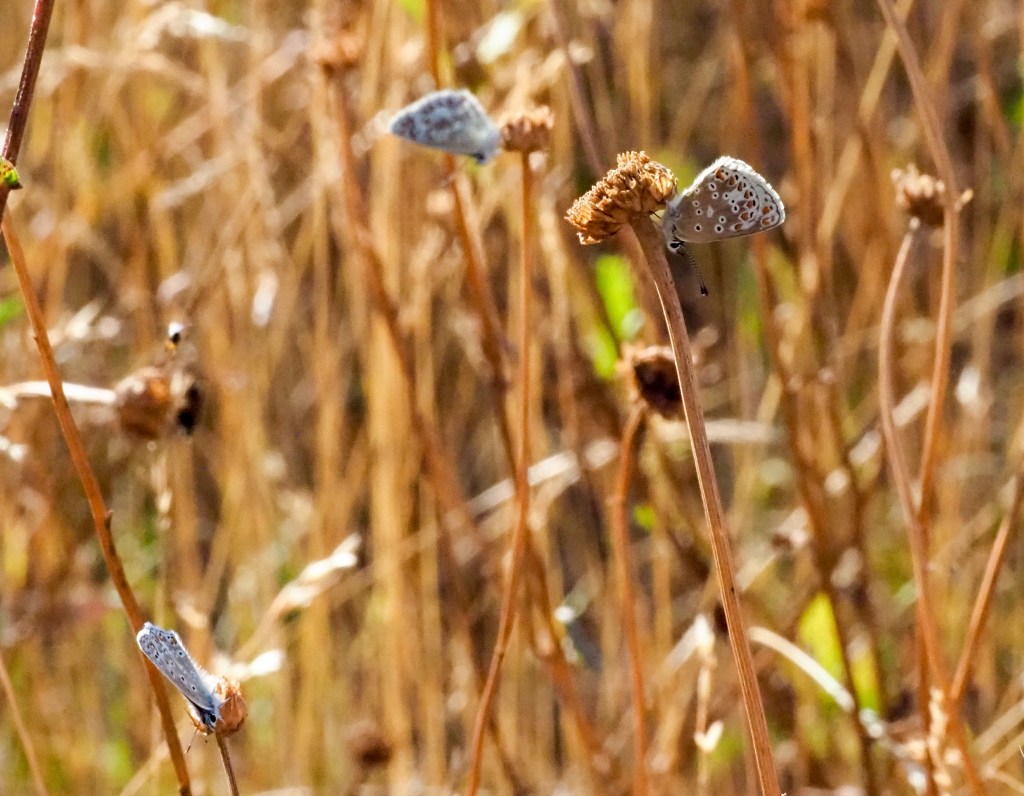
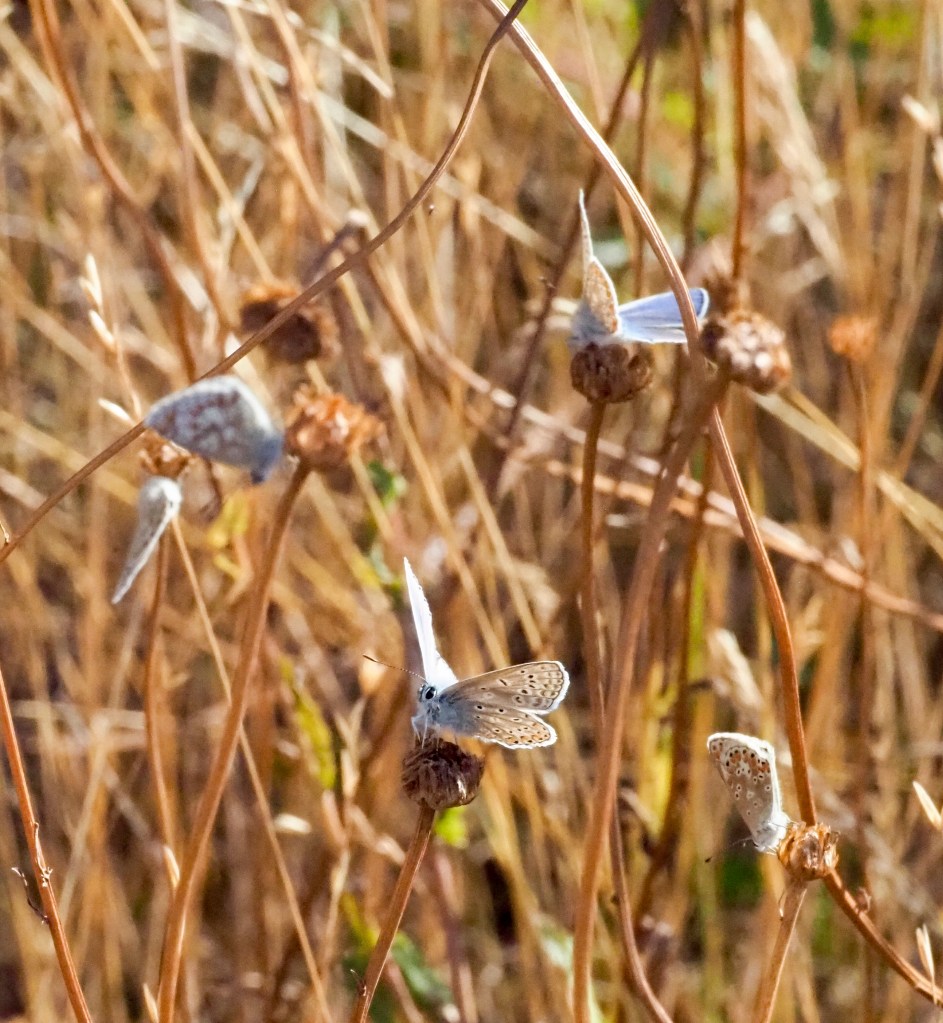
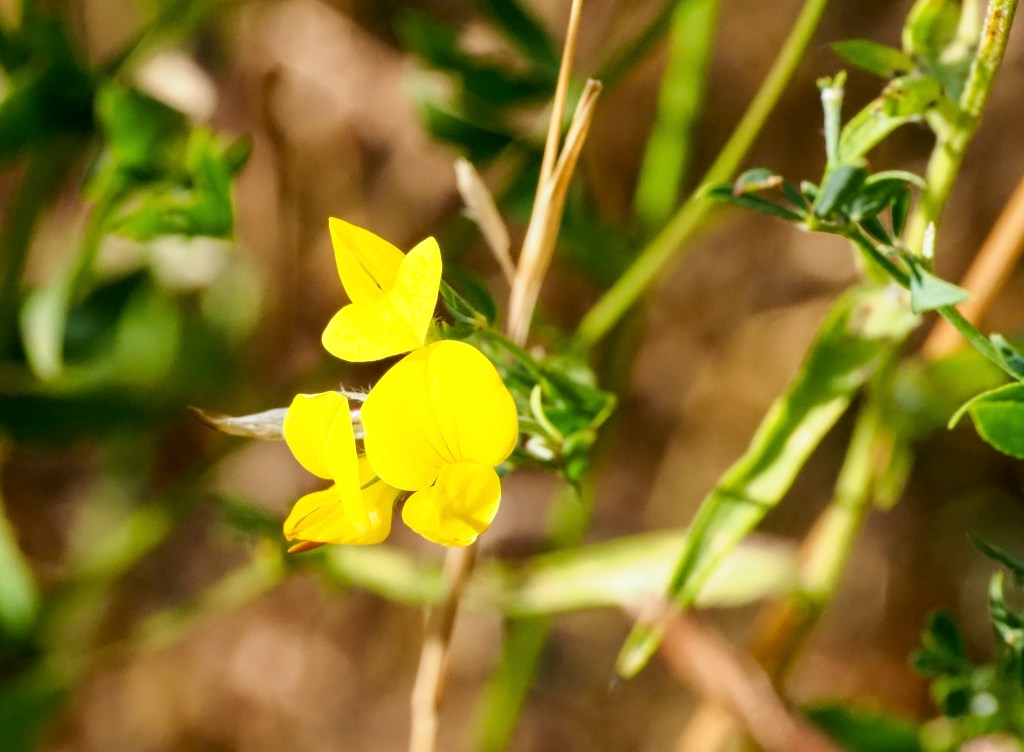
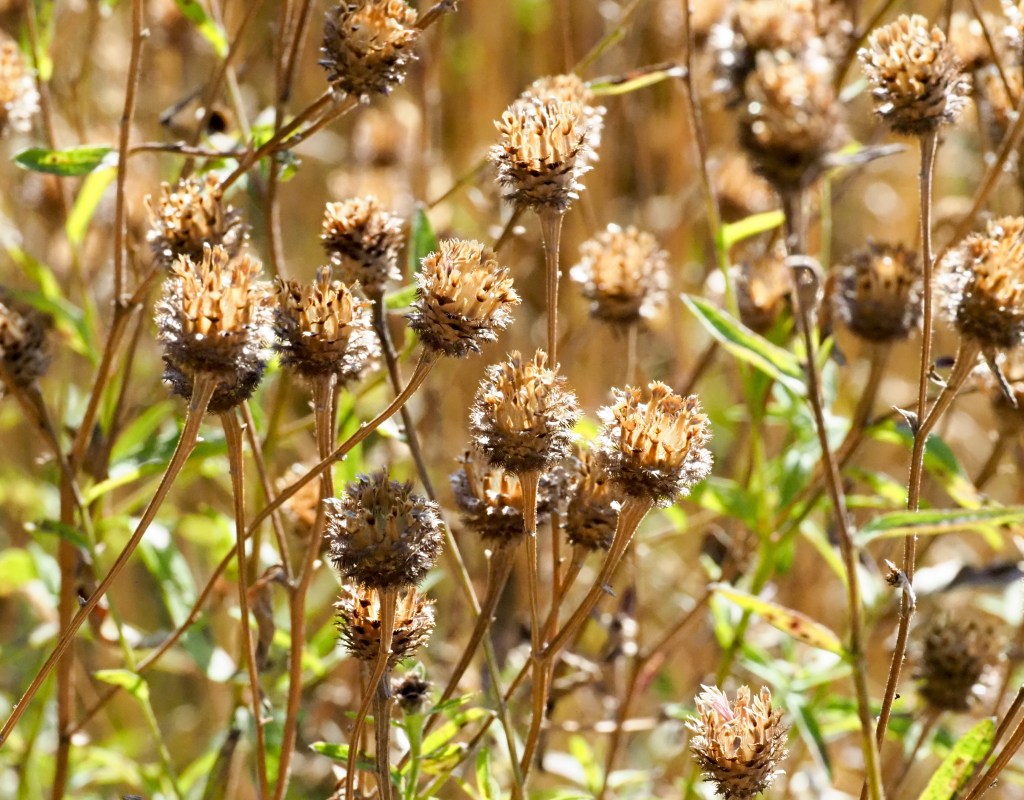
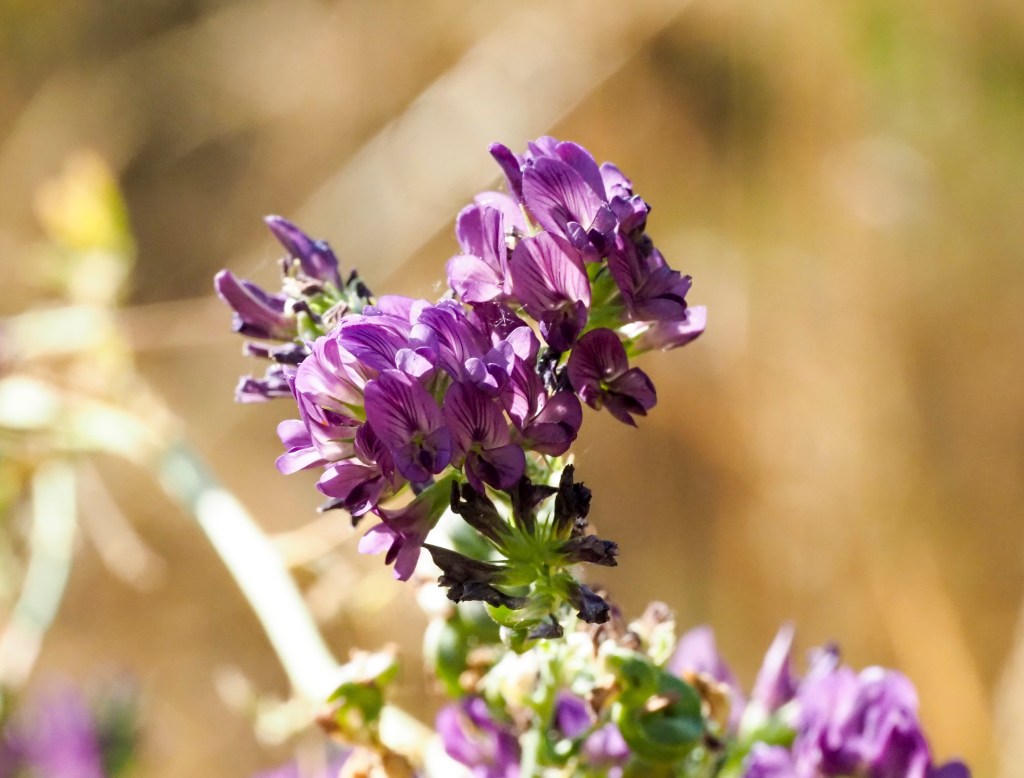
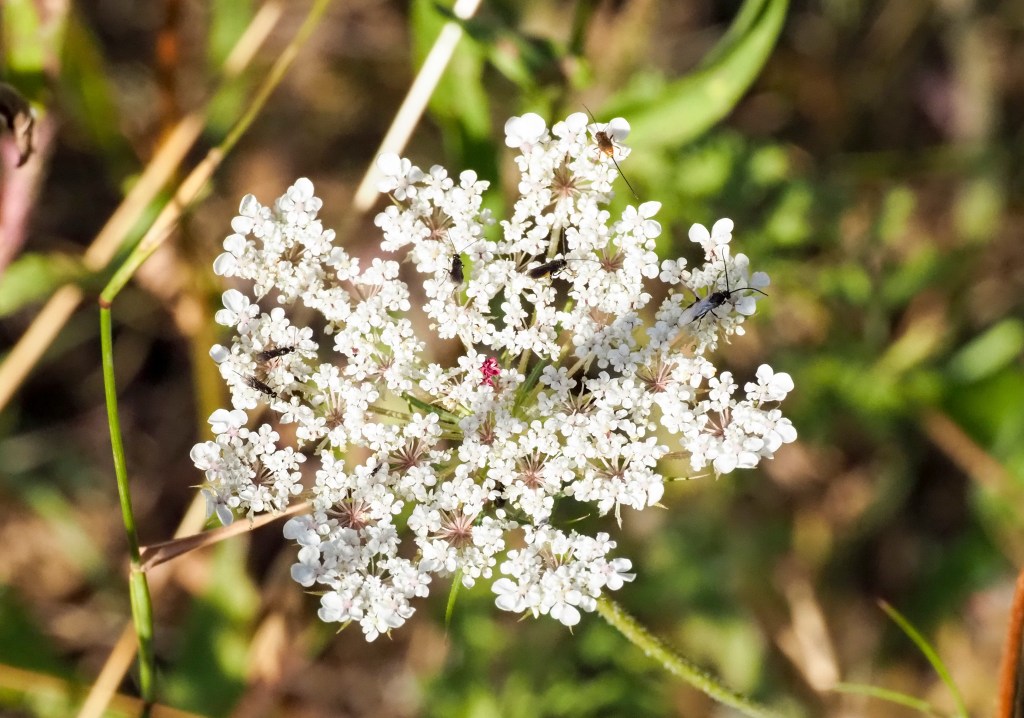
This field is usually left uncut, and is dominated by common knapweed (Centaurea nigra), but it also contains many other flowers of interest to butterflies and other pollinators, including ragwort, bird’s foot trefoil (below left), poppies, thistles, common sainfoin, lucerne (below right), wild carrot (below bottom), daises and so on.
This is what the field typically looks like in mid-July (below). N.B. I have described the insect biodiversity in this meadow in a previous blog (see here) but this was the first time I have came across so many ‘blues’.
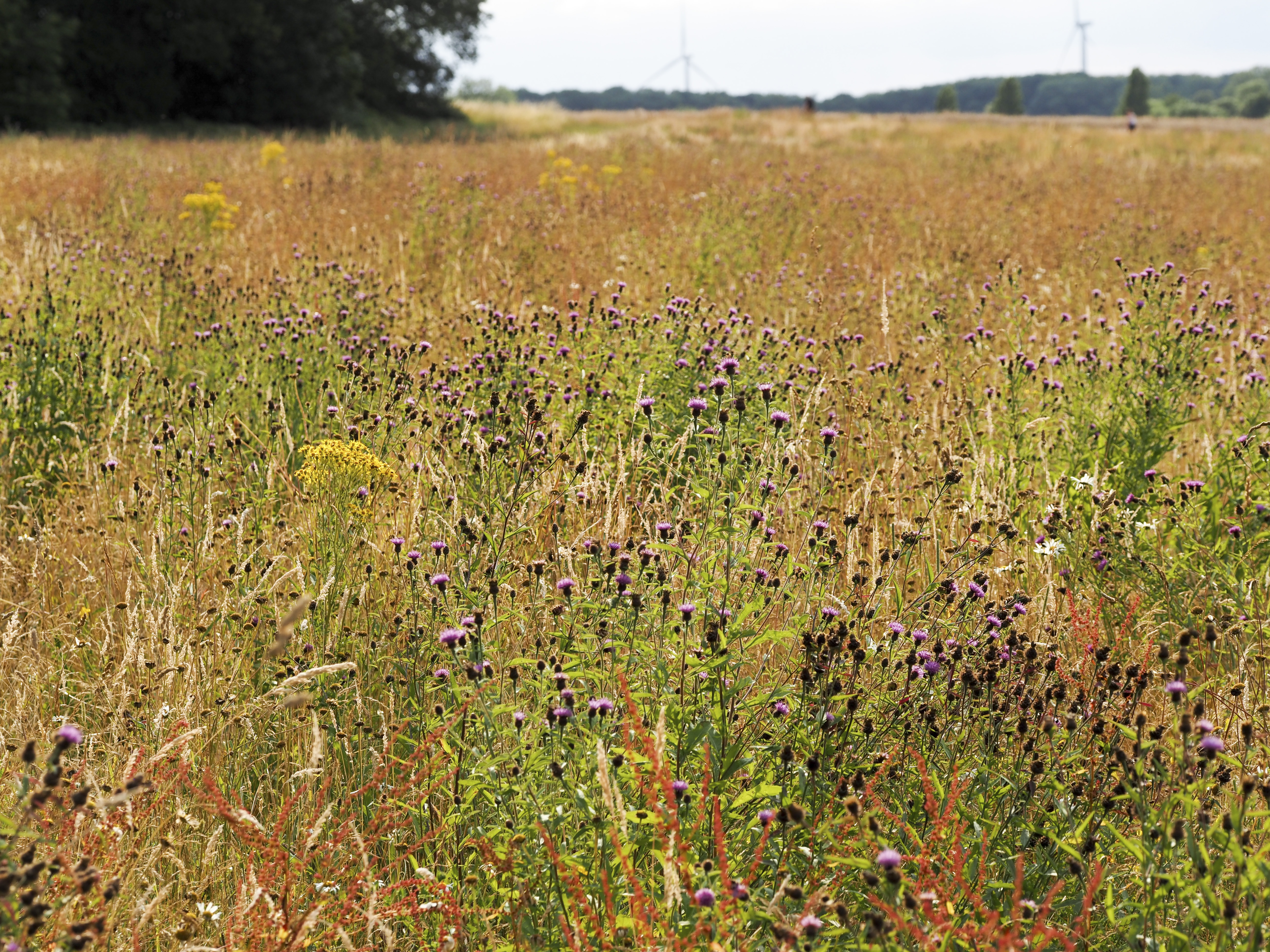
Photo by Raymond JC Cannon
Returning to the state of affairs this year (2026), the summer was exceptionally hot in southern England and by early August the meadow was very dry and almost all of the knapweed flowers had finished flowering (see below).
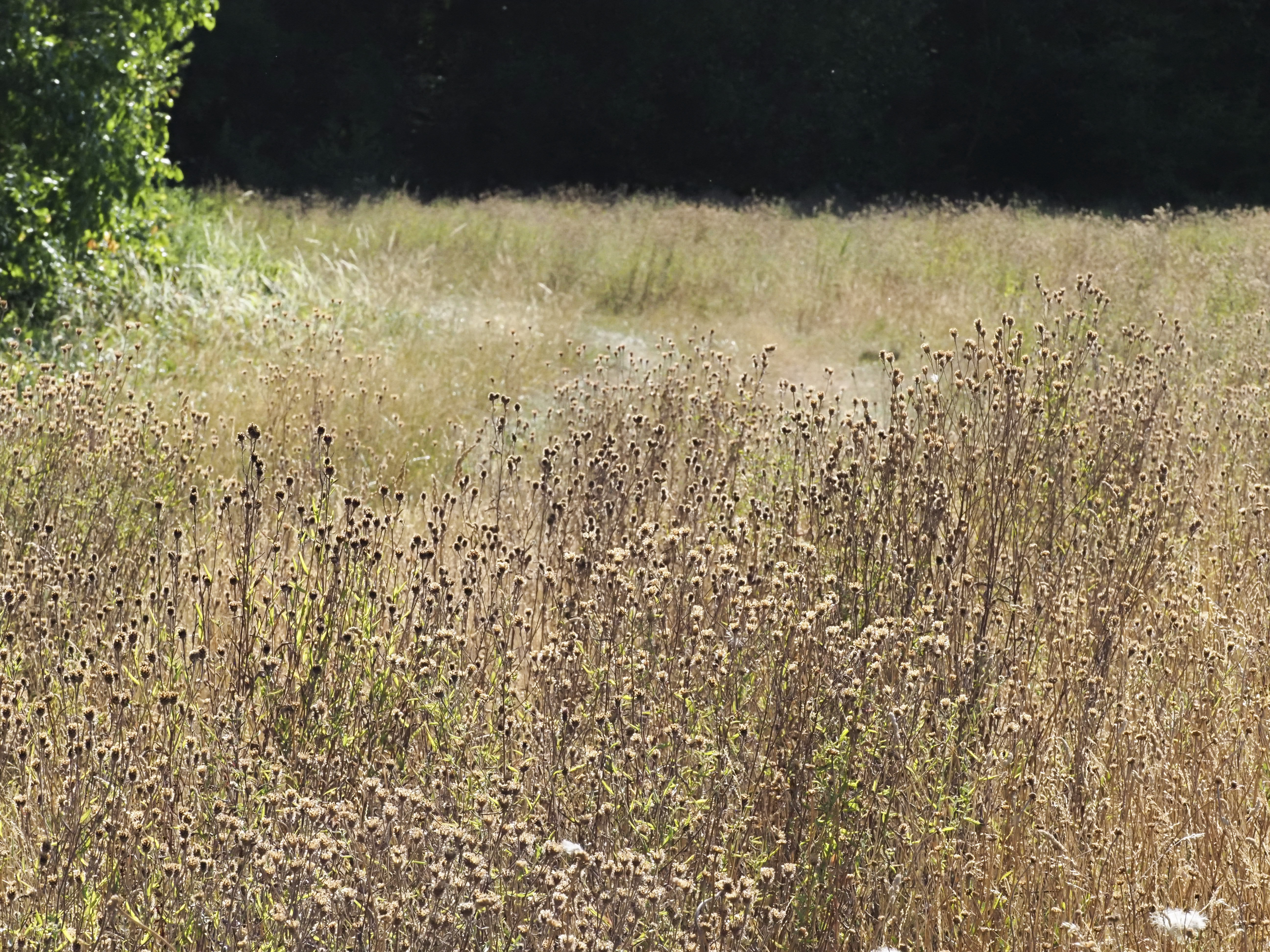
There were however, a few, scattered nectar sources of the types mentioned above, and I am sure that the butterflies were highly adept at finding them!
The butterflies present in early August were second broods – i.e. the second generation of the year – which typically emerge in late July to early August. These second generation populations can be very abundant in some years, and this hot summer was clearly one of them.
The knapweed and grass stems provided perching and basking sites for the butterflies, but they may have developed as caterpillars on host plants in the adjoining woodland areas.
Turning to the butterflies themselves now.
Common Blues
The upper wing surfaces of some female common blue butterflies can be quite brown, although they always have a fine dusting of blue scales near the body (see below).
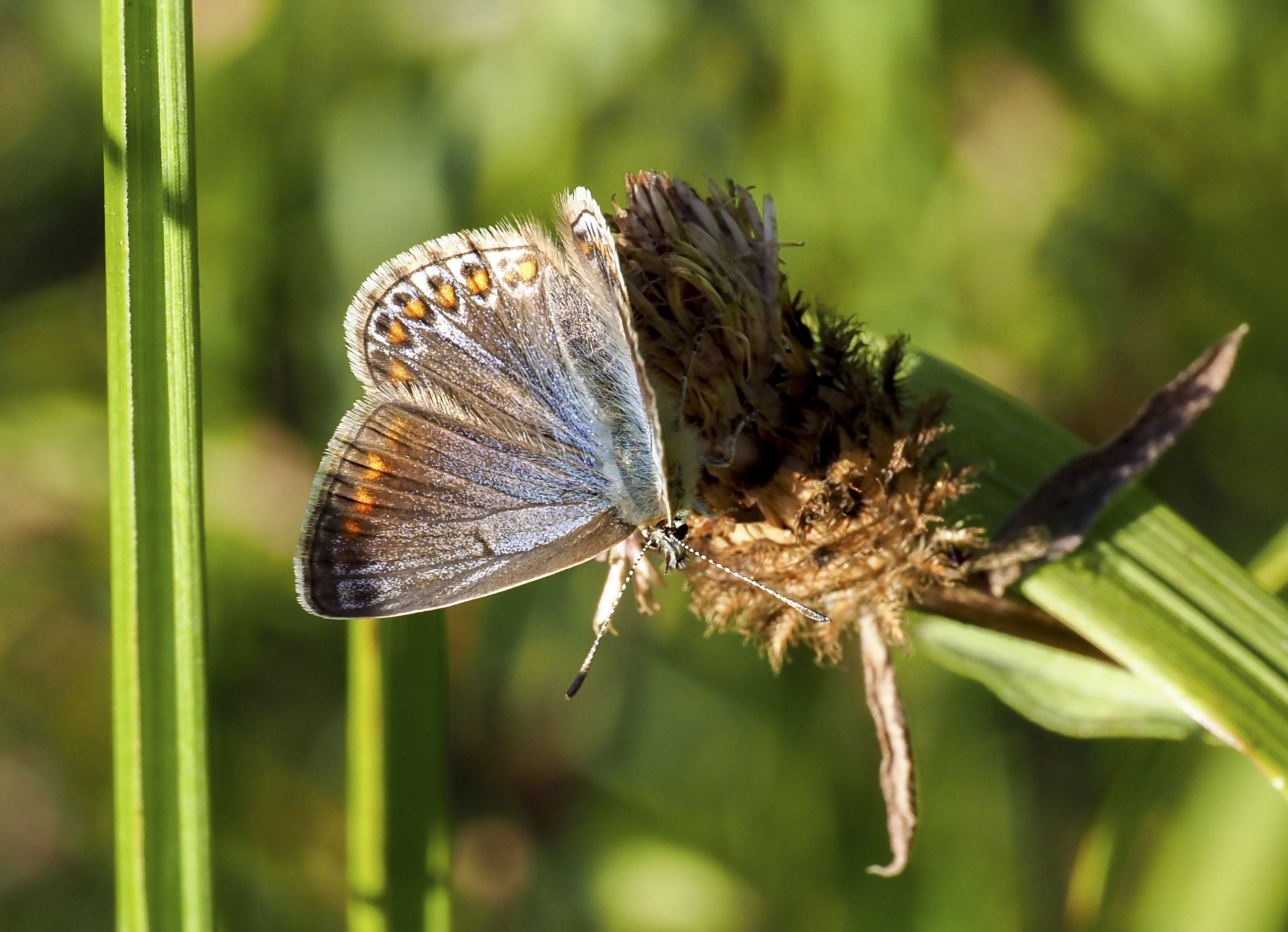
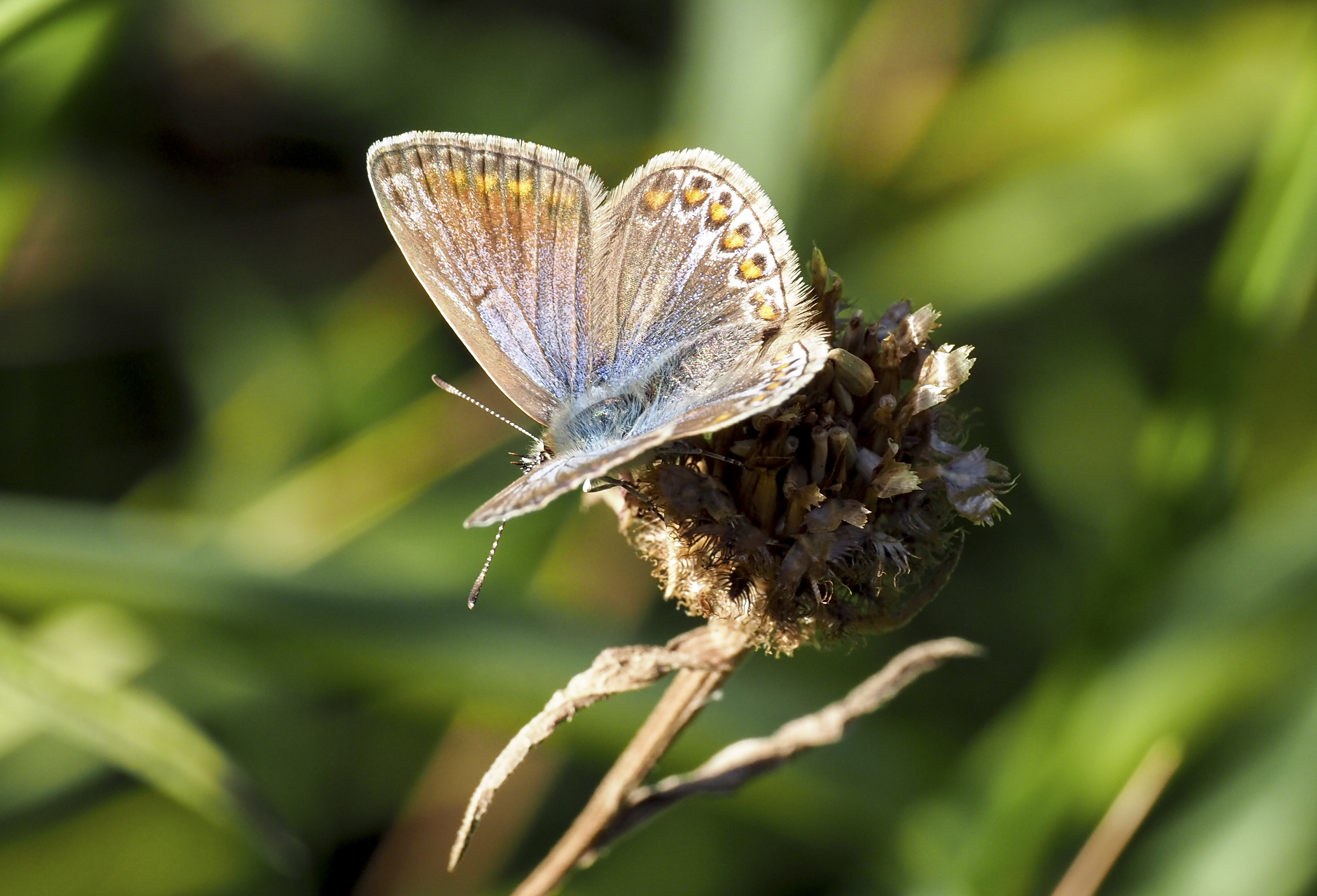
They also have a row of orange spots along the outer edges of the wings (ups), so they can sometimes be difficult to separate from female brown argus butterflies in the field. However, the forewings of the latter have a distinctive mark (see below) and a complete absence of blue scales.
The really beautiful thing about female common blue butterflies is the variability of their upper-wing colouration, with the amount of blue dusting depending on the region in which the develop. Some females are almost totally brown, while others exhibit quite a lot of blue.
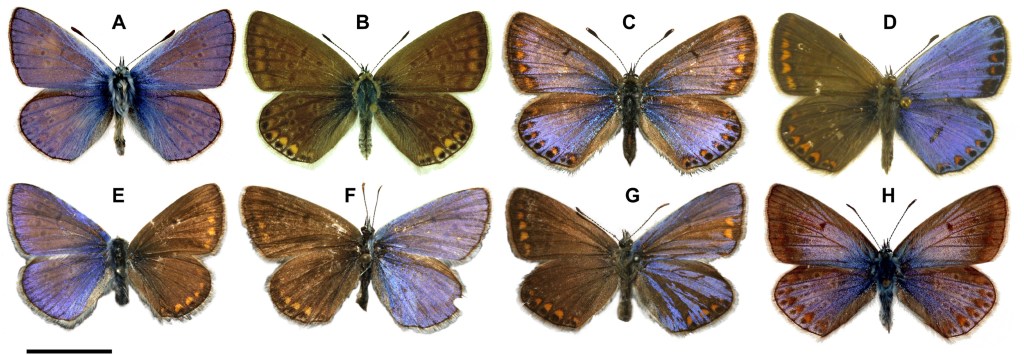
CC BY-NC-ND 4.0
In the UK, the colour of the upper (ups) wings of female common blues varies from “almost completely brown in southern England” to “predominantly blue in western Ireland and Scotland”, but the colour is often quite variable within local populations (Butterfly Conservation). For example, here are some more females I have photographed in Bedfordshire, officially in the East of England (below).
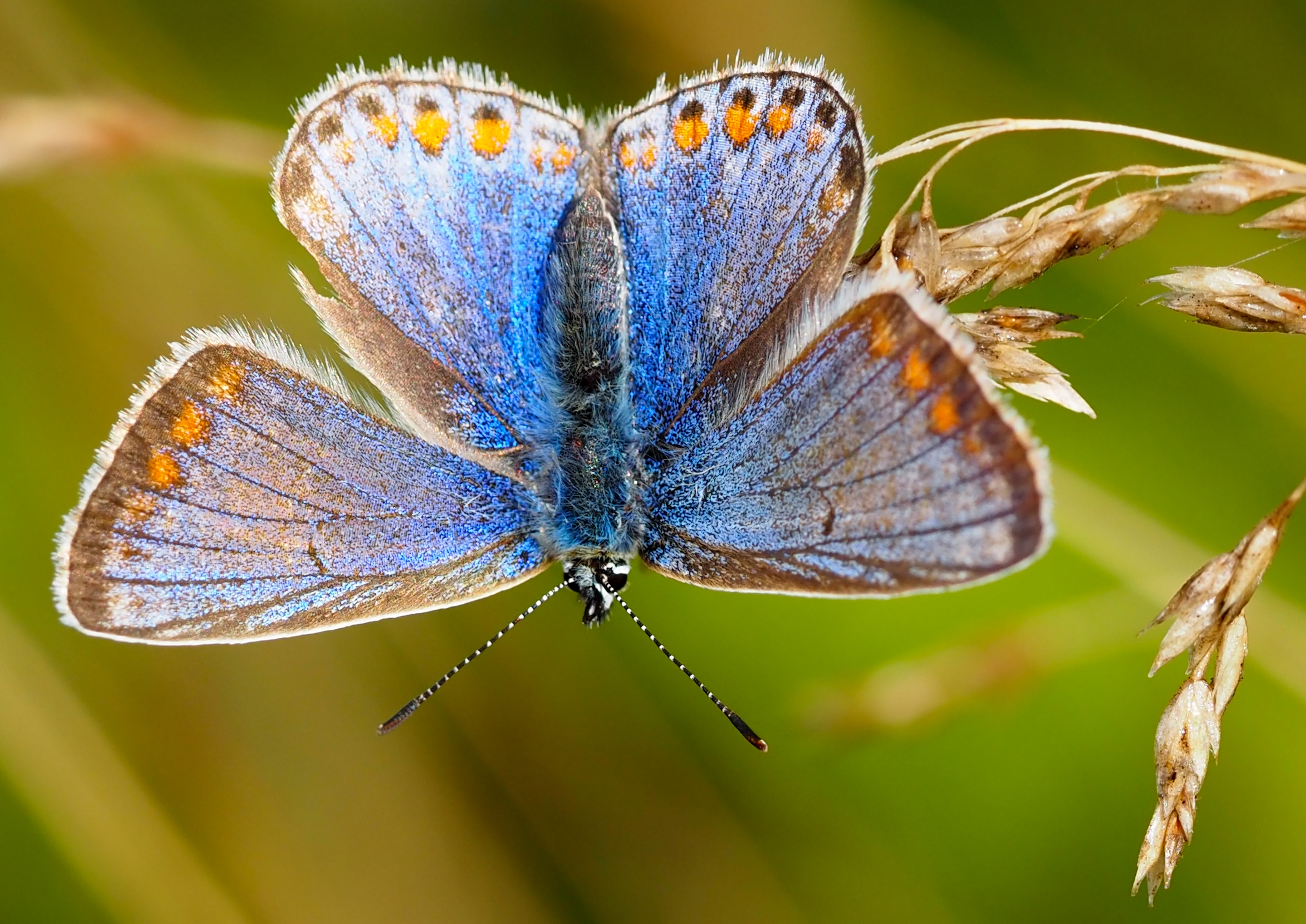
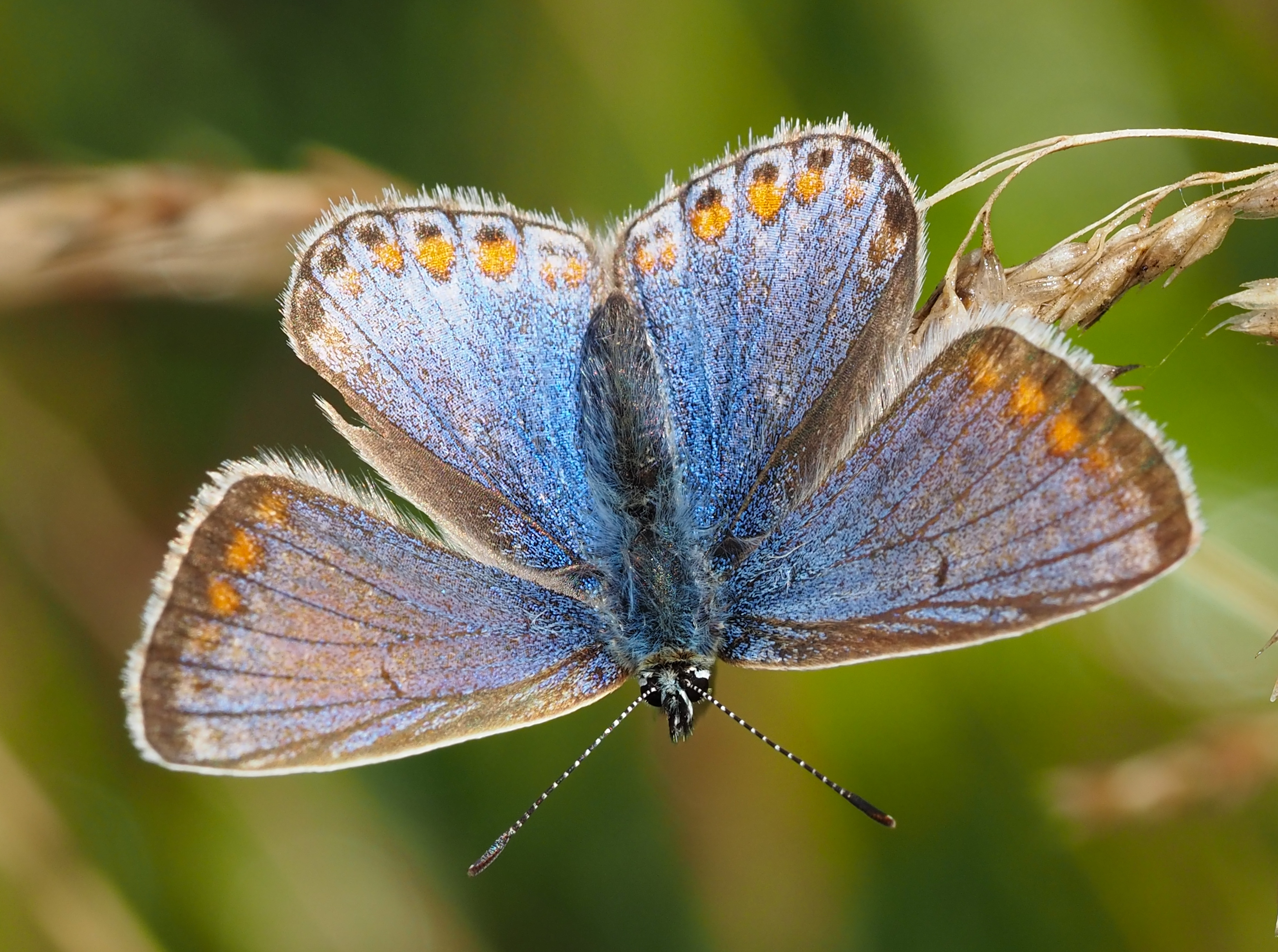
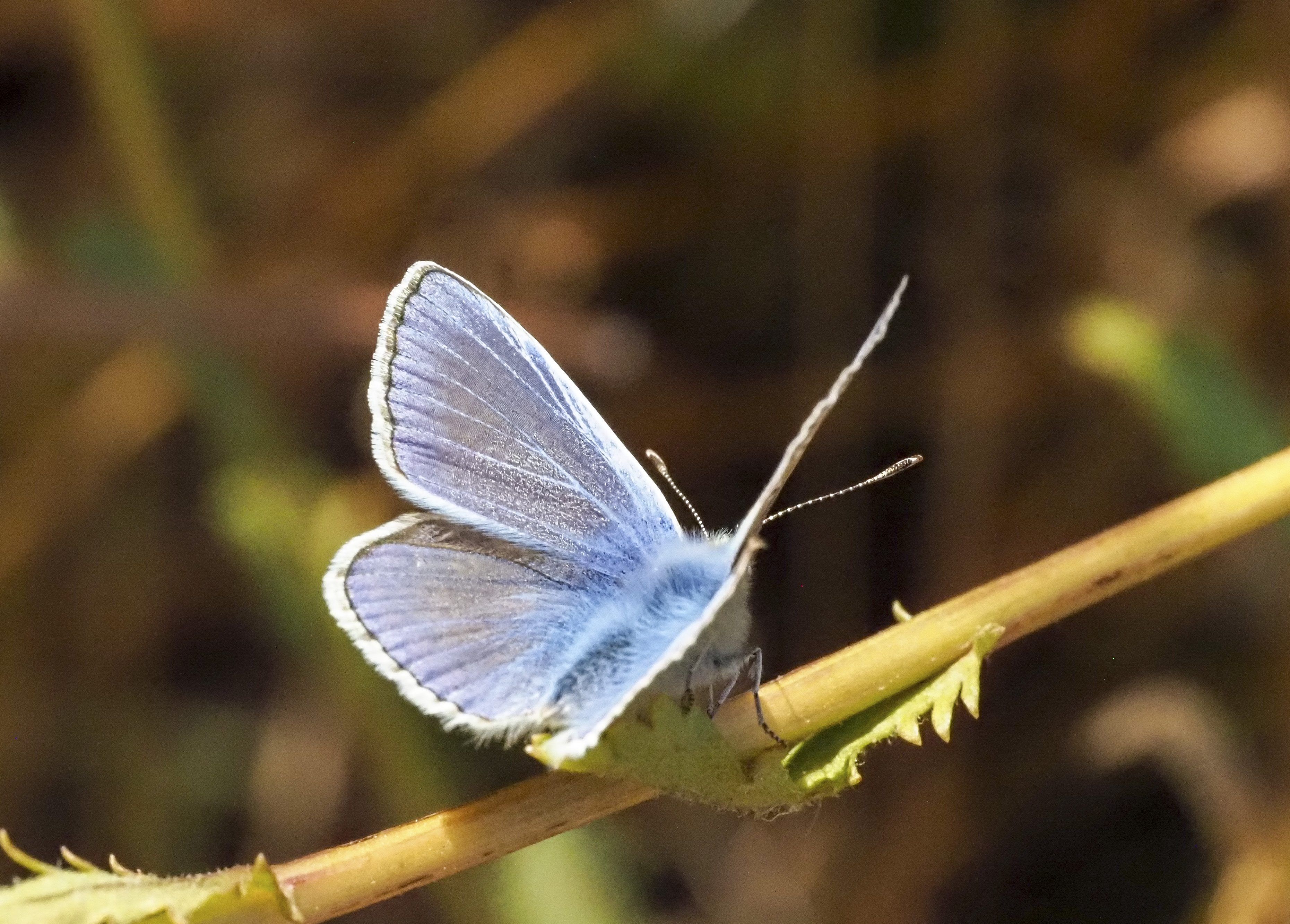
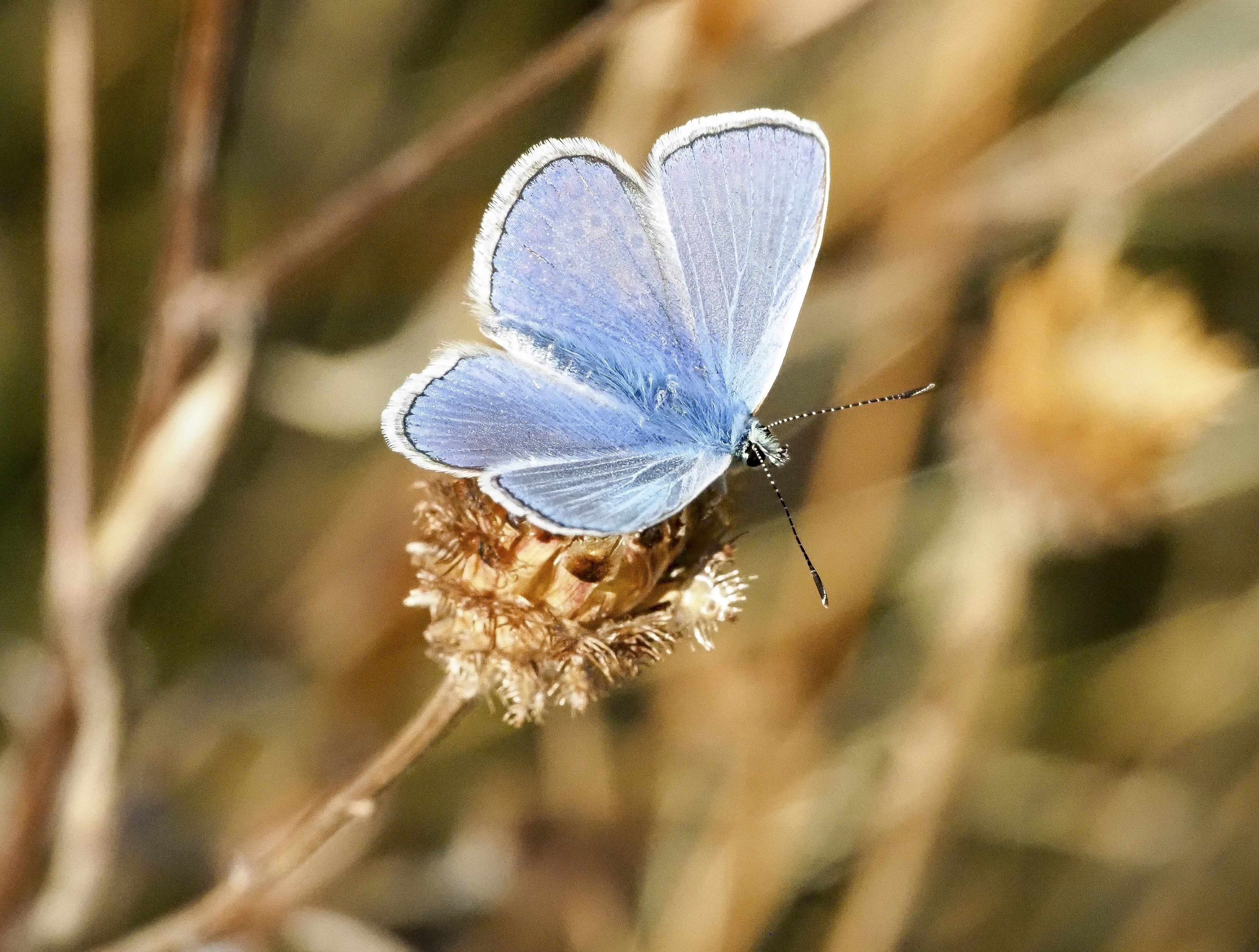
Male common blues have a highly conspicuous blue wing coloration which can be seen from a fair distance: a structural colouration generated by the photonic nanoarchitecture on the blue scales on the dorsal wing surface (see below).
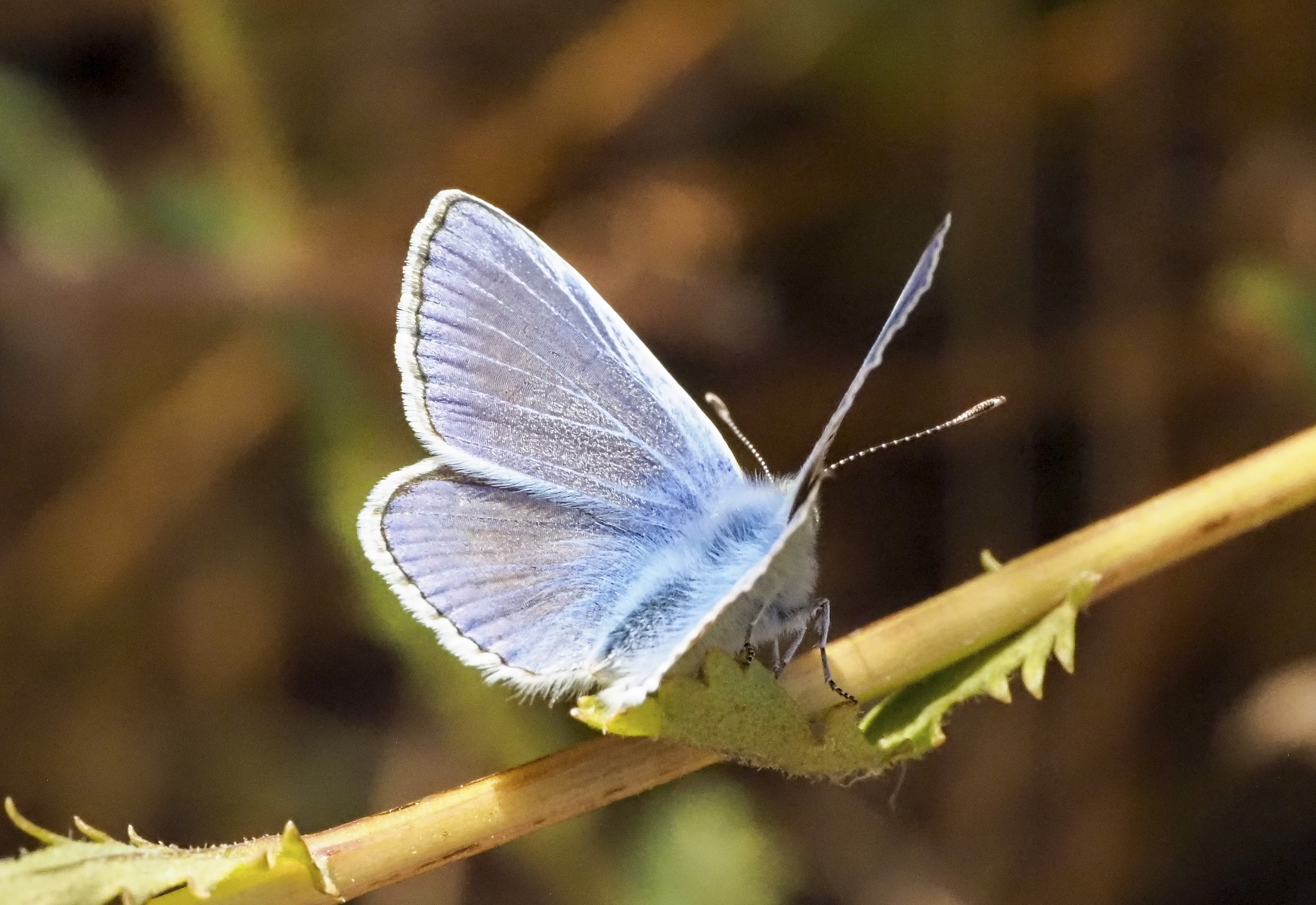
This iridescent blue colour is a sexual signal – both attractive to the opposite sex and a warning to other males – and the colour is remarkably stable. It remains at the same intensity in successive generations over the course of a year, and has not changed in at least 100 years – discovered by comparing museum specimens collected over a century – probably much longer (Kertész et al., 2019).
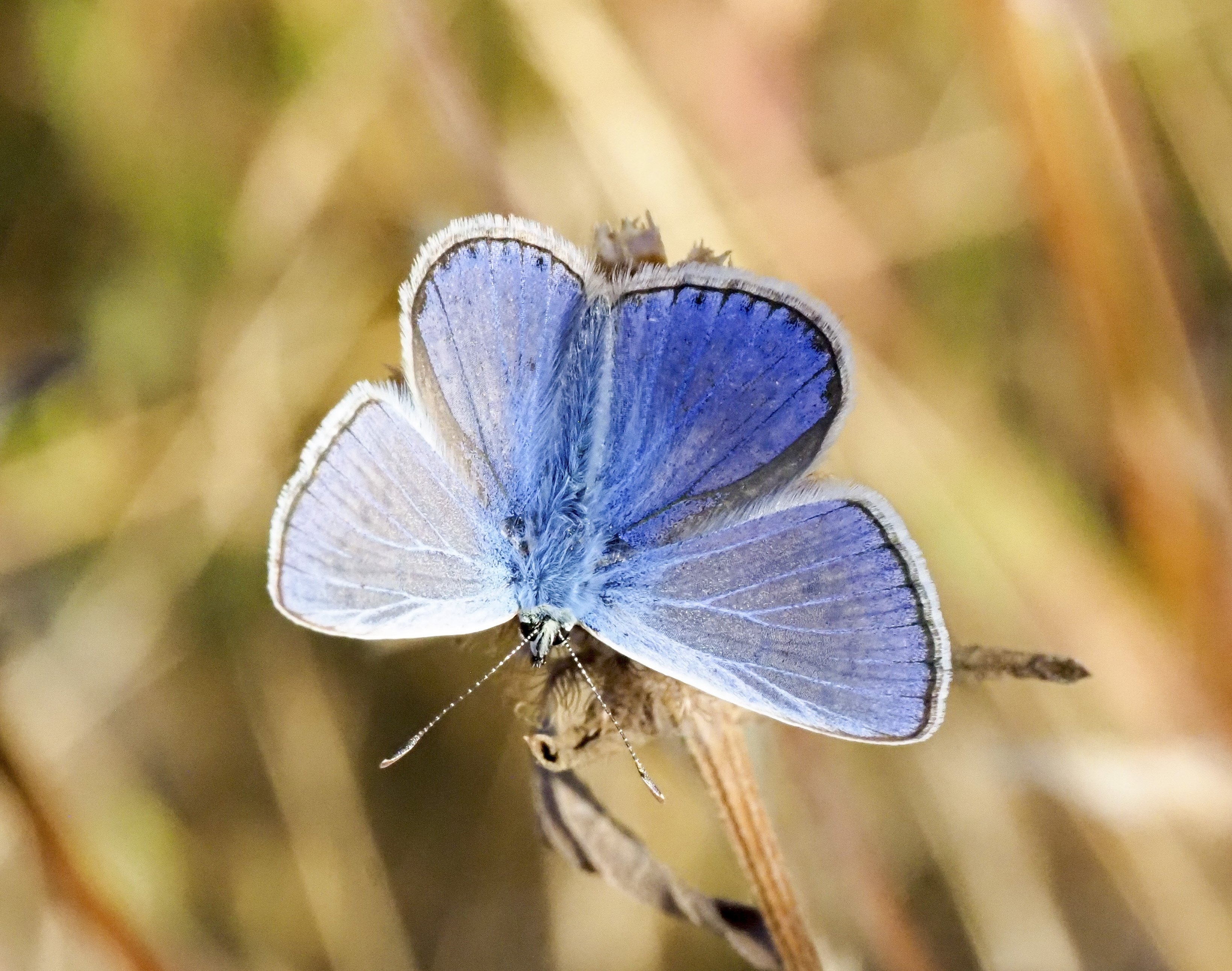
As mentioned above, the common blue butterfly usually has two distinct broods each year in southern England, but in especially warm and favorable years a partial third brood can occur. This appears to be happening now in September in some locations in southern England: see here.
Evaluating the quality of the opposite sex!
Butterflies have eyes that can see ultraviolet (UV) light, and they have intricate UV-reflecting structures on their wings, which may or may not be involved in communication within and between species. However, a number of different species use UV reflectance for mate recognition.
Flavonoids are naturally occurring plant compounds that absorb UV light. Many butterflies – including the common blue and the chalkhill blue, Polyommatus coridon – sequester these compounds whilst feeding as caterpillars on plants in the bean family, called Fabaceae or Leguminosae, such as Lotus corniculatus (see below).
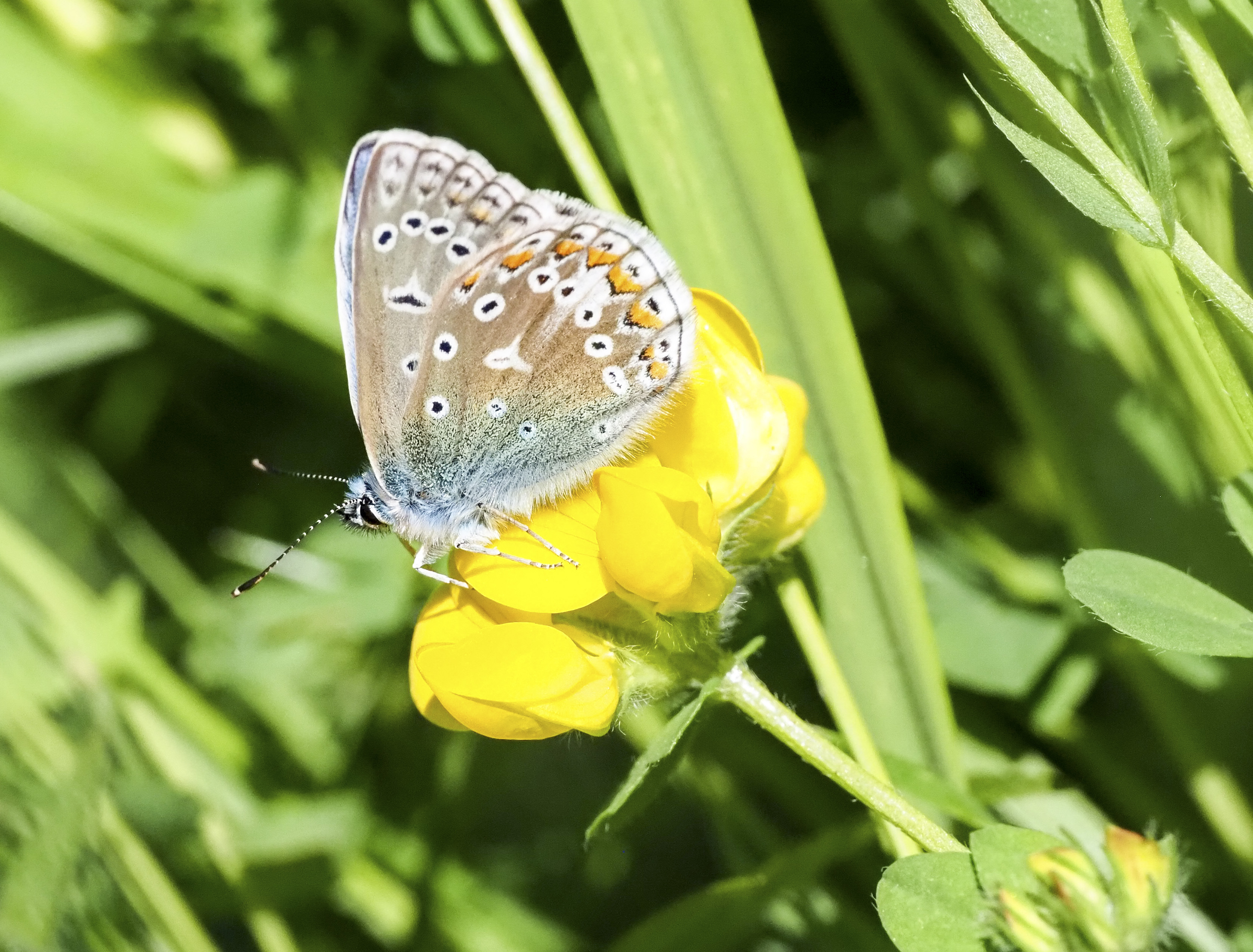
Photo by Raymond JC Cannon
Female common blues sequester larger amounts of flavonoids than males, and flavonoid-rich, strongly UV-absorbing, females are attractive to males, perhaps because of their more colour-saturated wings.
The undersides of the wings of flavonoid-rich butterflies are slightly more creamy or yellowish in colour – in visible light – but in ultraviolet light (or from the perspective of the UV-sensitive eyes of these butterflies) flavonoid-free butterflies reflect much more UV light than flavonoid-rich individuals. These differences are considered to be indicators of quality, i.e. of the larval diet.
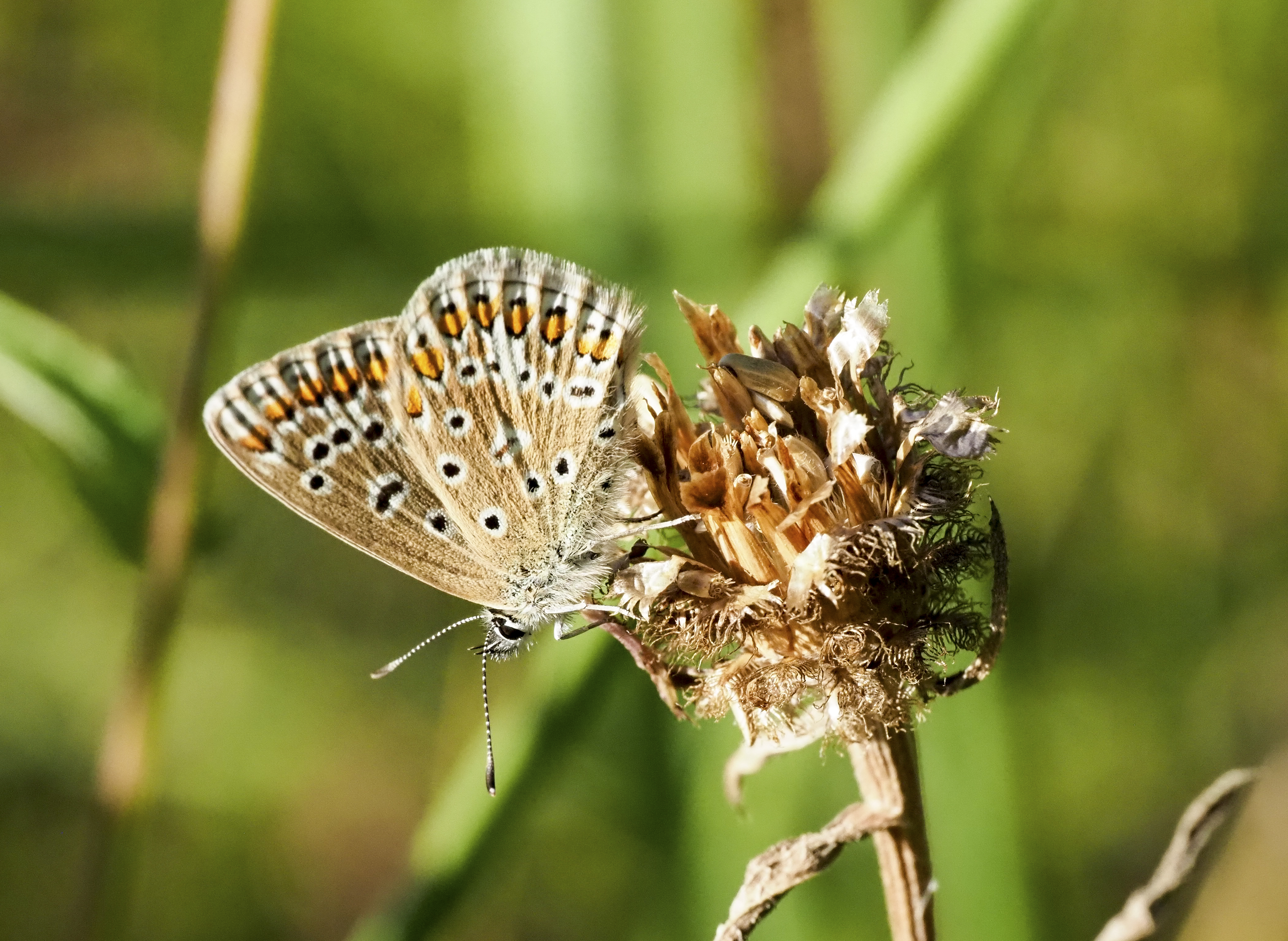
The flavonoid pigments are natural UV filters and rather than bouncing back ultraviolet wavelengths, these molecules capture and absorb short-wave UV radiation. So, the white wing patterning almost disappears completely in favonoid-rich individuals (Burghardt et al., 2000).
Male common blues are thought to use these contrasting UV-absorbing patterns to identify and evaluate female butterflies, finding flavonoid-rich females more attractive (discussed in Cannon, 2019).
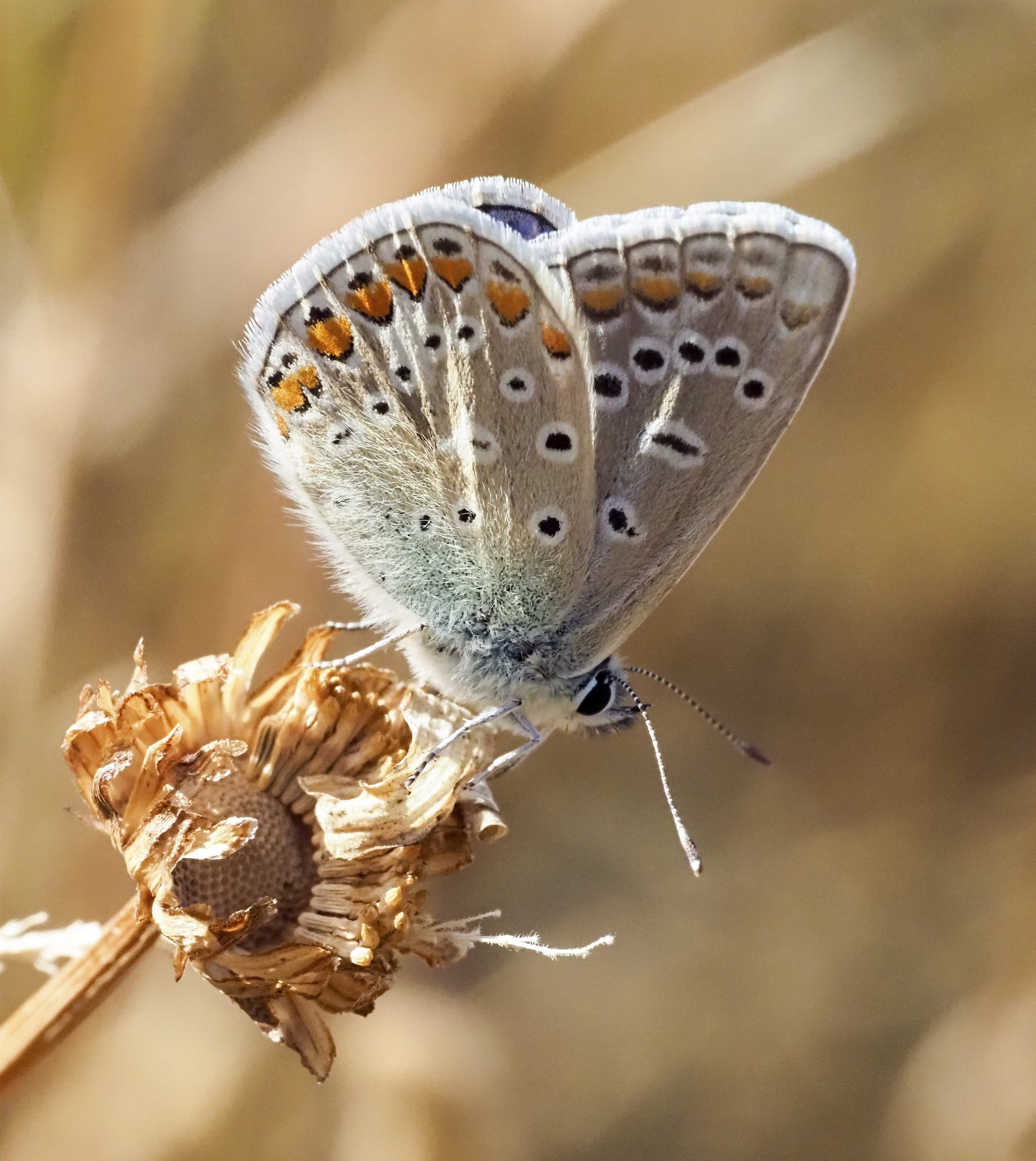
Fresh, which is to say newly emerged butterflies, with ‘intact reflectance colouration’ on their dorsal surfaces and an intensive, more saturated underside colour pattern, should be more conspicuous to other butterflies of the same sex in the field, especially over longer distances, according to Burghardt et al. (2001).
So the conventional wisdom is that these butterflies identify each other, and evaluate the intensity of their wing colouration, in both the ‘visible’ (i.e. visible to us humans) and ultraviolet (invisible to us) regions of the spectrum.
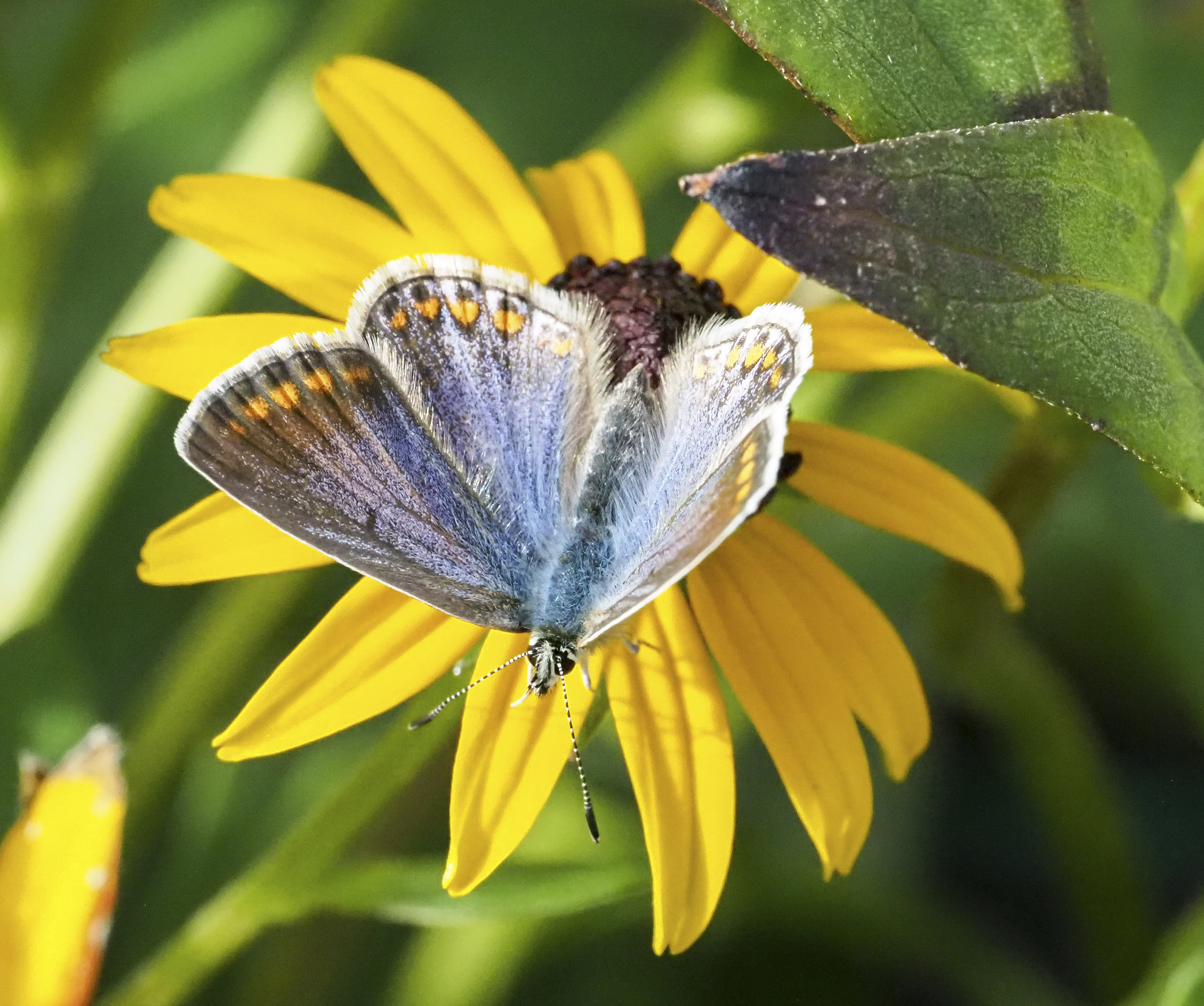
For females sitting amongst the vegetation waiting for mate-searching males which patrol through the habitat, the richness of their flavonoids substantially increases their attractiveness to the opposite sex (Burghardt et al., 2000). However, the older and more worn a female, the more likely it is that she will be ignored by the males (Burghardt et al. 2001).
In other words, P. icarus butterflies lose UV-absorbing flavonoid pigments during the course of their short lives via the loss of pigmented scales.
The three things most important things for the survival and reproduction of a butterfly population are:
i) that females and males need to find each other and mate;
ii) that adult females can successfully deposit their eggs in sites where their larvae can feed on the host plants; and
iii) that adults can find sufficient food in order to live long enough to fulfill the first two tasks (Wiklund, 1977).
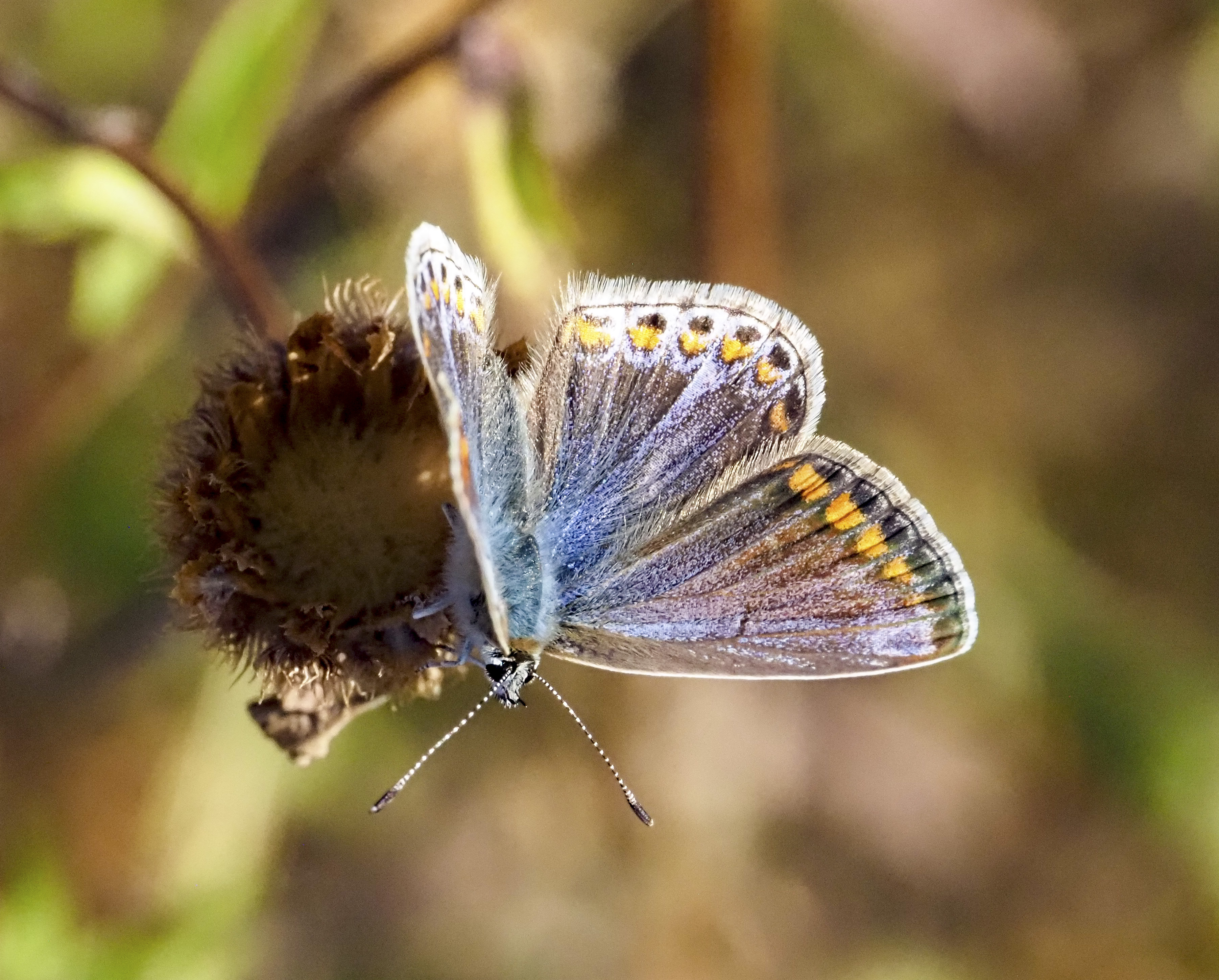
Depending on her ability to fly and the distribution of nectar sources, a female common blue must either use a limited area, which contains all three types of habitat – for mating, breeding and foraging – or she must move between areas that seperately provide these necessities (Janz et al., 2005).” In this case the different habitats are meadows and woodland.
Brown Argus butterflies
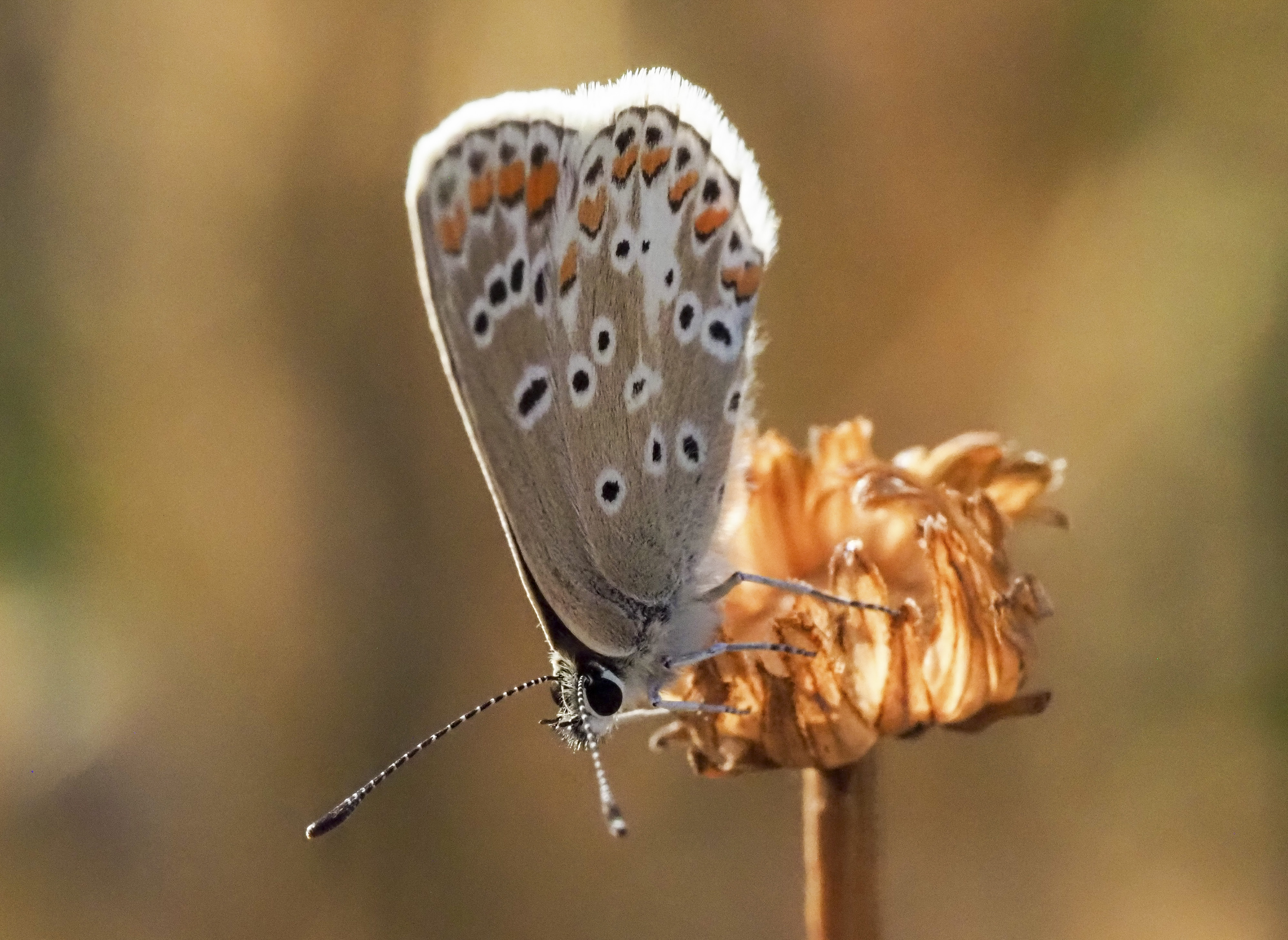
As we have seen, the brown argus can sometimes be confused with the dark form of the female common blue; however the latter lacks the tell-tale “figure of eight” mark on the undersides of the hindwing: two spots on the rear wing that are close together, almost forming a figure of eight, or a colon (see below). N.B. These spots are more widely spaced on the common blue.
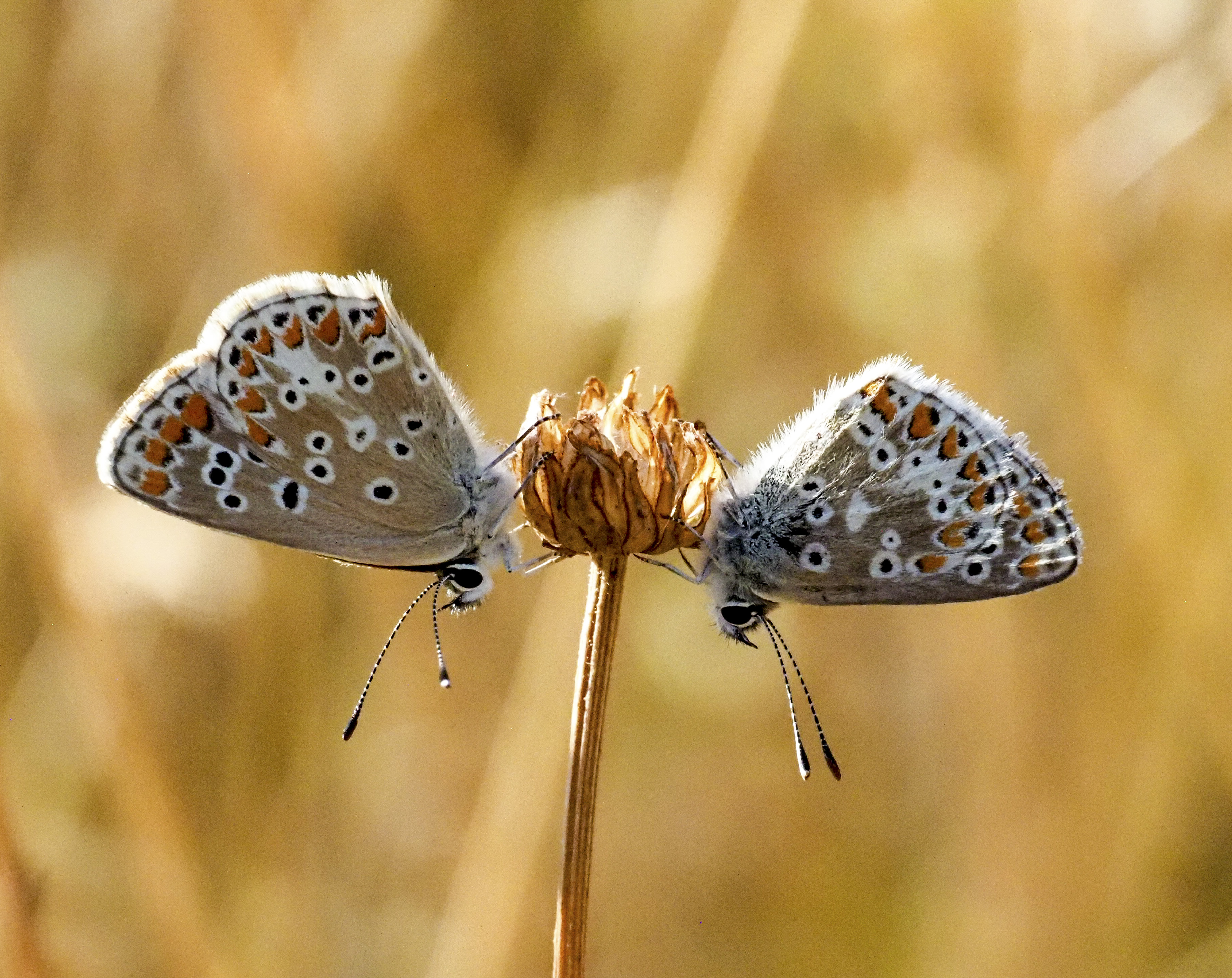
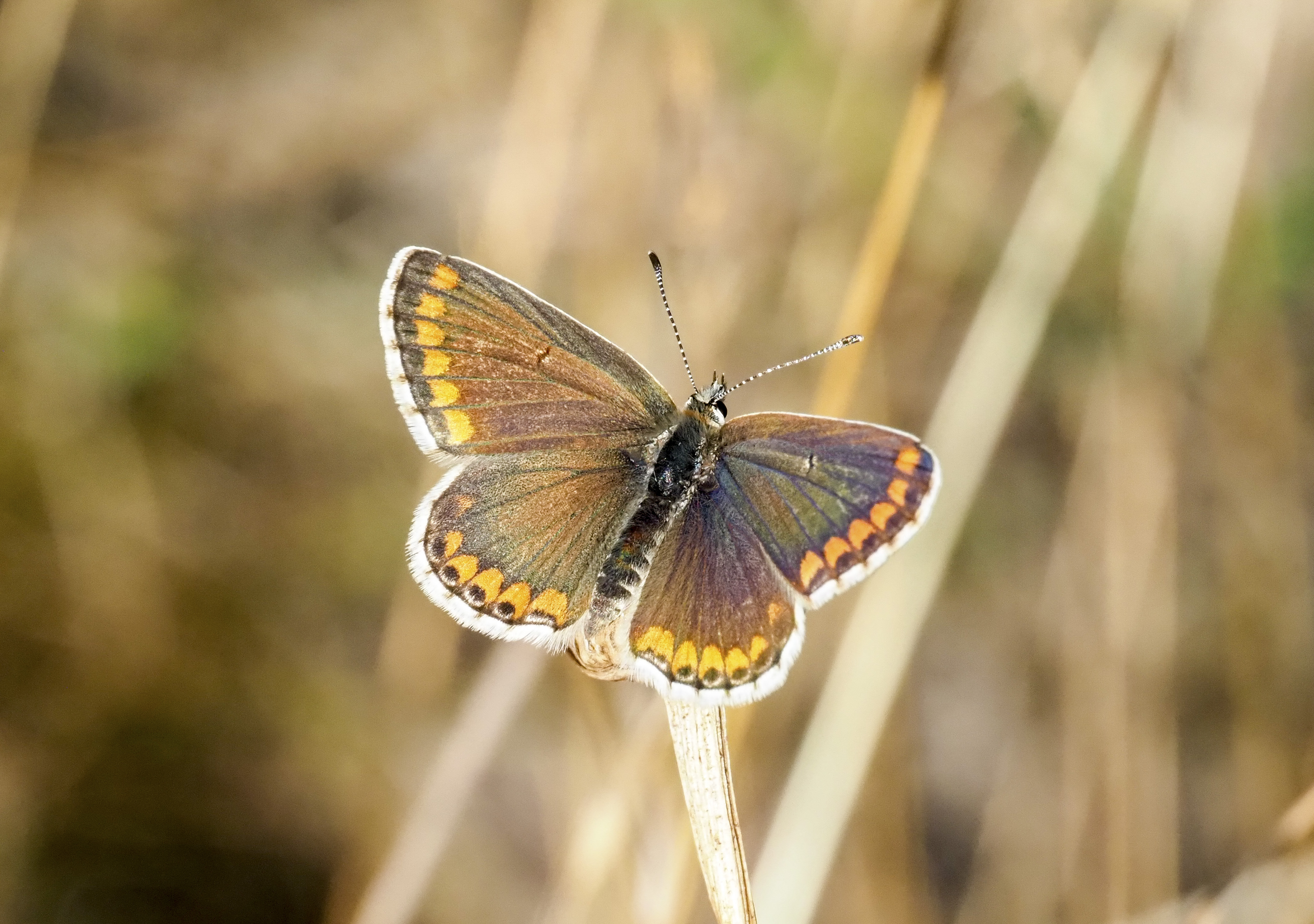
Brown argus butterflies are not markedly sexually dimorphic: both sexes have dark brown upper wings, highlighted by orange marginal lunules. There is no blue on the wings and there is a border of clear orange spots across both wings.
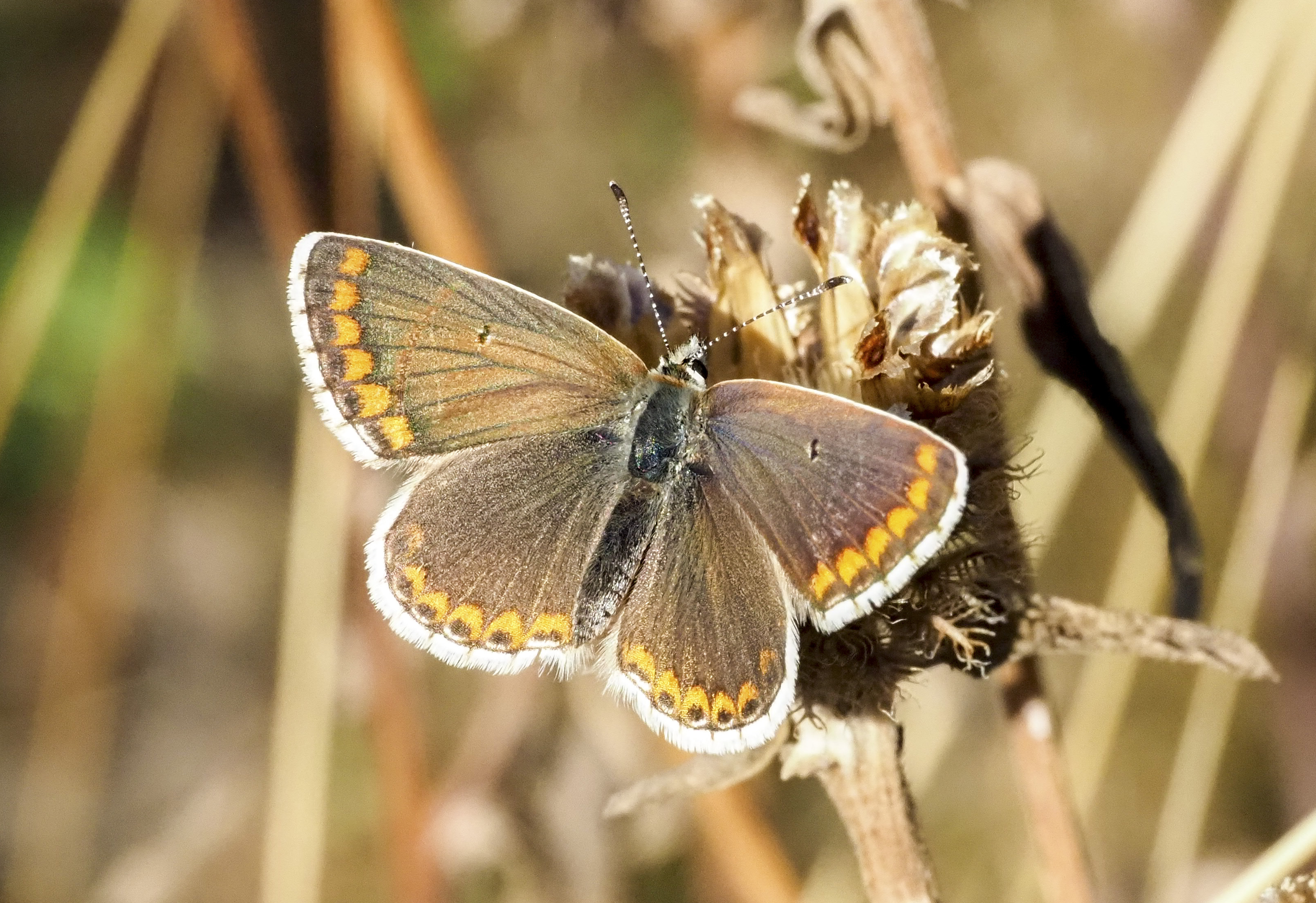
The band of orange spots on the upper wings can sometimes fade or become less distinct in older males, while females tend to maintain bright, prominent orange markings that extend well toward the wing tips.
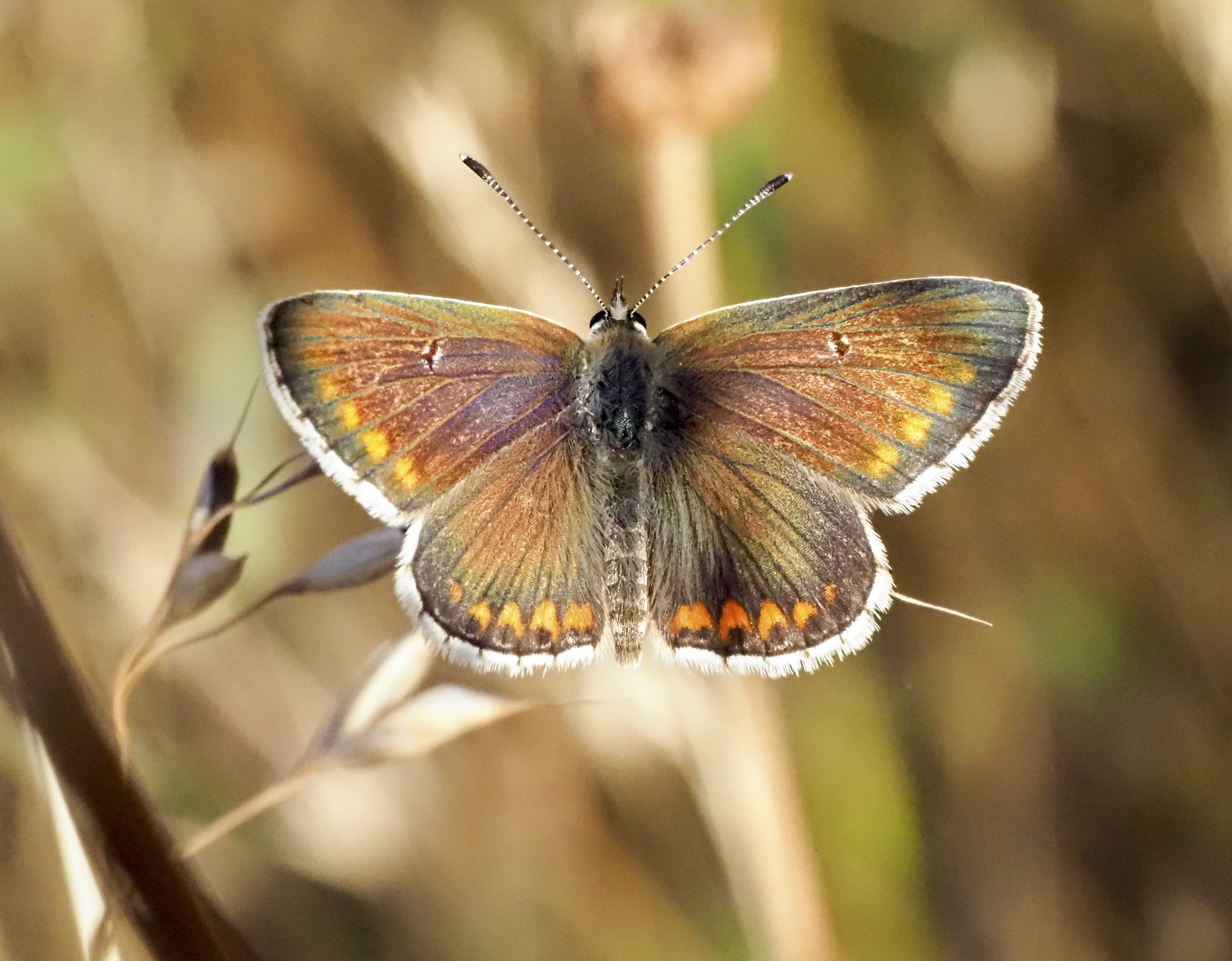
When warming up, the brown argus typically settles on low vegetation or bare ground with its chocolate-brown wings fully open and tilted directly toward the sun (see below). Maximum warming rates are achieved with the wings held fully open (De Keyser et al., 2015).
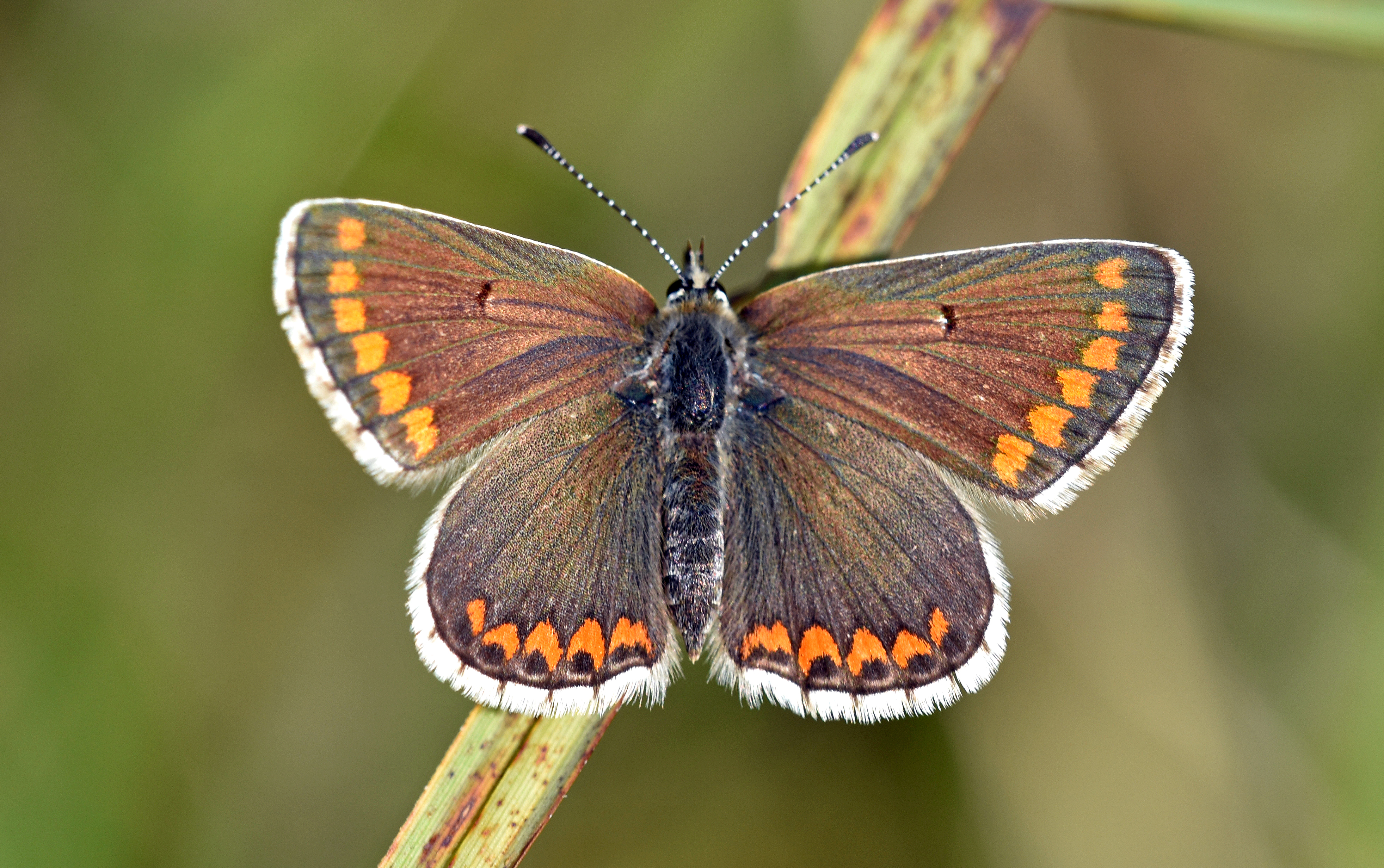
The male brown argus butterflies do not hold defined territories but rest on low grass stems and flower heads watching out for passing females. If disturbed, they can take flight, but often return to the same perch. If another similar sized butterfly comes into view, the male launches himself into the air and the two butterflies spiral upwards together before the intruder is chased off.
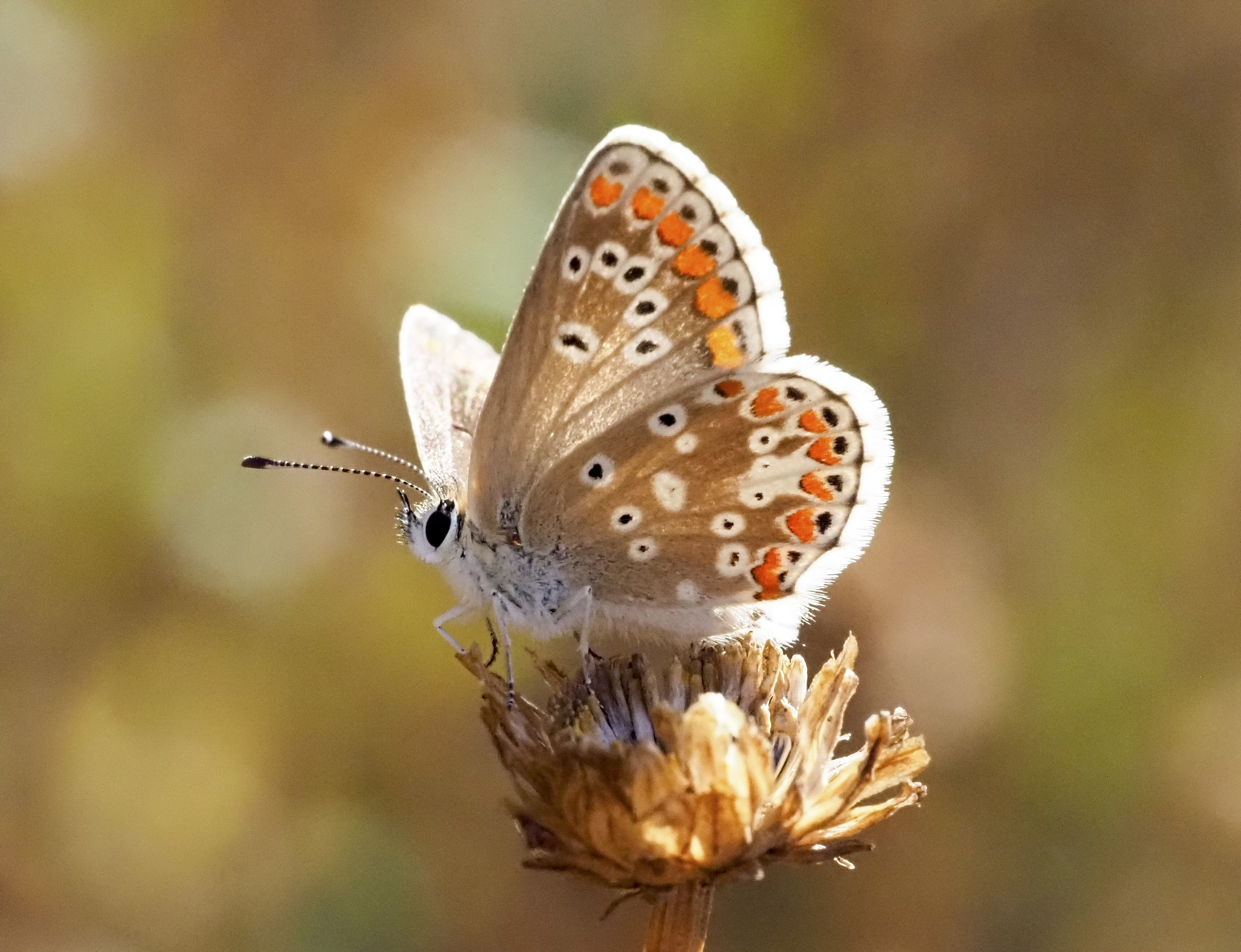
Mating usually occurs close to the ground and courtship involves a short, rapid flight, low down in, or over, the vegetation. I managed to photograph a male chasing a female (see below) in what looked to me like a courtship chase.
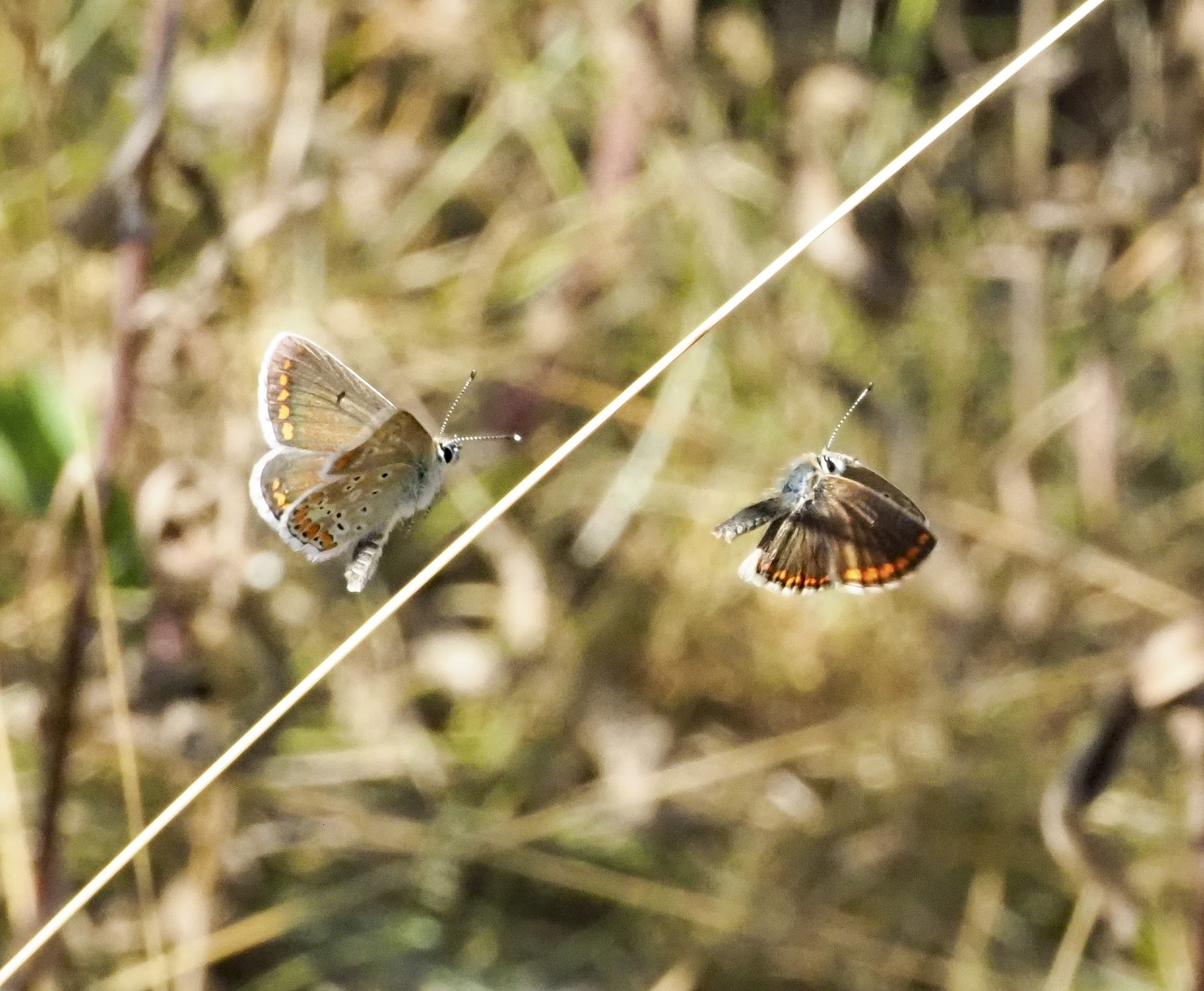
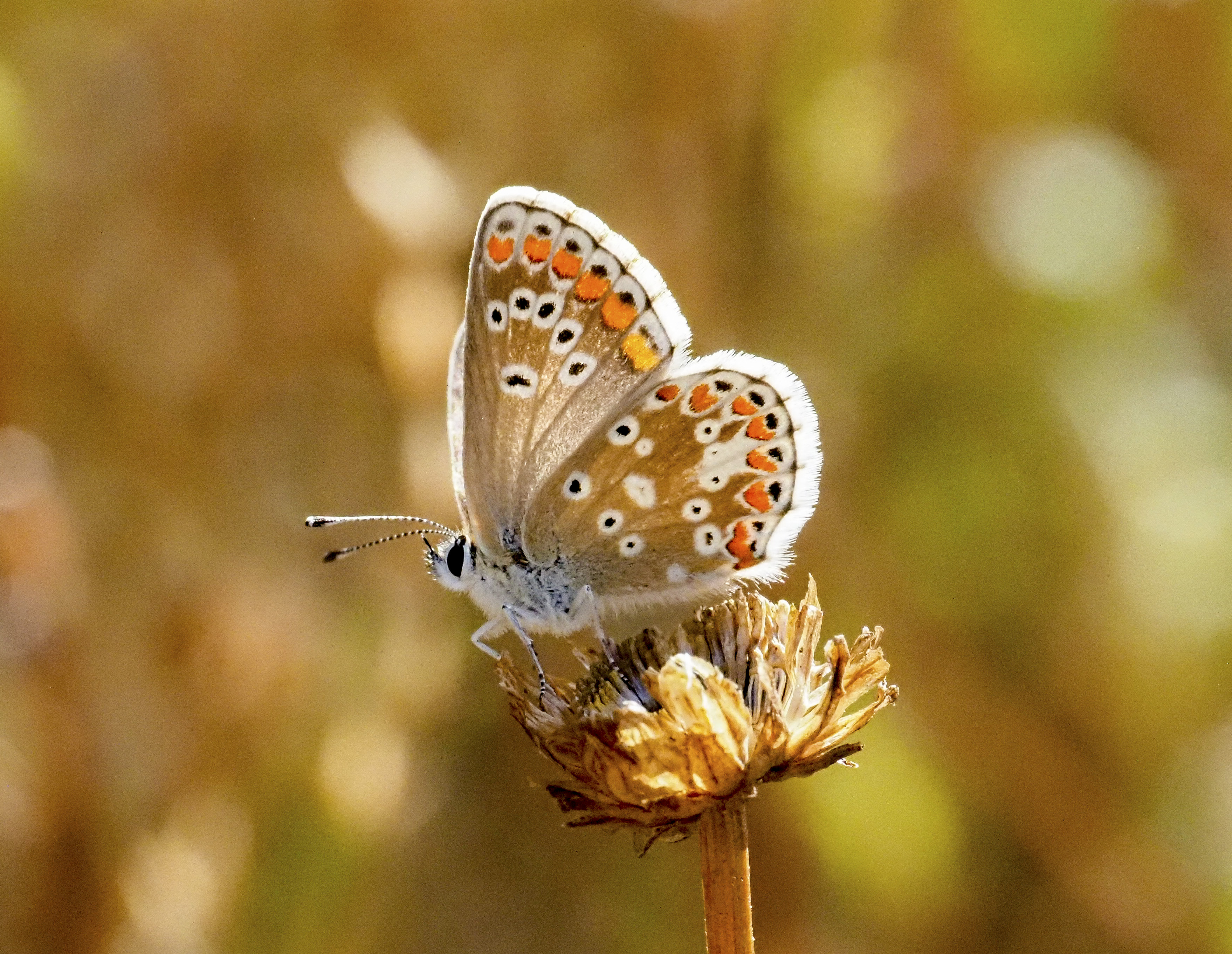
Females that have already mated, which usually includes the majority of individuals after a few days, signal their refusal to courting males by closing their wings and staying completely still in the herbage. Many of the individuals I saw and photographed were in this position (see below)
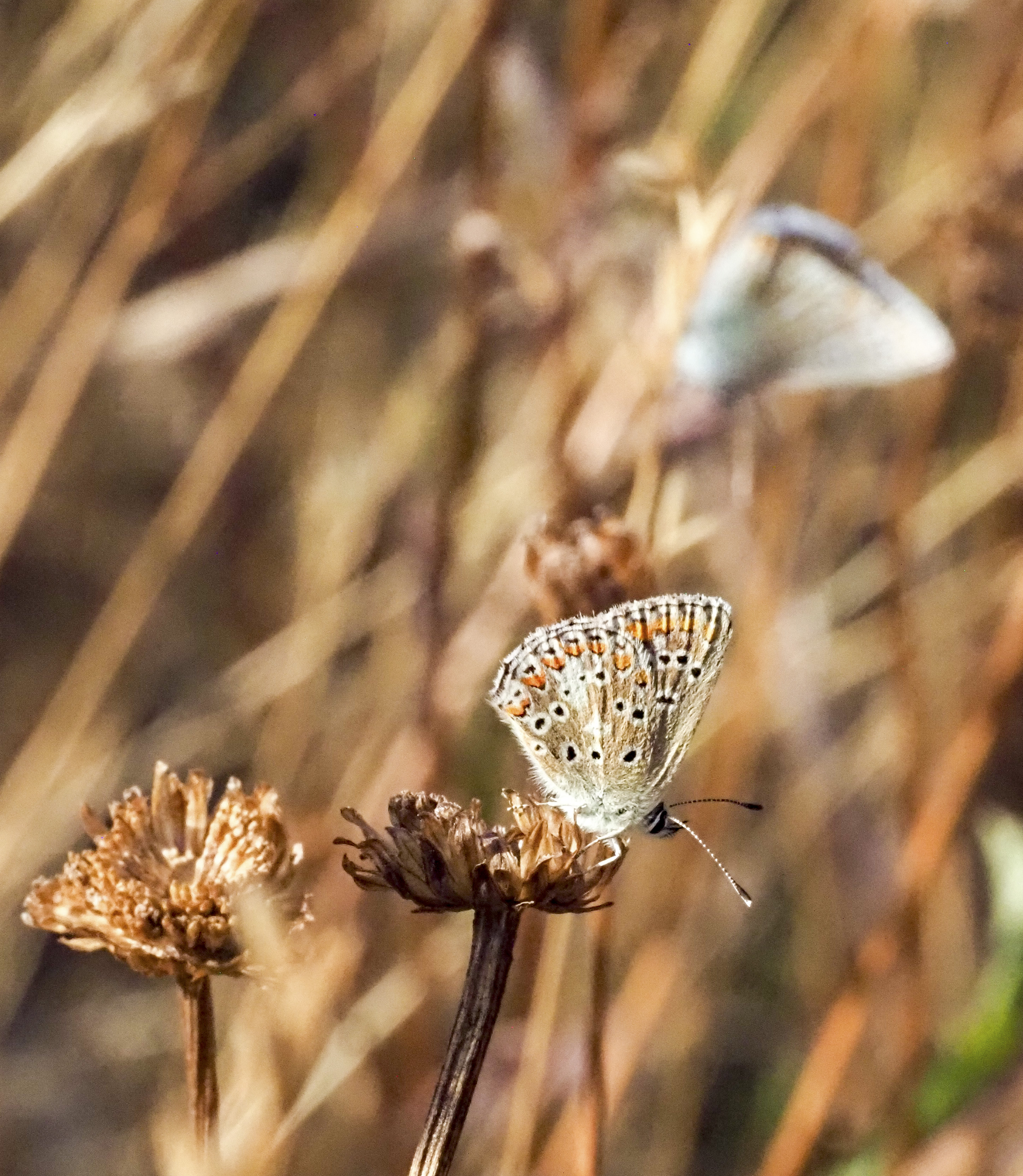
Telling each other apart
We naively assume that butterflies have no difficulty telling each other apart, but in practice, this assumption has rarely been tested scientifically for most species. It’s tempting to think that when they have a chance to get up close to each other and inspect their wing patterns – and other indictors such as smell, or even taste – they can work out the sex, and species, of the other butterfly. After all, that is what courtship is for: to find, evaluate and mate with the same species (Cannon, 2023).
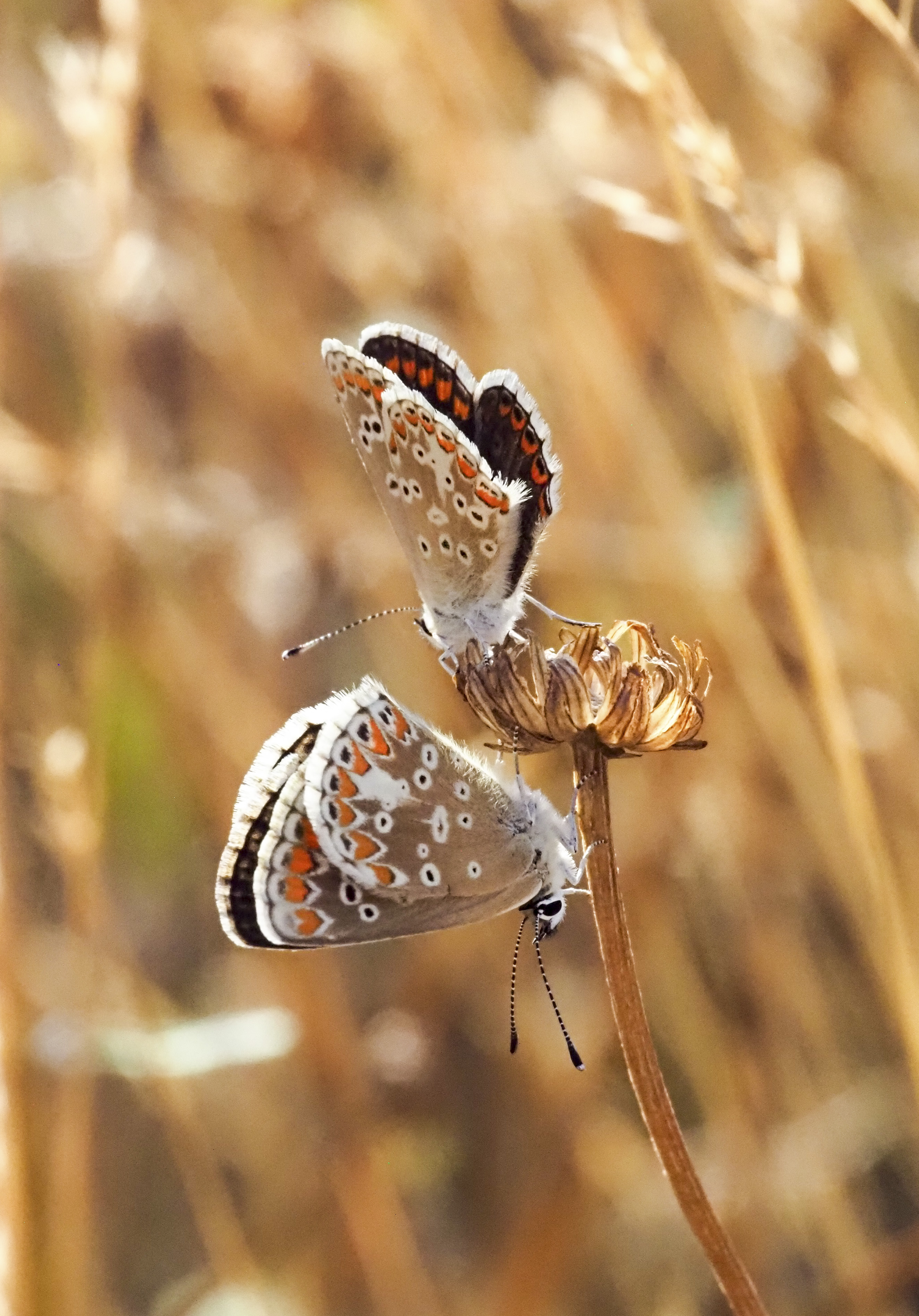
But accidents – sometimes called mating mistakes – do happen! Butterflies sometimes try to mate with the wrong species. Scientists call this ‘reproductive interference’ (Gröning & Hochkirch, 2008; Shuker & Burdfield-Steel, 2017), and it may have something to do with the way in which they recognise each other.
So how do they recognise each other?
Japanese researchers Tsuyoshi Takeuchi and Daisuke Muramatsu (2026) reviewed the literature on sexual and species recognition in butterflies in order to assess the extent to which they recognize the same sex and species. Surprisingly, they found no evidence that butterflies recognize their own species!
Now to me, this finding doesn’t mean that butterflies don’t recognise individuals of their own species; there are many species-specific pheromones that conclusively prove that individual moths and butterflies can recognise each other. It just means that no-one has proved it in terms of visible features like wing colours and patterns.
There is some evidence that female butterflies perceive females of their own sex as less attractive partners, but the question is: are they actually identifying them as being female? Takeuchi & Muramatsu (2026) argue that what has traditionally been interpreted as sexual or species recognition, is in fact, indistinguishable from mate choice.
In other words, butterflies of each sex are programmed to respond to a repetoire of visual and chemical signals corresponding to the opposite sex – what Takeuchi & Muramatsu (2026) call a sexual-partner template – but are not actually identifying them as being of the same species, or identifying them categorically, as male or female.
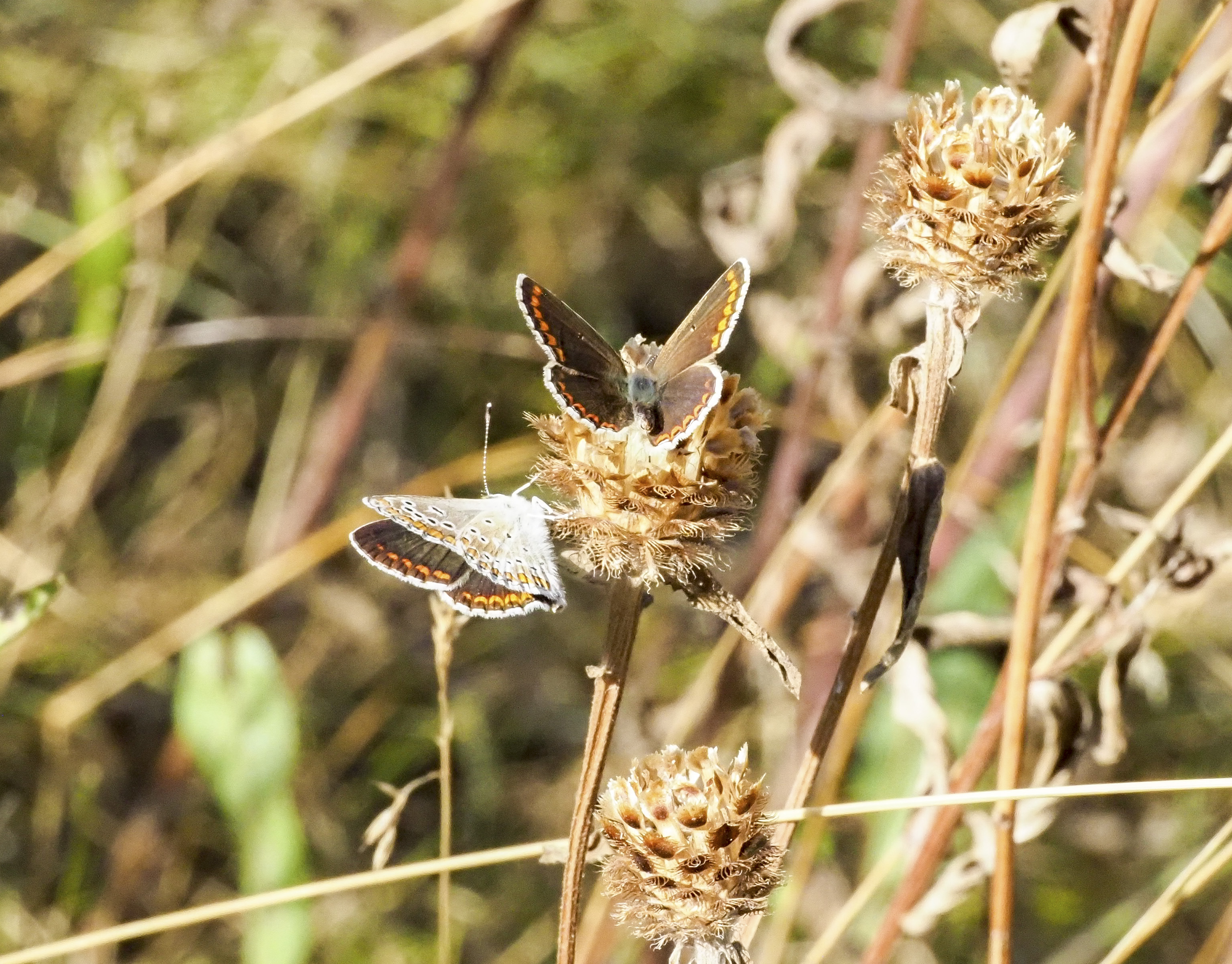
Animals see the world in a multitude of ways, very often completely outside of our own sensory capabilities. So we should not jump to conclusions that they see themselves, and other species, in a similar way to how we do.
In abstract terms, we identify and categorise other animals as being species A or species B; and A(male), A(female); B(male) or B(female). Takeuchi & Muramatsu (2026) have devised a hypothesis they call Partner-Hazard Space (PHS) and suggest that butterflies locate other animals in this 3D space according to their similarity to i) sexual partners or ii) hazards. Almost like an on-off switch perhaps: 1) I like!; 2) I don’t like!
The sexual-partner template has evolved to elicit mating behavior: for example, female common blue butterflies are attracted to the bright blue, light-reflecting wings of the males – or to avoid hazards, by eliciting escape responses.
As Takeuchi & Muramatsu (2026) describe: from the perspective of PHS, butterflies have to find their potential mates among a variety of ‘objects’ – including males and females of two (or more) rather similar species – at least from the perspective of the underwing resting position – that resemble sexual partners.
They assume that the sensory mechanisms used by butterflies to detect the opposite sex of their own species (a conspecific partner) are imperfect, therefore any traits advertising sexual availability – like bright blue wings – to the conspecific opposite sex are favored by sexual selection because they increase the noticeability of potential mates.
So selection is driving mate finding via sexual traits or ornaments, not by having brains that can tell the difference between the males and females of different species, like a large-brained primate taxonomist!
In short, Takeuchi & Muramatsu (2026) are taking a stricter, more absolutist approach; or in other words, a strictly scientific approach seeking scientific proofs. They take the view that butterfly interactions – both male-male and male-female – can be explained by assuming that they possess a sexual-partner template – what I would call an in-built repetoire of programmed responses, activated by specific traits, moulded by evolution – that elicits mating behavior.
Takeuchi & Muramatsu (2026) also posit that butterflies have what they call a hazard template, that elicits escape responses, for example, when males come into contact with each, e.g. in so-called spiralling dances.
According to this hypothesis, males always chase something that resembles the sexual-partner template, but give up when they have established – e.g. by flying alongside it for a while – that it is another male. Other individuals can be located in a hypothetical space according to their similarity to sexual-partner and hazard templates.
Summing up
It was a welcome sight to see so many butterflies after our hot dry summer and I wonder to what extent this population flux will carry over into next year. The encounter was stimulating in many ways, as it is always uplifting to see nature thriving, especially in these challenging times.
The abundance of both populations – common blue and brown argus – concentrated in a patch of the same habitat got me thinking about how butterflies recognise each other. Trawling through the literature, I came across a recent paper that presented a rather different perspective, that they do not recognise each other as such, but rather find a suitable mate by responding to signals which have evolved to help them find a mate.
Using the rather abstract concept of a partner-hazard space, the butterflies are – if I have understood their hypothesis correctly – simply responding in a positive (I like you!) or negative (I don’t like you; or you scare me!) way to sexual partners or potential hazards, respectively.
Related links
Relevant references
Bálint, Z., Katona, G., Kertész, K., Piszter, G., Tóth, B., & Biró, L. P. (2024). Not all apparently gynandromorphic butterflies are gynandrous: The case of Polyommatus icarus and its relatives (Lepidoptera: Lycaenidae). Arthropod Structure & Development, 80, 101359.
Burghardt, F., H. Knüttel, M. Becker & K. Fiedler (2000). Flavonoid wing pigments increase attractive-
ness of female common blue {Polyommatus icarus) butterflies to mate-searching males. Naturwissenschaften 87: 304-307.
Burghardt, F. (2001). Loss of flavonoid pigments with ageing in male Polyommatus icarus butterflies (Lycaenidae). Notalepid. 24 (1/2): 77-84.
Cannon, R. J. C. (2019). Courtship and mating in butterflies. CABI.
Cannon, R. J. C. (2023). Courtship and mate-finding in insects. CABI.
De Keyser, R., Breuker, C. J., Hails, R. S., Dennis, R. L., & Shreeve, T. G. (2015). Why small is beautiful: Wing colour is free from thermoregulatory constraint in the small lycaenid butterfly, Polyommatus icarus. PLoS One, 10(4), e0122623.
Gröning, J., and A. Hochkirch. (2008). Reproductive Interference Between Animal Species. Quarterly Review of Biology 83, 3, 257-282.
Janz, N., Bergström, A., & Sjögren, A. (2005). The role of nectar sources for oviposition decisions of the common blue butterfly Polyommatus icarus. Oikos, 109(3), 535-538.
Kertész, K., Piszter, G., Bálint, Z., & Biró, L. P. (2019). Biogeographical patterns in the structural blue of male Polyommatus icarus butterflies. Scientific reports, 9(1), 2338.
Kertész, K., Piszter, G., Horváth, Z. E., Bálint, Z., & Biró, L. P. (2017). Changes in structural and pigmentary colours in response to cold stress in Polyommatus icarus butterflies. Scientific Reports, 7(1), 1118.
León‐Cortés, J. L., Cowley, M. J., & Thomas, C. D. (1999). Detecting decline in a formerly widespread species: how common is the common blue butterfly Polyommatus icarus?. Ecography, 22(6), 643-650.
Piszter, G., Bálint, Z., Kertész, K., Szatmári, L., Sramkó, G., & Biró, L. P. (2023). Breeding Polyommatus icarus serves as a large-scale and environmentally friendly source of precisely tuned photonic nanoarchitectures. Insects, 14(8), 716.
Piszter, G., Kertész, K., Bálint, Z., & Biró, L. P. (2016). Variability of the structural coloration in two butterfly species with different prezygotic mating strategies. PLoS One, 11(11), e0165857.
Piszter, G., Kertész, K., Horváth, Z. E., Bálint, Z., & Biró, L. P. (2019). Reproducible phenotype alteration due to prolonged cooling of the pupae of Polyommatus icarus butterflies. PLoS One, 14(11), e0225388.
Piszter, G., Kertész, K., Sramkó, G., Bálint, Z., & Biró, L. P. (2022). Structural colors of blue butterflies: From photonic nanoarchitectures to DNA. In Light in Nature IX (Vol. 12214, pp. 47-53). SPIE.
Piszter, G., Szatmári, L., Sramkó, G., Kertész, K., Laczkó, L., Krízsik, V., … & Biró, L. P. (2026). Differences in structural color and population genetic structure of Western and Central Palearctic Polyommatus icarus populations. Scientific Reports.
Shuker, D. M., and E. R. Burdfield-Steel. (2017). Reproductive Interference in Insects. Ecological Entomology 42, 65–75. .
Takeuchi, T. (2017). Agonistic Display or Courtship Behavior? A Review of Contests Over Mating Opportunity in Butterflies. Journal of Ethology
35, 1, 3–12.
Takeuchi, T. (2019). Mating Behavior of the Old World Swallowtail, Papilio machaon. Lepidoptera Science 70, 17–24.
Takeuchi, T., & Muramatsu, D. (2026). Reexamining Sexual and Species Recognition in Butterflies: The Partner‐Hazard Space Framework. Ecology and Evolution, 16(8), e74101.
Takeuchi, T., S. Yabuta, and H. Takasaki. (2019). Uncertainty About Flying Conspecifics Causes Territorial Contests of the Old World Swallowtail, Papilio machaon. Frontiers in Zoology 16, 22.
Takeuchi, T., S. Yabuta, and Y. Tsubaki (2016). The Erroneous Courtship Hypothesis: Do Insects Really Engage in Aerial Wars of Attrition? Biological Journal of the Linnean Society 118, 970–981.
Wiklund, C. (1977). Courtship behaviour in relation to female monogamy in Leptidea sinapis (Lepidoptera). Oikos, 29(2), 275–283.


having followed a couple of related links, it’s amazing how similar the two butterflies are. So is it convergent evolution or a single species that split how long ago?
Since they see UV colours and differences that we don’t and they all have their own pheromones surely it would be blatantly obvious to them who’s the right mate/species and who’s not?
Most interesting Ray, I tried to catch up with Blues this summer with not much luck, think had timing or location wrong. But great patch of thistle and ragwort on Strensall Common with Marbled White and other larger spp. Best Wishes, Peter R