I love the sight of a tiny dronefly hovering in front of me in a small pocket of sunlit space. If you listen carefully you can hear them droning on! No, not really.😁 Droneflies are called drone-like because of their supposed resemblance to male honeybees, drones. They do buzz though!
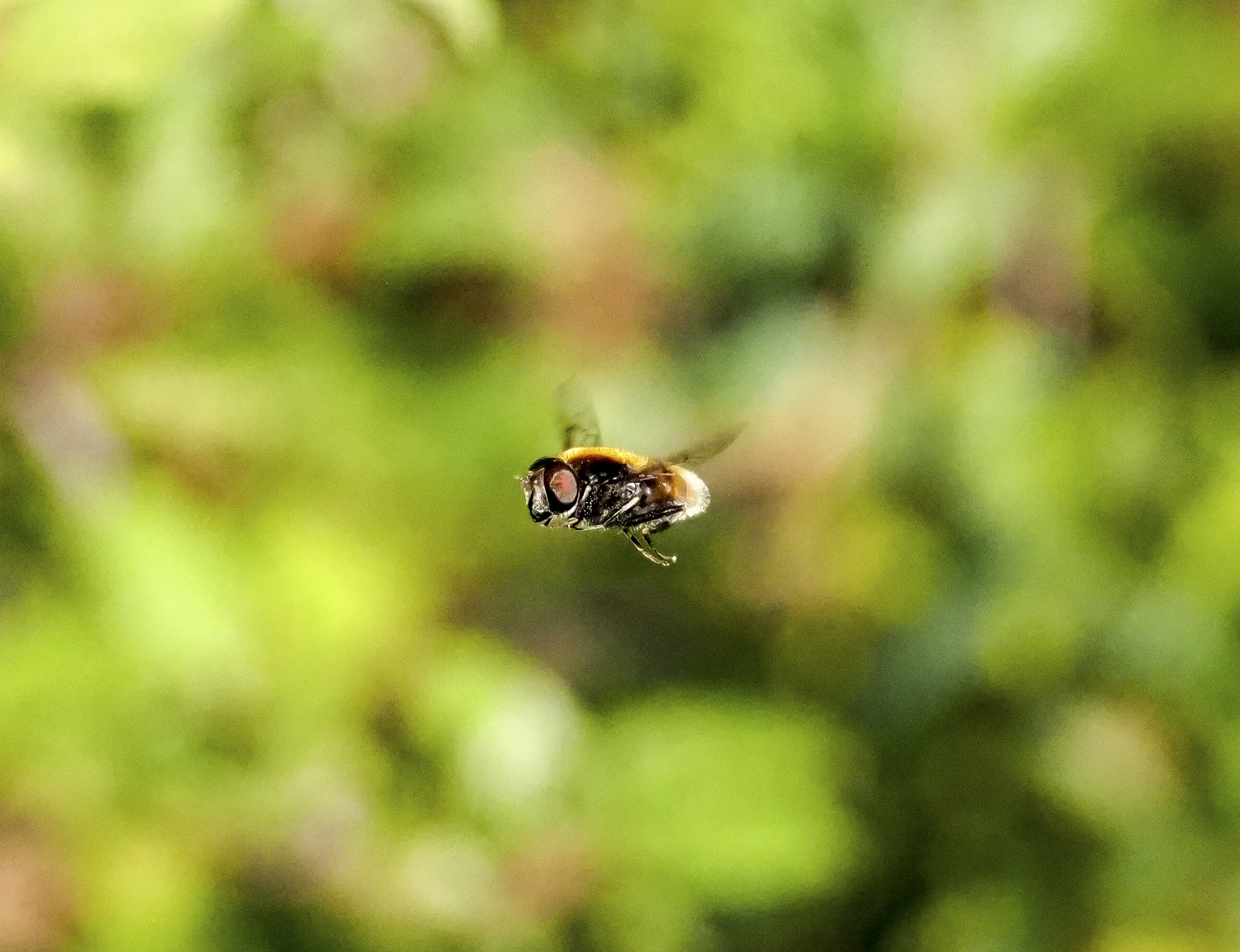
Male Common droneflies, Eristalis tenax, often hover motionless – apart from their buzzing wings – in or above a territory, looking out for passing females and ready to chase away unwanted intruders. Male Furry droneflies, Eristalis intricaria, also engage in the same behaviour and it is this species which I managed to capture in flight (below).
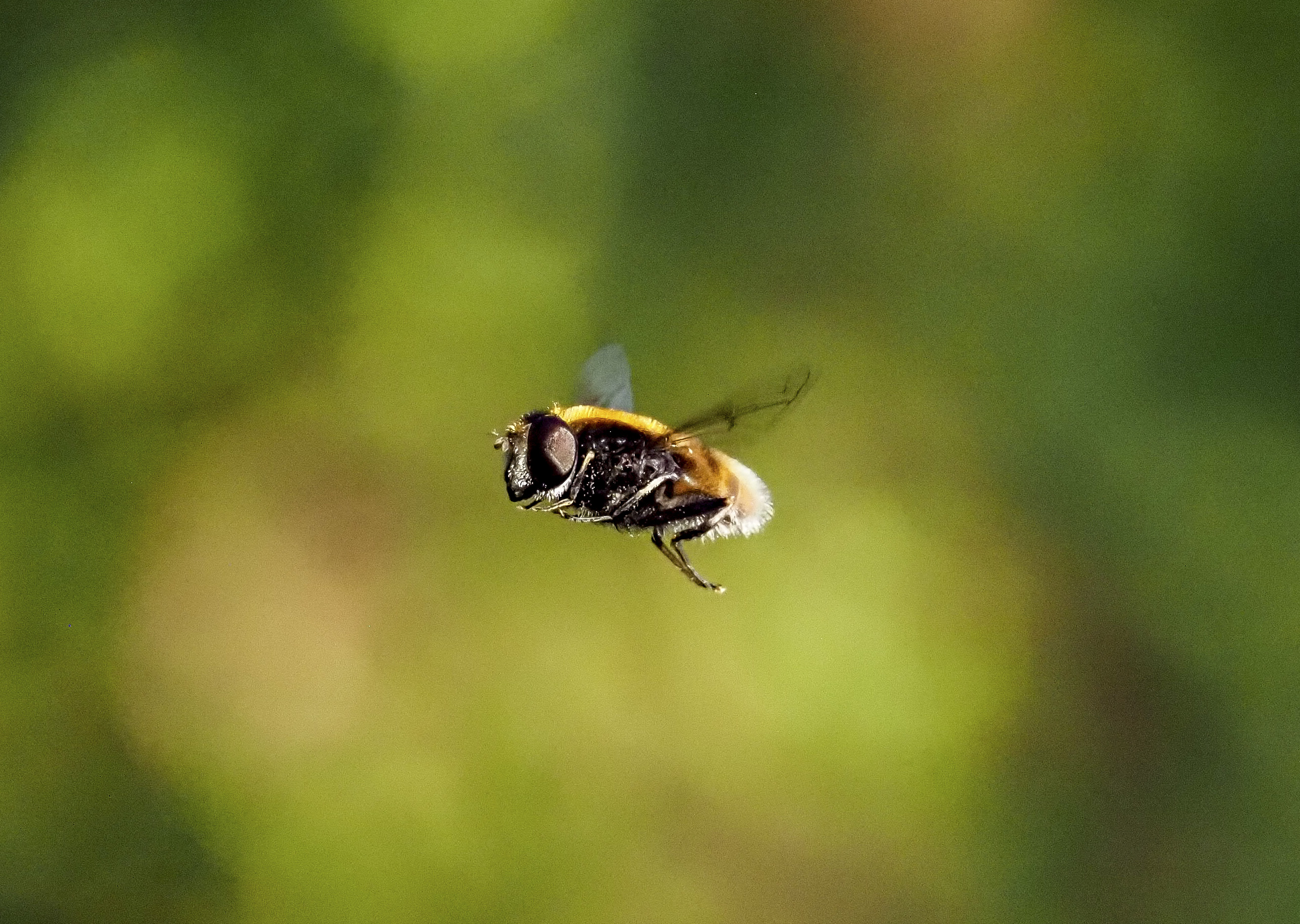
Photo by Raymond JC Cannon
I am not a master photographer of flying insects – like the amazing Paul Wright – but I do occasionally get lucky and manage to capture an insect in flight, like this surprisingly cooperative hoverfly who stayed perfectly still – aerially stationary that is – right in front of me. Long enough to snap off a few reasonably shots at 1/4000th of a second using my trusty 90mm macro lens.
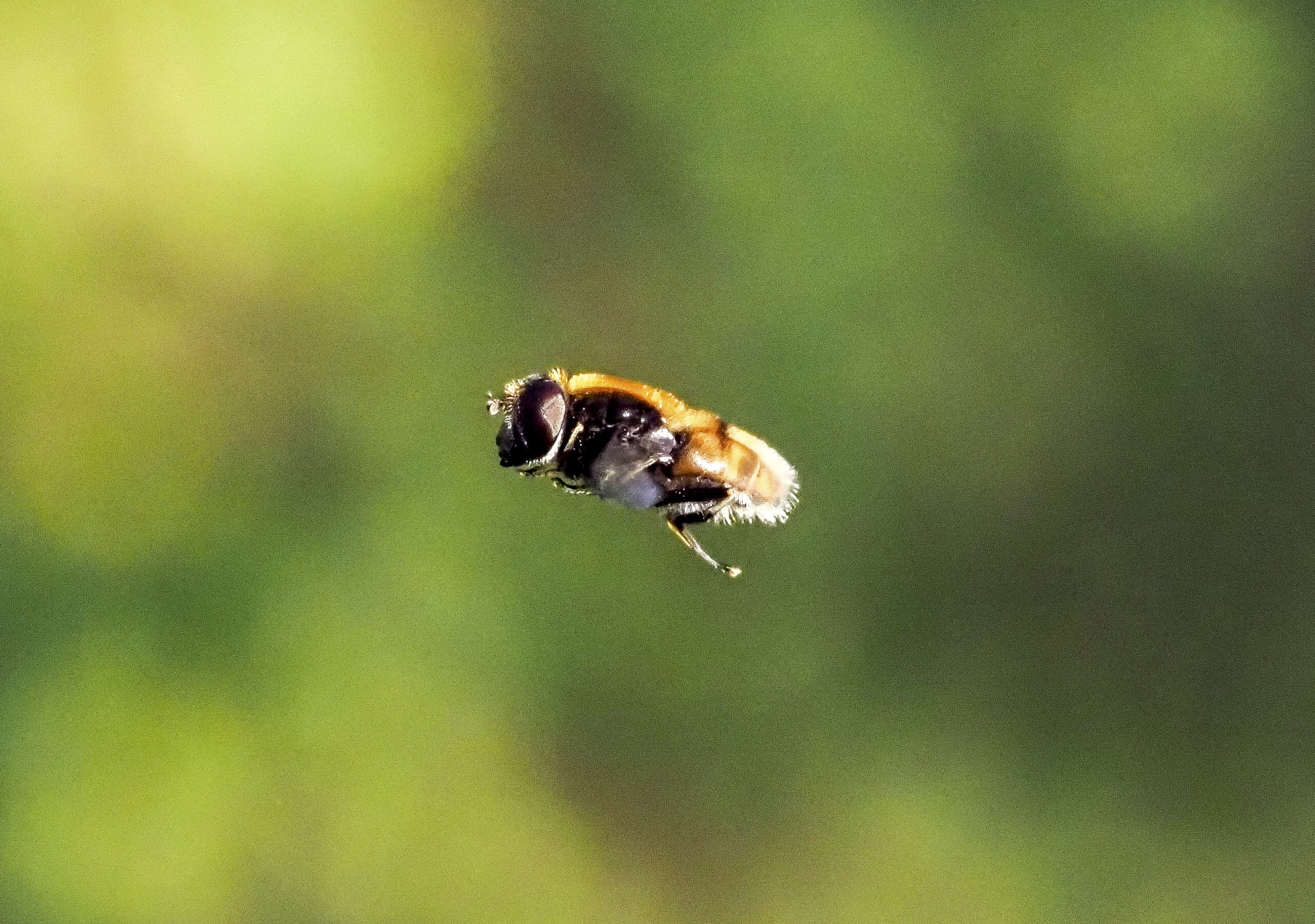
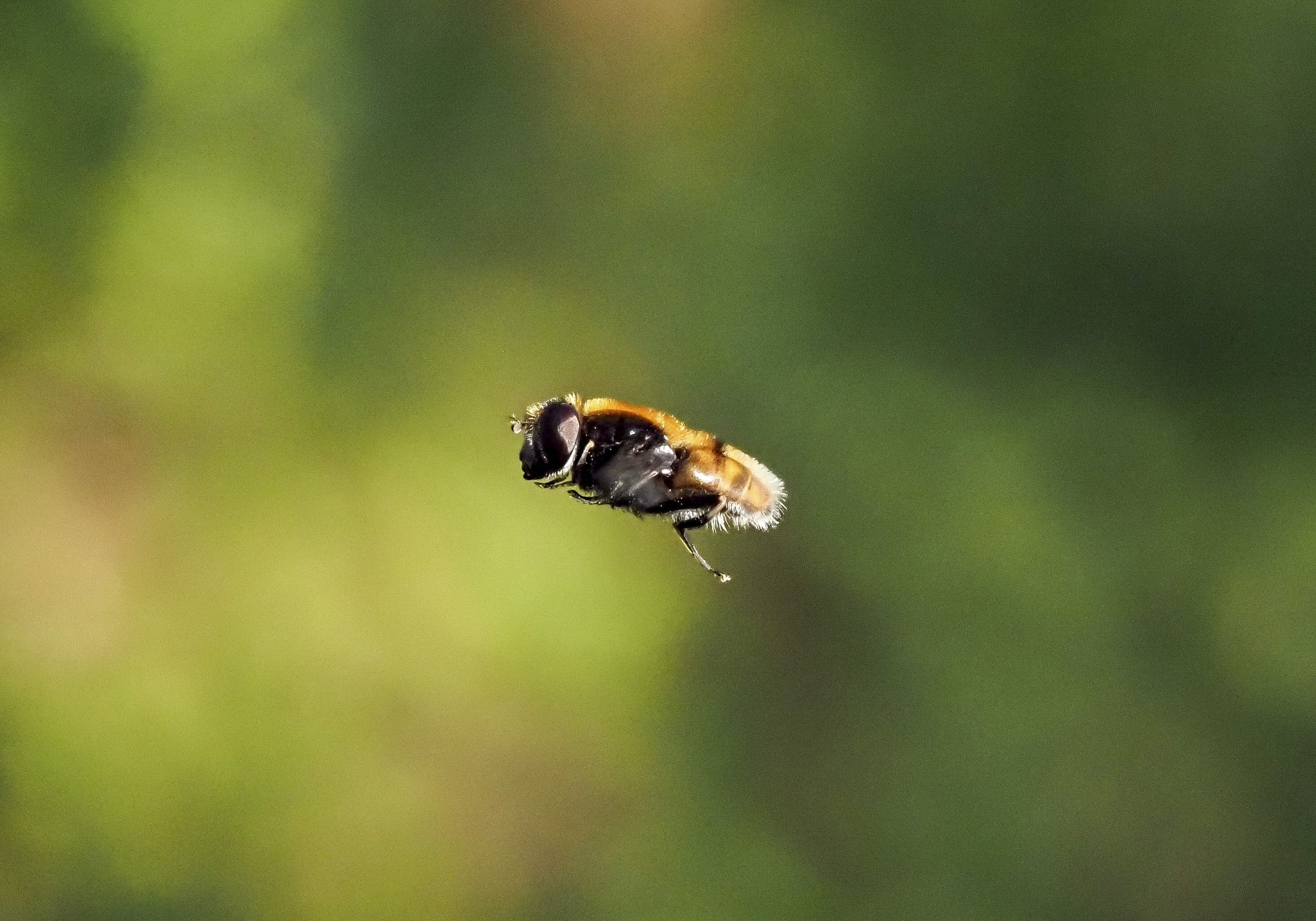
I often come across hoverflies (and dragonflies) on this particular path through a patch of woodland beside a lake (Felmersham gravel pits SSSI, Beds). Insects make full use paths or tracks, i.e. human made woodland clearings, for perching, hovering, basking and mate-finding (Cannon, 2023).
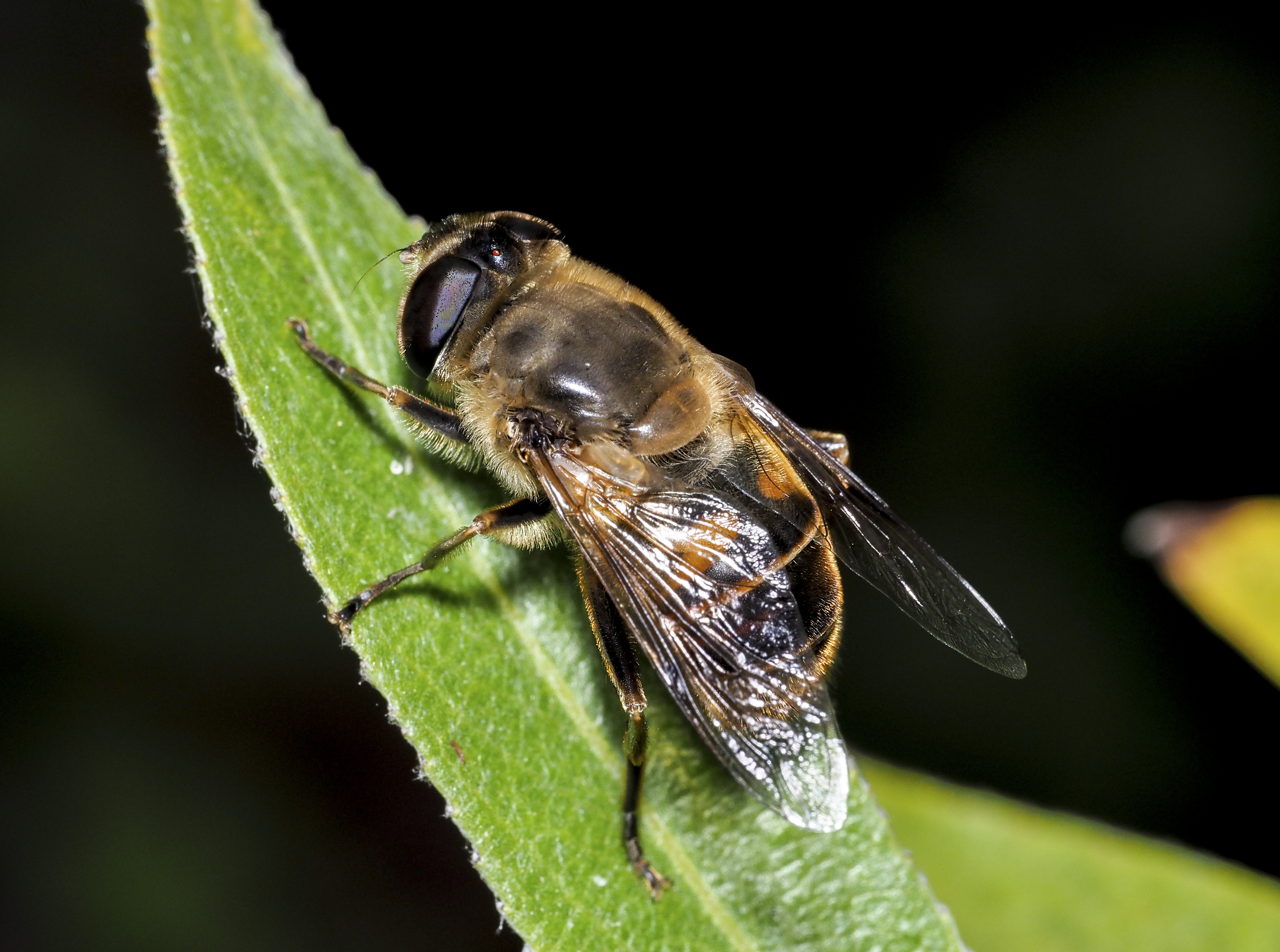
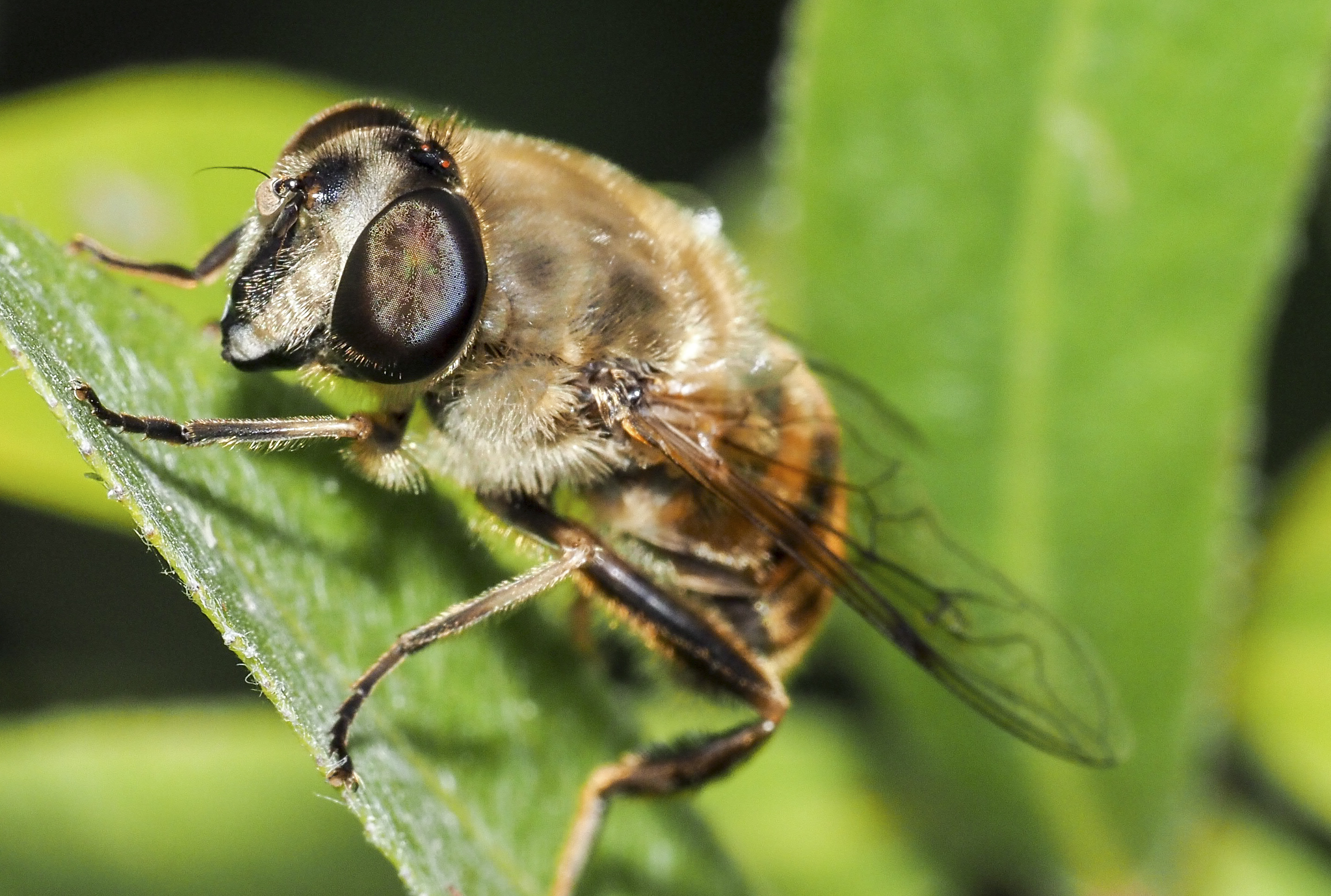
It is not mean feat to be able to hover motionless above the ground with your wings tracing out tiny parabolas 200 times a second, and after a few minutes hovering this particular individual landed on leaf to rest and warm up (below).
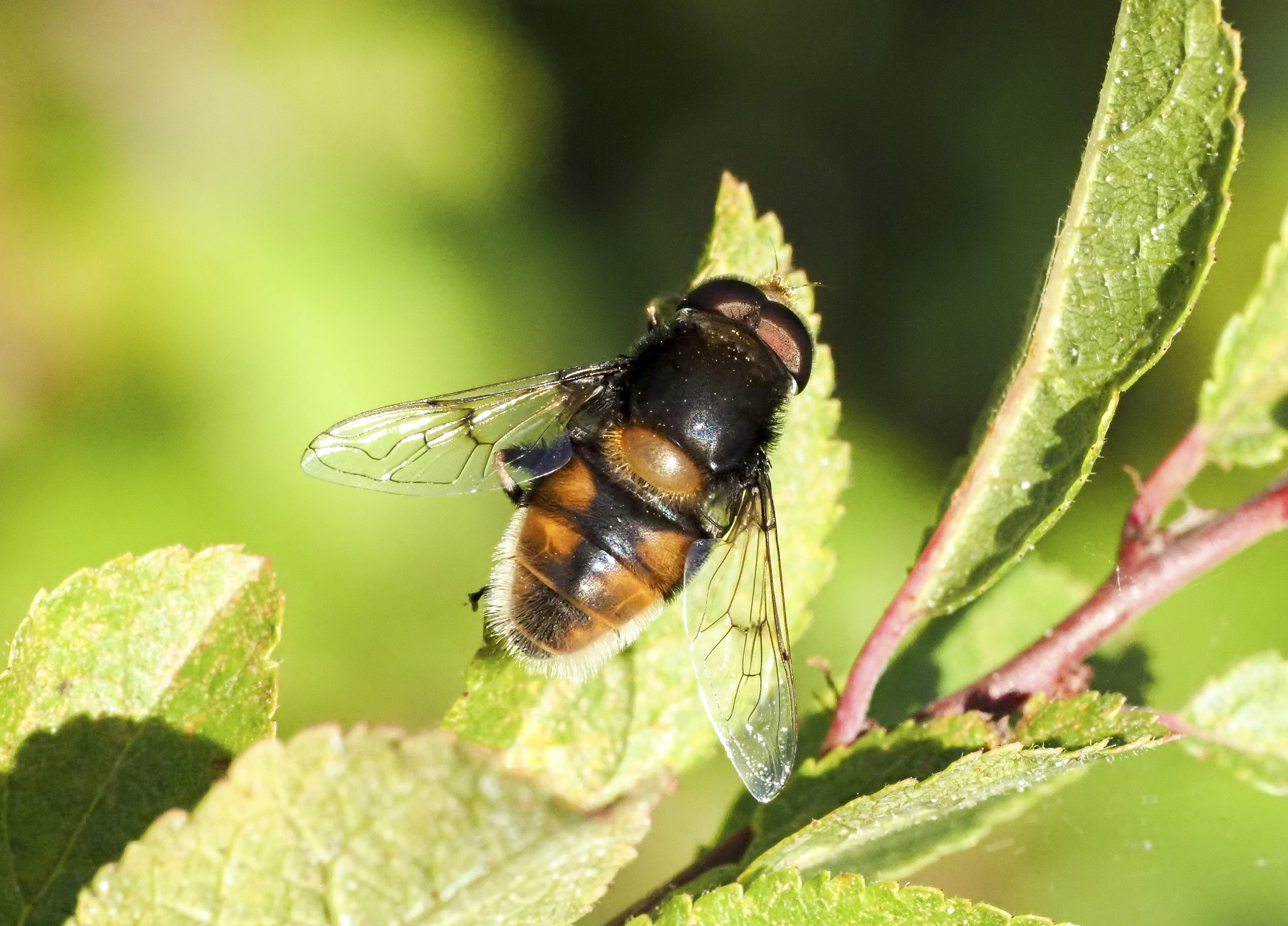
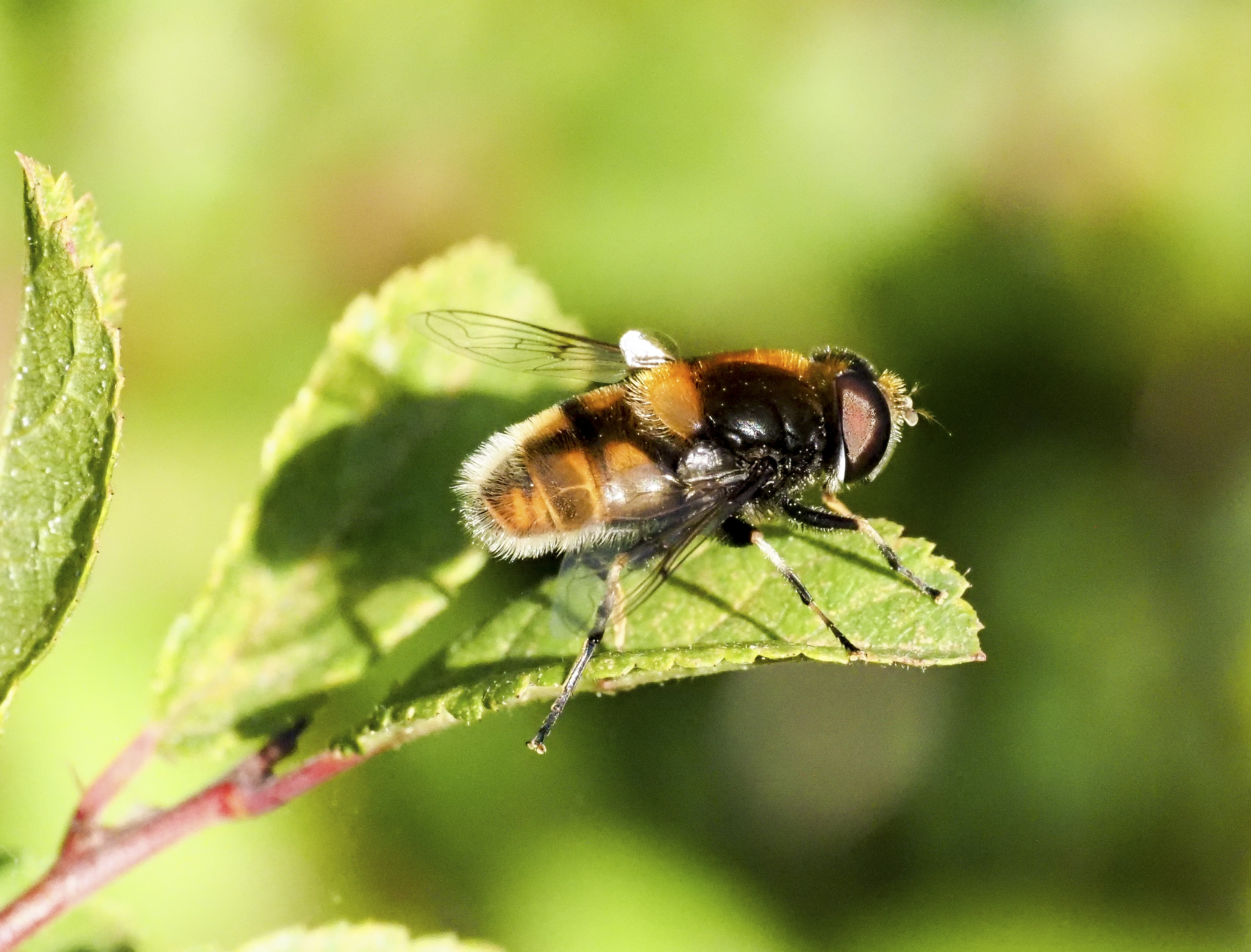
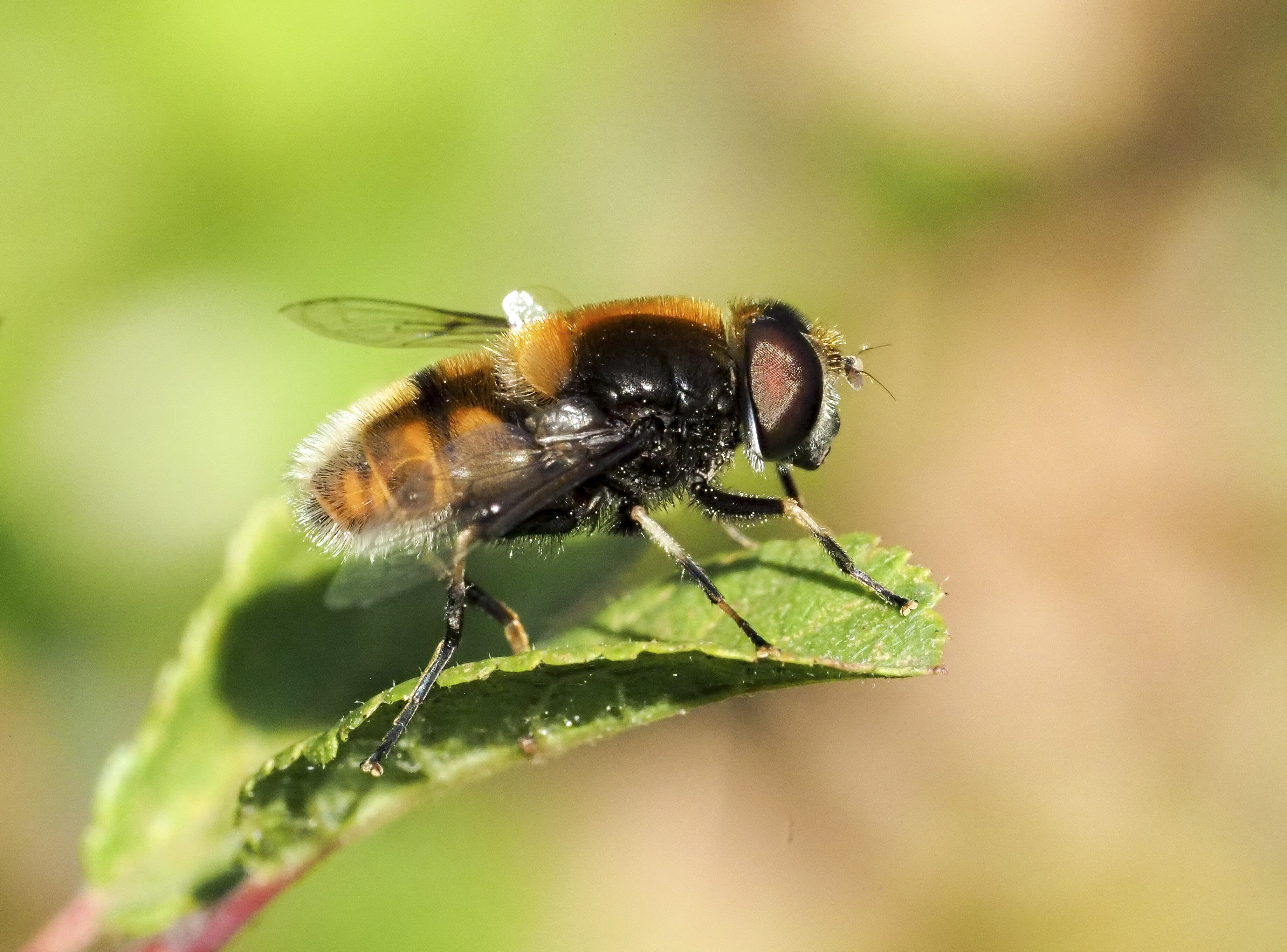
Photos by Raymond JC Cannon
The aerodynamics of hovering
The wings of droneflies move up and down through a relatively narrow arc (c. 65°): a short stroke-amplitude that produces most of the vertical lift using a unique ‘paddling’ mechanism – explained below in ‘Staying airborne’ – during a brief portion of the downstroke.
Because the wings flap so rapidly, this type of flight creates considerable aerodynamic and biomechanical demands. To avoid expending excessive amounts of energy during the rapid accelerations and decelerations of their wings, short-amplitude flying insects like hoverflies, have evolved special energy storage systems which function a bit like mechanical springs.
To produce a so-called elastic recoil at the end of each flap, hoverflies use elastic proteins (resilin), together with a flexible thoracic hinge, so that kinetic energy from the rapid deceleration of the wing at the end of a stroke is absorbed into a spring-like structure and returned as kinetic energy at the start of the reversal stroke. Wing joints packed with proteinaceous rubber!
As we have seen, droneflies are very accommodating little insects, much loved by research scientists because they happily hover away in the laboratory under the glare of bright lights and high speed cameras! However, most laboratory studies have been carried out using the Common dronefly, Eristalis tenax (below).
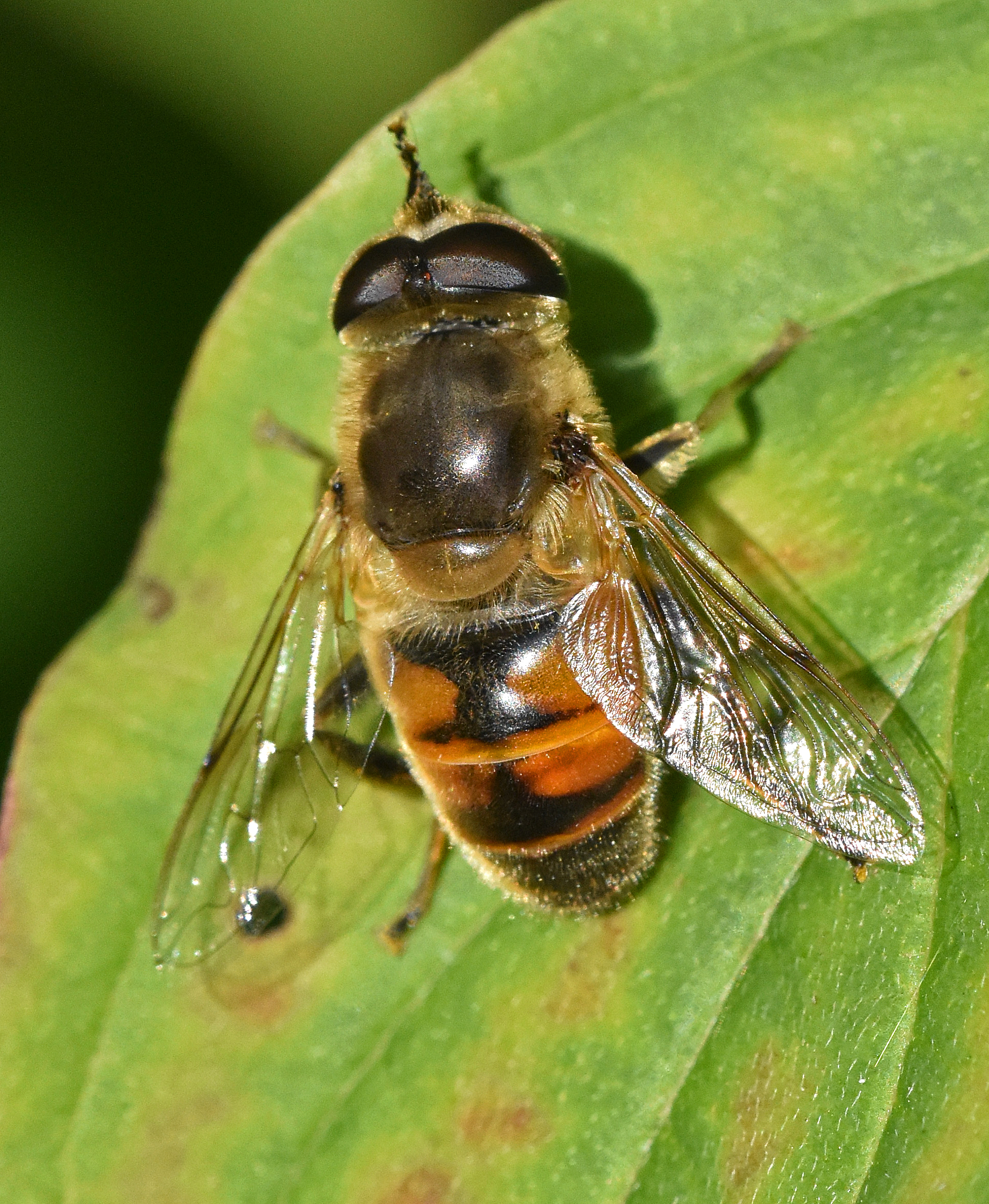
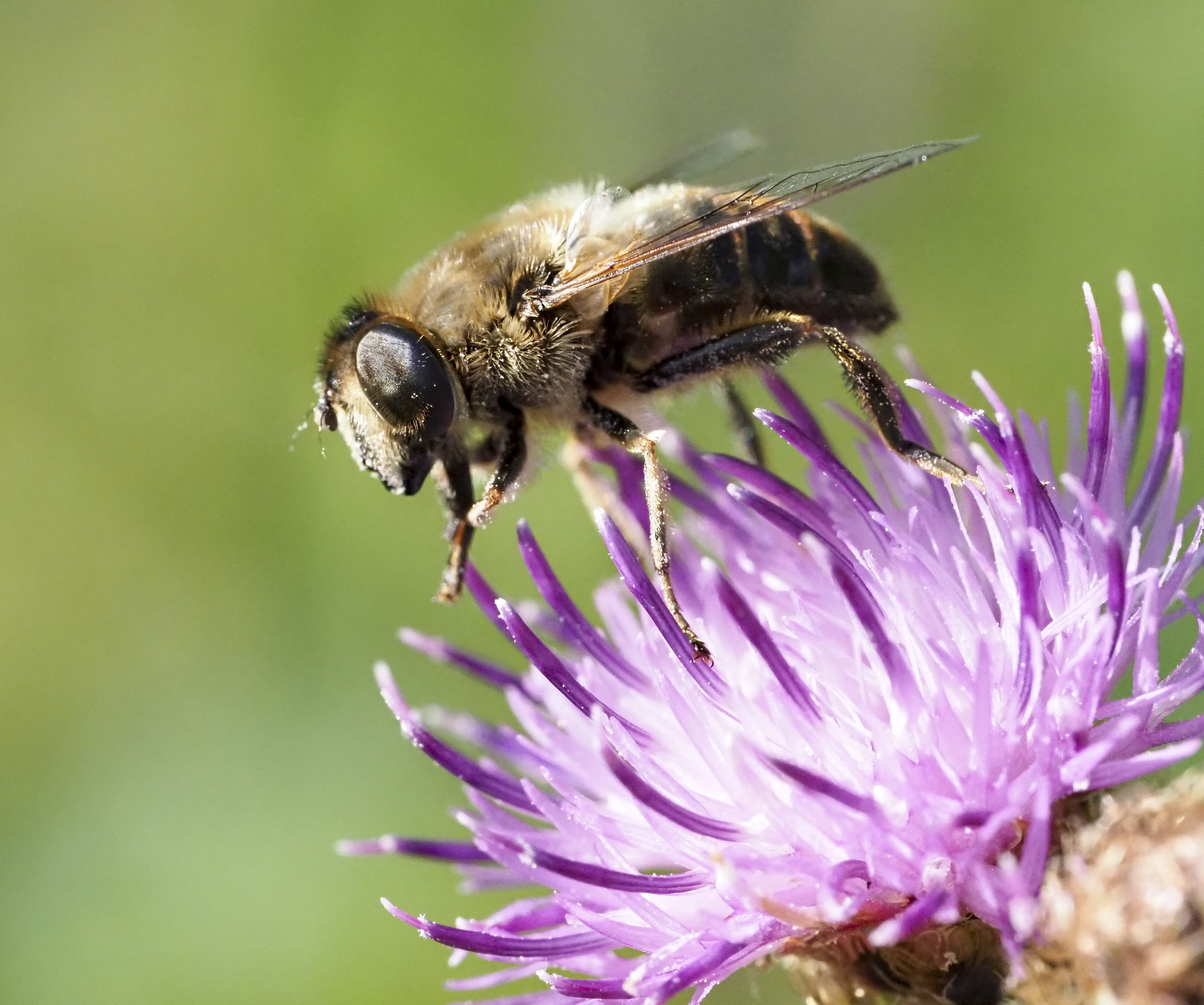
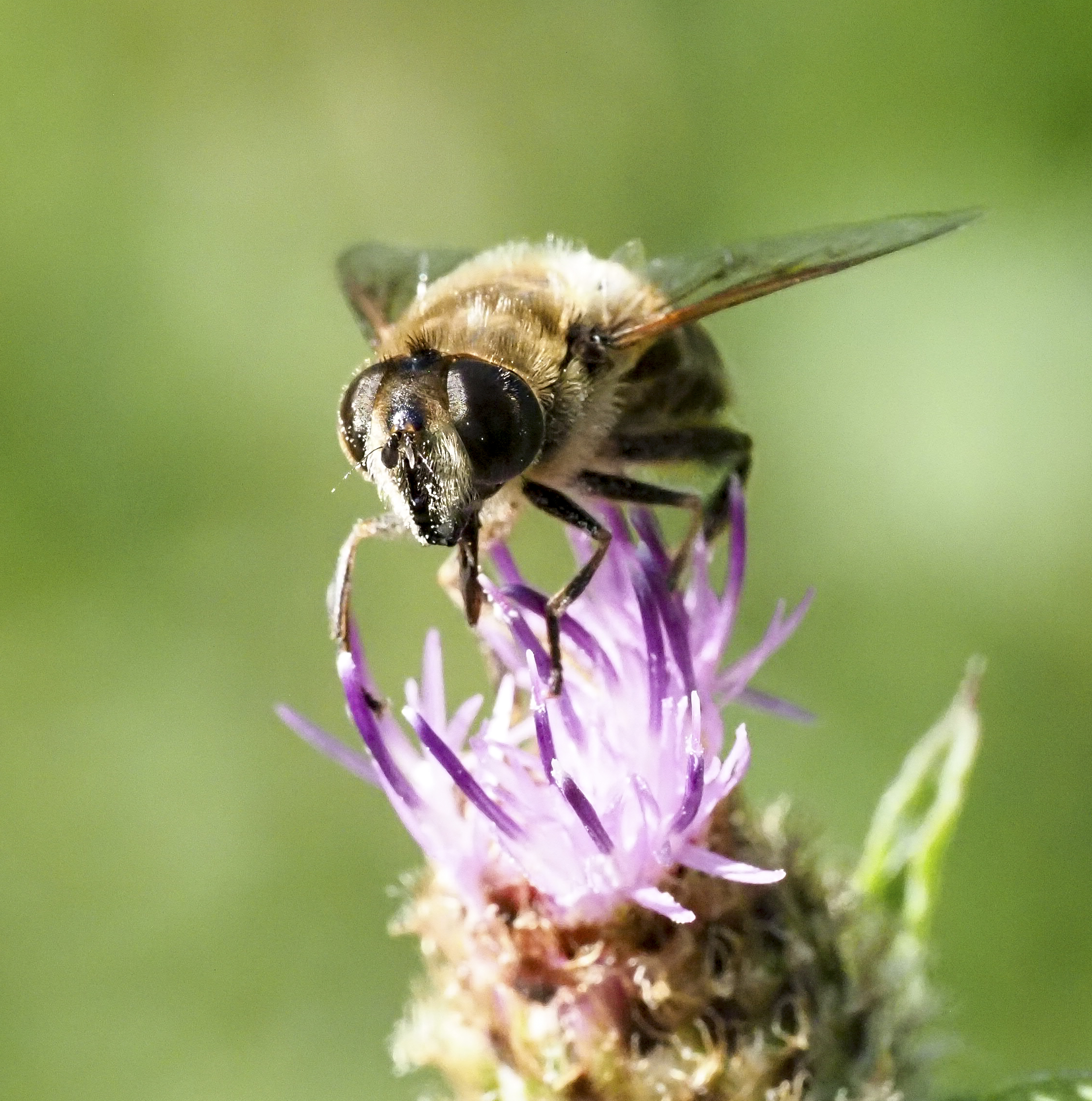
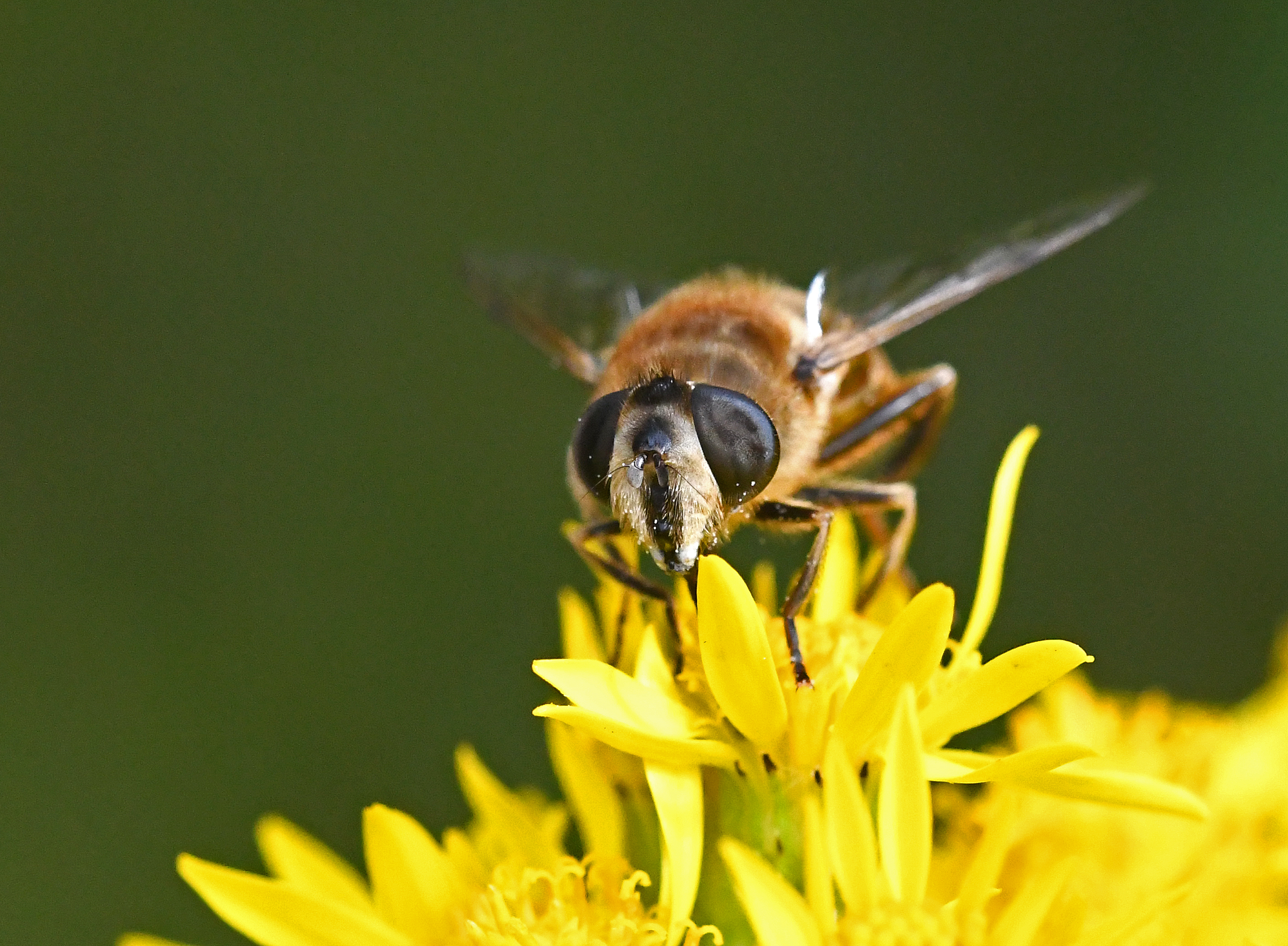
Most of the recent research seems to have been done by very clever, mathematically-minded Chinese scientists who have worked on the aerodynamics of these little buzzers! I dipped into their papers (see references), skipped the equations – which were well beyond the distant memory of my ‘O’-level New Maths! – and tried to come away with a few insights.
Getting airborne
Insects launch themselves into the air using large downward forces, generated either by jumping (e.g. in locusts, and fruit flies) or by using their wings. Take-offs are relatively fast: for example, fruit flies become airborne in less than half a wingbeat – experiencing a maximum vertical acceleration of 6 g (gravitational acceleration) – and butterflies becomes airborne in less than a quarter of a wingbeat, experiencing accelerations of about 10 g (Chen et al., 2013). That’s the absolute G-force limit a human fighter pilot can endure!
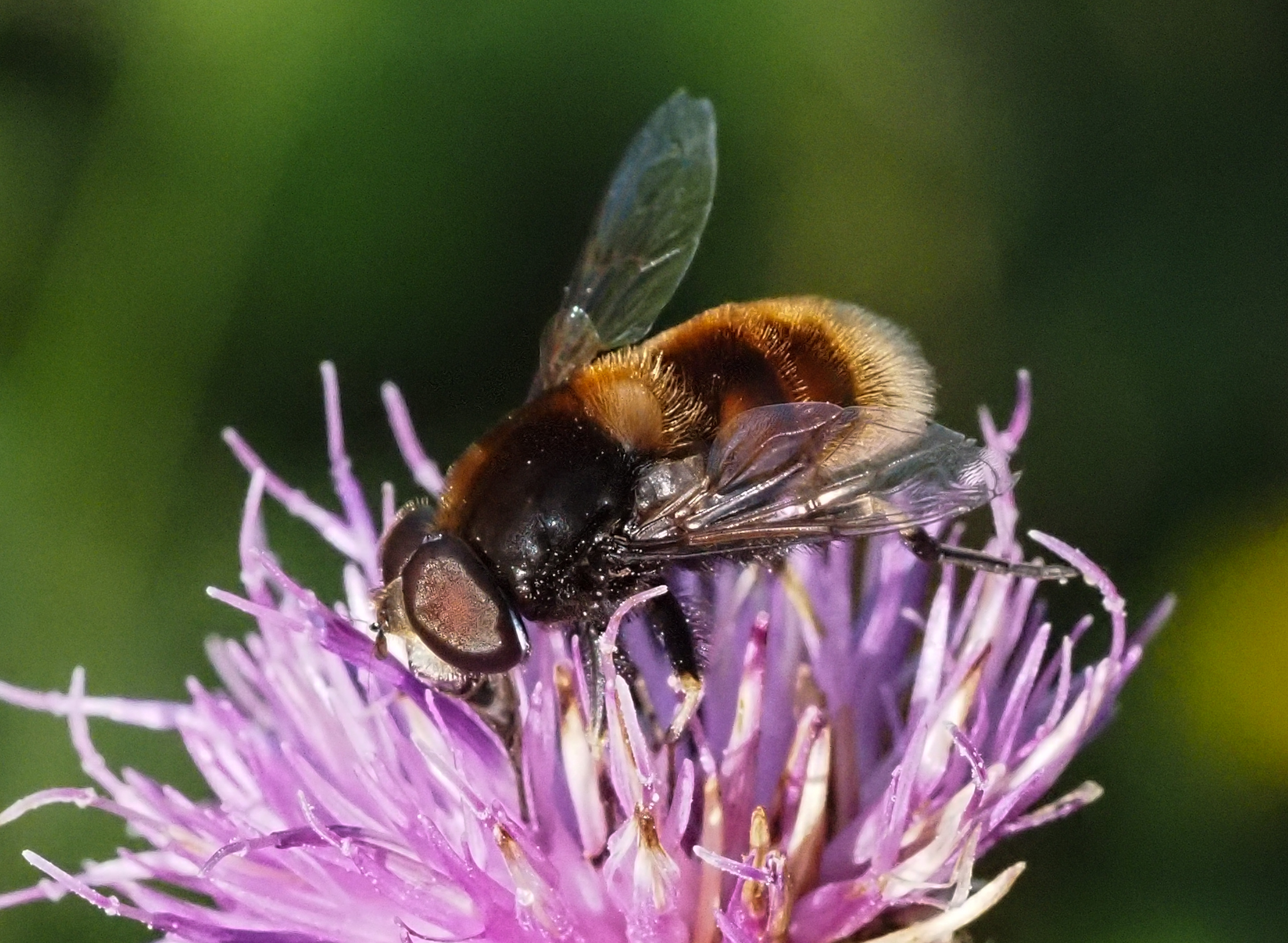
Photo by Raymond JC Cannon
Droneflies (Eristarlis tenax) and other hoverflies, on the other hand, perform a much slower take-off. For example, droneflies gradually increase the amplitude of their wing strokes in the first 10 to 14 wingbeats and only become airborne at about the 12th wingbeat (Chen et al., 2013). In short, the take-off of droneflies is relatively slow, but smoother than many other insects.
Staying airborne
To reiterate, the wings of droneflies move through a relatively restricted arc (c. 65.6 degrees), using an inclined stroke plane, meaning that the path of the flapping wing is tilted at an angle relative to the horizontal ground. During the mid-downstroke, the wing tilts to a large angle of attack, of roughly 48°, and most of the weight-supporting vertical force – which keeps the fly from hurtling down to the ground – is generated during the downstroke (Zhu & Sun, 2017).
In hovering flight, the motion of the dronefly is weakly unstable owing to two unstable natural modes of motion, which may play a role in limiting the flight speed of the insect (Zhu et al., 2020). At high flight-speeds the flight becomes more and more unstable until it reaches its maximum flight speed of about 8.6m/s (or 19.24 mph). That’s faster than I can run, although Usain Bolt reached a peak top speed of 27.8 miles per hour during his world-record 100-meter sprint!
Nevertheless, droneflies can turn on a sixpence, so to speak (a British idiom that means to change direction very quickly and sharply within a tiny space); turning through 90° in the time it takes for 10 wingbeats, or about 55 milliseconds if you prefer! (Zhang & Sun, 2010). At wingbeats of 200 times a second, droneflies should, in theory, be able to make a quite a few changes of direction in the course of a second!
Finally
Not surprisingly perhaps, Sir David Attenborough and his team at the BBC got there first! See this video of the hoverfly taken from the BBC’s Life in the Undergrowth documentary series produced in 2005. There are other videos of hovering hoverflies on the web and the technology available today could produce much better images than the BBC managed in 2005.
There is a worldwide obsession with mechanical drones, for war and peace, and insect-sized research drones (i.e. under five grams) – Google it – are currently being developed. Ah! So, that’s why the scientists were so interested in the dronefly! Let’s hope and pray that we are not entering a dystopian era of the slaughterbots! Tiny, insect-sized drones that can fly like the wind and turn on a sixpence!
The final thought must however, go to these tiny insects; leading their peaceful – unless you are a rival male! – buzzing lives, hovering away in sunlit glades oblivious of the crazy human race, apart from encountering an occasional looming naturalist poking a funny looking lens in their faces (and coming away happy to gain an insight into their tiny hovering lives).😁
Links
https://asknature.org/strategy/hoverflies-remarkable-roll/
References
Cannon, R. J. (2023). Courtship and mate-finding in insects: A comparative approach. CABI. https://www.cabidigitallibrary.org/doi/book/10.1079/9781789248623.0000
Chen, M. W., Zhang, Y. L., & Sun, M. (2013). Wing and body motion and aerodynamic and leg forces during take-off in droneflies. Journal of the Royal Society Interface, 10(89), 20130808.
Meng, X., Liu, X., Chen, Z., Wu, J., & Chen, G. (2023). Wing kinematics measurement and aerodynamics of hovering droneflies with wing damage. Bioinspiration & Biomimetics, 18(2), 026013.
Meng, X. G., & Sun, M. (2016). Wing and body kinematics of forward flight in drone-flies. Bioinspiration & Biomimetics, 11(5), 056002.
Wu, J. H., & Sun, M. (2014). Wing kinematics in a hovering dronefly minimize power expenditure. Journal of Insect Science, 14(1), 159.
Zhang, Y., & Sun, M. (2010). Wing kinematics measurement and aerodynamics of free-flight maneuvers in drone-flies. Acta Mechanica Sinica, 26(3), 371-382.
Zhu, H. J., Meng, X. G., & Sun, M. (2020). Forward flight stability in a drone-fly. Scientific reports, 10(1), 1975.
Zhu, H. J., & Sun, M. (2017). Unsteady aerodynamic force mechanisms of a hoverfly hovering with a short stroke-amplitude. Physics of Fluids, 29(8).


This was a fascinating and delightful post! I didn’t know hoverflies existed, so now I’ll be looking for them!